China launches world's first 16 MW floating wind turbine at sea
China's CNOOC deployed the world's first 16 MW floating wind turbine with tension-leg platforms in the South China Sea.
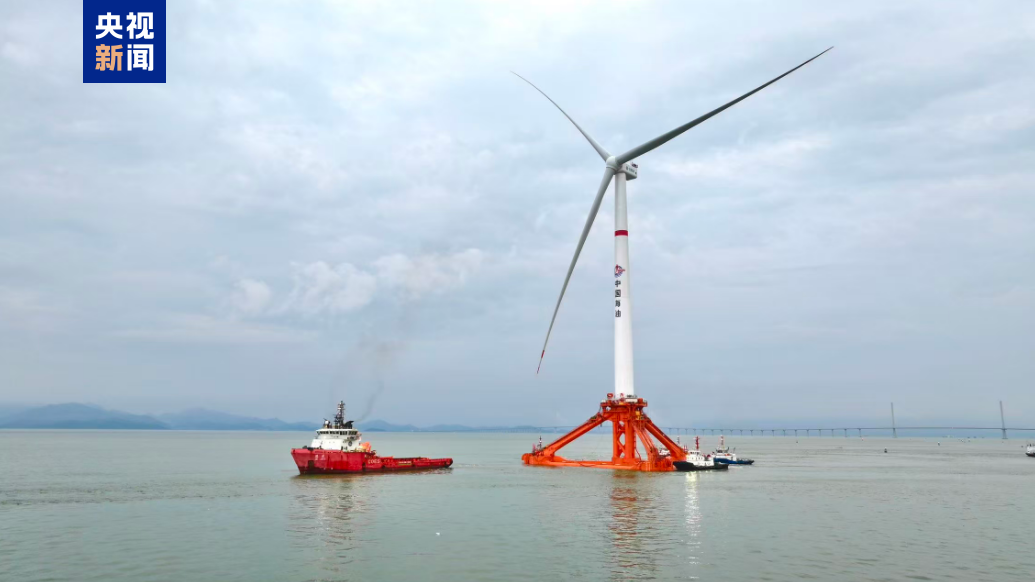
The turbine will power the "Lufeng" oil platform — turning fossil fuel extraction into one of the first industries to have its own offshore green energy source. For Kazakhstan, which is developing offshore production in the Caspian Sea, this is a technological benchmark for the future.
The Gist
- On June 28, 2026, CNOOC shipped the world's first floating wind turbine with a capacity of 16 MW on tension-leg platforms from Zhuhai, according to Chinese media outlet CGTN. Its destination is the "Lufeng" oil platform in the South China Sea.
- The structure, 307 m tall and weighing 8,000 tons, is anchored to the seabed by vertical steel cables that eliminate vertical motion and ensure stability in deep water.
- Expected annual output is 54 million kWh. This will reduce CO₂ emissions by 35,000 tons and save about 15,000 m³ of fuel oil used to operate the platform's pumps.
- As of 2025, China controls 78% of global offshore wind power capacity. The country's total installed power generation capacity reached 4.01 billion kW by May 2026.
- China's offshore wind power capacity grew by 17% over the past year — to 660 million kW.
Why Floating and Not Fixed
Most existing offshore wind farms are built on fixed foundations driven into the seabed — which limits their application to depths of up to 60 meters. A significant portion of promising wind zones in the Pacific and Atlantic Oceans lie at depths from 60 to several hundred meters — where conventional foundations are technically or economically unfeasible.
A floating platform on tension-leg supports solves this problem: steel cables, stretched from the platform to the seabed, create rigidity in the vertical plane, compensating for heave and allowing operation in the open ocean. This technology has long been used for oil platforms — CNOOC has essentially adapted it for wind power generation.
Green Energy for Oil Production
The concept of a wind turbine powering an oil platform — paradoxical at first glance — has a very practical logic. Offshore drilling platforms consume vast amounts of electricity for pumps, lighting, life support, and drilling equipment. Traditionally, this energy was generated by diesel and gas generators — with high operating costs and emissions.
A wind turbine located next to the platform allows replacing a significant portion of this consumption with clean generation, reducing fuel costs and lowering the carbon footprint of extraction — which is becoming increasingly important as ESG requirements for oil and gas companies tighten.
Kazakhstan Context
Kazakhstan conducts large-scale oil production on the Caspian Sea shelf — at fields like Kashagan, Kurmangazy, and others. The Caspian is a closed sea with relatively shallow depths, making both fixed and floating structures technically feasible in certain areas.
Using offshore wind turbines to power Caspian platforms is not yet a pressing issue, but it is a technologically maturing idea. As capacities grow and the cost of floating structures decreases — and the Chinese record is accelerating exactly this curve — the question of green energy supply for offshore production will become increasingly practical. For KazMunayGas and partners in Caspian consortia, monitoring this direction is part of long-term technological planning.
Author's Conclusion
CNOOC's 16-megawatt floating turbine is not just a power record, but a demonstration of a concept: offshore wind power is moving beyond shallow water zones and starting to operate where only oil used to be. China, controlling 78% of global offshore wind capacity, continues to set the pace of the technological race. The rest can only watch — and learn to apply these technologies in their own conditions.

Comments ()