China tests 582-ton heart of fusion reactor
China tested a key component of its future fusion reactor, unofficially dubbed an "artificial Sun."
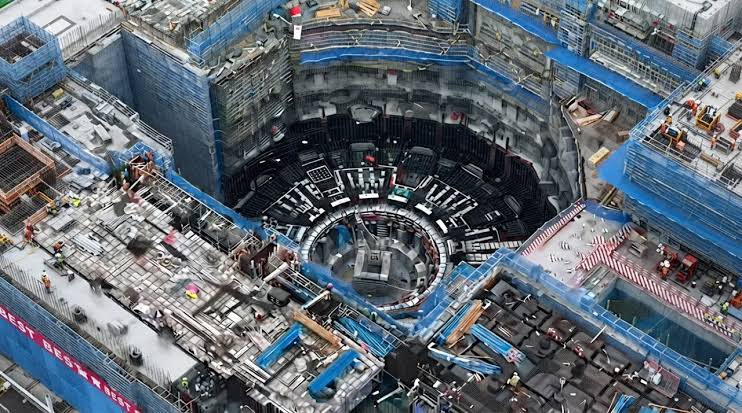
The Institute of Plasma Physics of the Chinese Academy of Sciences has announced the completion of tests of two superconducting magnets — key components of a fusion reactor, the work on which should lead China to industrial fusion energy generation as early as 2030, reports globaltimes.cn. While Kazakhstan is only forming a consortium and project documentation for its first nuclear power plant based on conventional fission reactors, one of Asia's largest energy players is already preparing the next generation of technology.
The gist
- The Institute of Plasma Physics of the Chinese Academy of Sciences has completed full-parameter tests of the toroidal superconducting magnet and the central solenoid for the BEST fusion reactor.
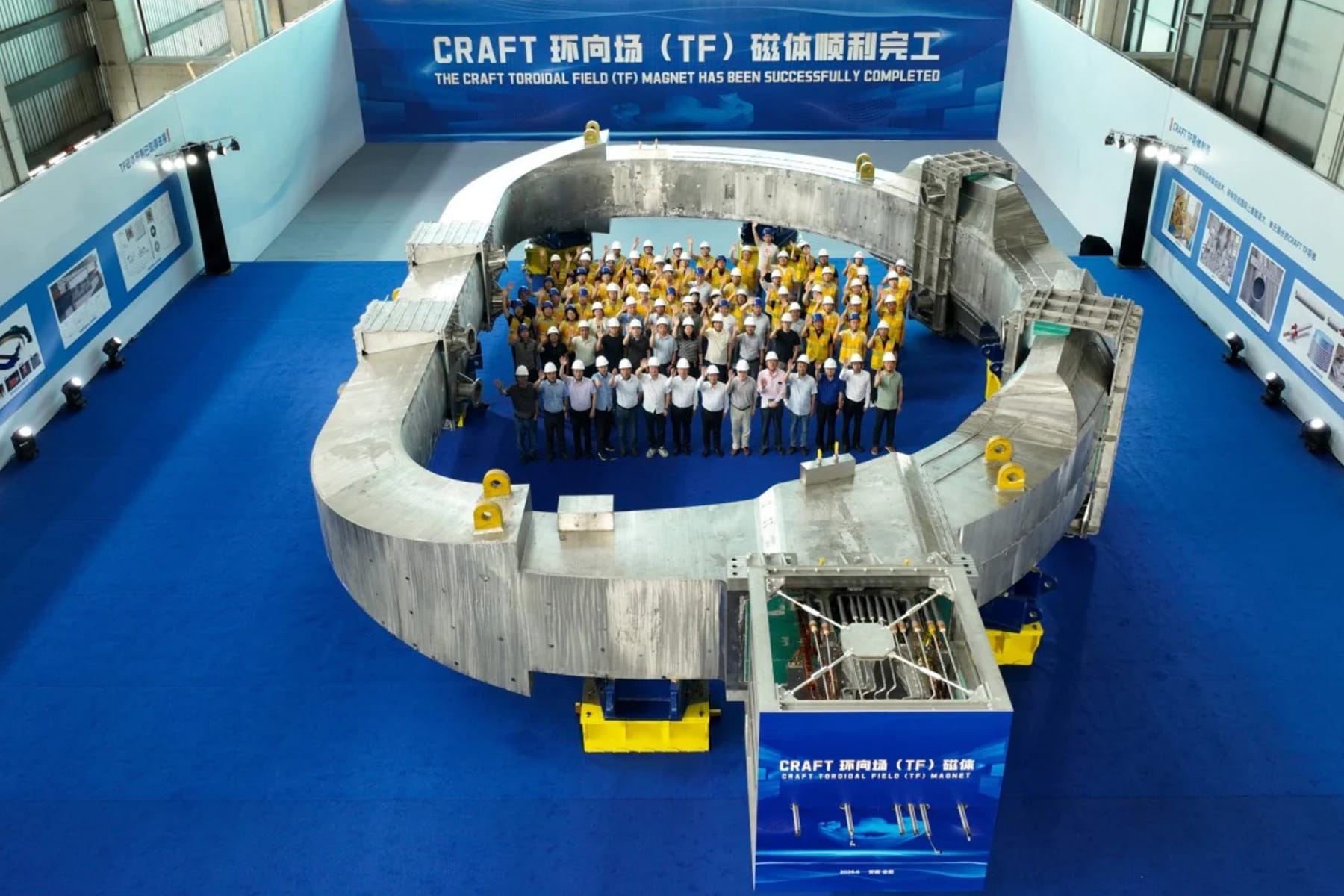
- The toroidal magnet is the largest ever built: 21 meters long, 12 meters wide, weighing 582 tons, 1.3 times larger in volume and three times more powerful in stored energy than its counterparts in the international ITER project.
- The project is fully localized — 100% domestic technologies and materials, 47 patents, 25 industry standards; the cost of superconducting tape has been reduced from 400 to 100 yuan per meter.
- According to China's roadmap, the BEST reactor should be completed by the end of 2027, with fusion energy generation expected to begin around 2030.
What exactly was tested
The toroidal superconducting magnet is a D-shaped structure designed to form a ring of 16 such coils, creating a magnetic field of 6.5 tesla at the plasma center. According to Institute of Plasma Physics researcher Wu Yu, the magnet's task is to confine plasma heated to 100 million degrees inside the vacuum vessel, preventing it from touching the walls — an "invisible but extremely strong magnetic cage." On the same day, a second key component passed its tests — the high-temperature superconducting central solenoid coil, which researcher Qin Jinggang compared to a car engine's spark plug: it is what excites and sustains the plasma current, directly determining whether the reactor can ignite and operate stably.
Why this is an engineering challenge
Fusion reactor magnets must operate reliably for 60 years at minus 268.95°C, under the influence of strong currents, intense radiation, and significant mechanical loads — extreme conditions for modern materials science. During heat treatment of niobium-tin superconductors, a temperature deviation of just a few degrees can destroy the material's properties, and maintaining uniform temperature in a furnace for coils over 10 meters in size is itself an advanced engineering task. The team achieved internal joint resistance of 0.04 nano-ohms — effectively zero losses at currents in the 100-kiloamp range — and conductor samples withstood more than a thousand electromagnetic and thermal cycles at 4.2 Kelvin, still exceeding design specifications.
The path to fusion energy
The current breakthrough builds on China's previous record: the experimental fusion reactor EAST sustained plasma at 100 million degrees in steady-state high-confinement mode for 1066 seconds — the result of 22 rounds of physics experiments and 160 thousand rounds of testing. As a key participant in the international ITER project, China has taken on the development of more than 9% of the project's major components. According to the country's three-stage roadmap, the BEST reactor should be completed by the end of 2027, fusion-based energy generation should begin around 2030, and the next step should be a demonstration fusion power plant that could become the world's first of its kind.
Why this matters for Kazakhstan
The gap in planning horizons between the two energy projects is telling. The Kazakhstan "Balkhash" NPP is a classic fission reaction using VVER-1200 reactors, with first concrete pouring in 2029 and commissioning by 2035–2036; the country has yet to resolve even the question of choosing the type of cooling towers for its future power units. Fusion energy, which China is preparing for, promises a fundamentally different model — without long-lived radioactive waste and, at least theoretically, with a lower need for cooling water, which is critical for water-scarce countries like Kazakhstan. At first glance, the difference is not in Kazakhstan's favor — but both technologies solve the same problem through different means and on different time horizons, and fusion energy remains an expensive and risky bet whose commercial payoff is not yet guaranteed even for China itself.
Author's conclusion
The successful magnet tests represent, by the Chinese engineers' own admission, about 80% of the overall task: ahead lie the assembly of the full-scale reactor and prolonged testing under extreme conditions. For Kazakhstan, which is only now entering the construction stage of its first industrial nuclear power plant, fusion remains a technology of another decade — but it is precisely such breakthroughs that will determine what the energy sector looks like by the time Kazakhstan's current fission reactors approach the end of their life cycle.
Comments ()