Chinese solar farms have demonstrated a new model for rural development.
Chinese solar station experience draws attention from both energy experts and farmers.
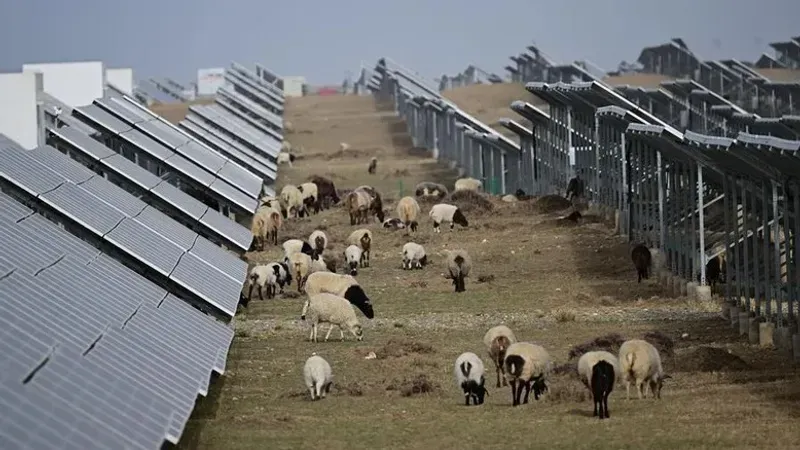
China continues to be the world's largest consumer of coal, but at the same time it is increasing investments in renewable energy. One of the most notable projects is the Gonghe photovoltaic park on the Tibetan Plateau. The experience of Chinese solar power plants is attracting attention not only from energy experts but also from farmers, as it demonstrates how energy infrastructure can be used for agricultural development.
In Brief
• The Gonghe photovoltaic park covers approximately 420 sq km.
• Sheep grazing has been organized between the panels at solar power plants in Tibet.
• This practice helps reduce maintenance costs for the facilities and supports farmers.
• Studies show improved soil conditions and increased biodiversity in certain areas.
Solar Energy is Changing the Desert Landscape
The Gonghe photovoltaic park covers an area of approximately 420 square kilometers, roughly seven times the size of Manhattan. Despite the industrial scale of the facility, its impact extends far beyond electricity generation.
According to researchers, solar panels create more favorable conditions for moisture retention and vegetation growth. As a result, areas of desert terrain are gradually changing, and the soil receives additional protection from overheating.
Why Sheep Became Part of the Energy Infrastructure
At the Talatan solar power plant, authorities and project operators entered into an agreement with local farmers, allowing sheep to graze directly under the solar panels.
This solution proved beneficial for several parties. Tall grass can shade the panels and increase the risk of fires, while sheep naturally control the vegetation. The animals use the shade from the panels as shelter from the sun and can reach areas where mechanized equipment is difficult to use.
For farmers, this creates an additional source of income without the need to expand pastures. Interestingly, the first panels installed in 2012 were positioned too low for animal grazing. The design was later modernized, increasing the height of the equipment.
China's Experience Extends Beyond Its Borders
Similar practices are applied not only in China. Since 2018, the American Solar Grazing Association (ASGA) has been operating in the United States, helping to establish cooperation between solar power plant owners and livestock farms.
The spread of such projects shows that solar energy is increasingly being seen not as a competitor to agriculture for land resources, but as an opportunity to combine electricity generation and agricultural activity on the same territory.
What This Means for Kazakhstan
For Kazakhstan, where the development of renewable energy and efficient use of land resources are actively discussed, the Chinese experience may be of practical interest. Combining solar power plants with pasture livestock farming allows for a dual benefit from land use, especially in arid regions.
The presented materials do not provide data on the implementation of similar projects in Kazakhstan. However, China's experience shows that energy facilities can perform not only a production function but also support the development of rural areas.
Author's Conclusion
Chinese solar farms demonstrate that the transition to clean energy can create additional opportunities for agriculture. Combining livestock grazing and electricity generation allows for more efficient land use, supports farmers, and simultaneously reduces the environmental burden. For countries with large pasture areas, including Kazakhstan, this approach could become one of the options for developing agricultural and energy infrastructure.

Comments ()