Court rejects Kashagan operator's appeal to cancel 2.3 trillion tenge recovery
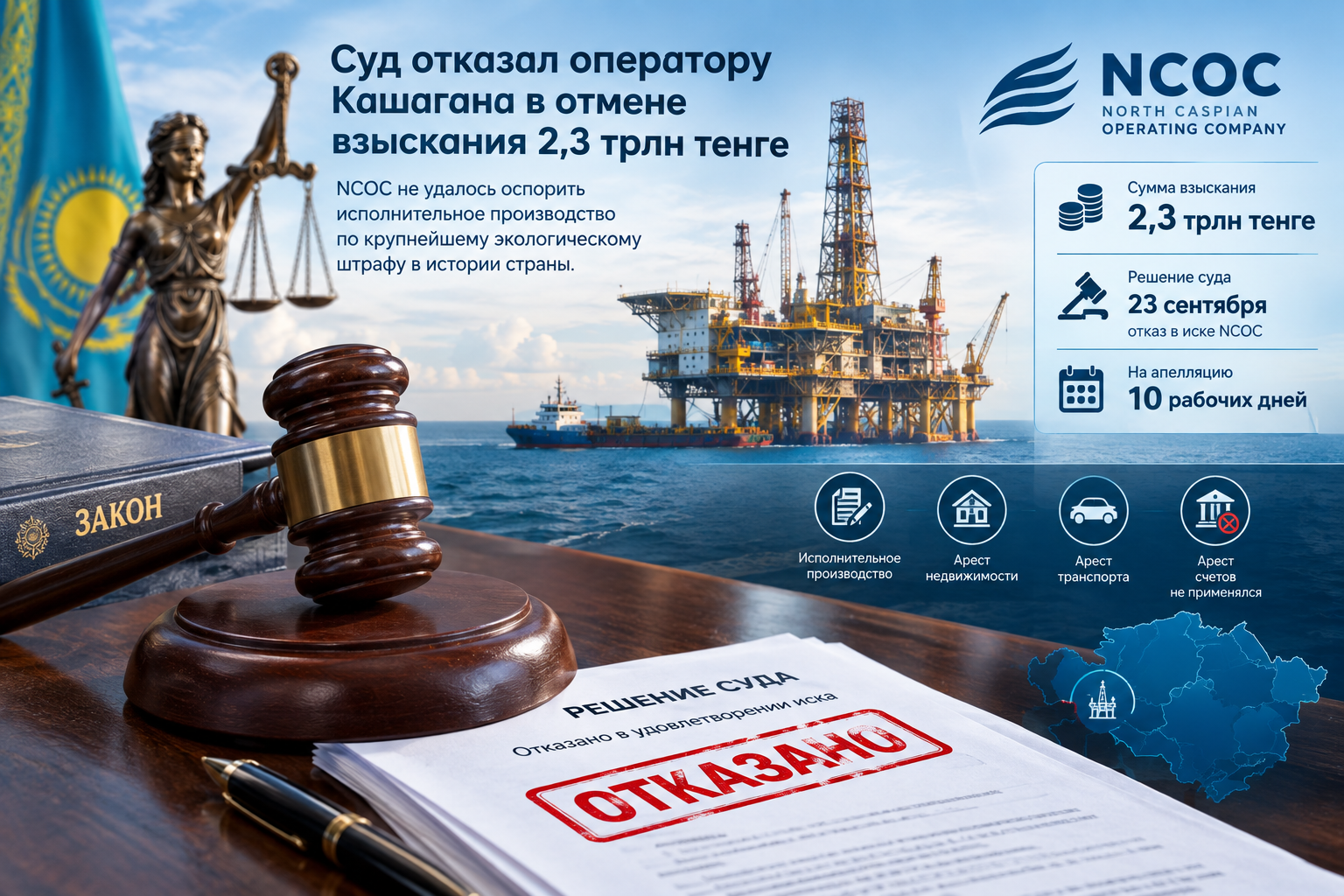
Atyrau's specialized administrative court rejected NCOC's claim to cancel enforcement of Kazakhstan's largest-ever environmental fine.
The money has not yet been recovered, but the September pause in enforcement is likely coming to an end.
The essence in brief
- The Atyrau Region Court, by a decision dated September 23, refused NCOC's request to declare unlawful the order initiating enforcement proceedings, the seizures of property, and the imposed restrictions.
- According to the registry, the debt of the company's branch amounts to 2,356,293,268,036 tenge; the money has not yet been recovered.
- NCOC has 10 working days to file an appeal, after which the decision will enter into force or be reviewed by a higher instance.
- In parallel, the UNCITRAL international arbitration continues, where the company is challenging the fine itself.
What exactly the company tried to overturn
NCOC asked the court to declare unlawful several actions of the state bailiff at once: the order initiating enforcement proceedings dated July 21, the seizure of real estate dated July 21, the seizure of vehicles dated July 22, as well as restrictions imposed on July 23 and 30, Interfax reports. The court refused on all points. Thus, at the first stage, the operator failed to overturn any of the key measures by which the state began enforcement recovery.
Enforcement proceedings were initiated after the deadline for voluntary payment expired. (Recall that the Ministry of Justice of the Republic of Kazakhstan warned the head of the consortium, Giancarlo Ruiu about administrative and criminal liability after the deadline of July 20, 2026 expired and the fine of about $4.9 billion was never paid.) Within the proceedings, the bailiff seized the company's real estate and vehicles and imposed bans on certain actions. According to the case materials, no seizure of bank accounts was applied.
Why the recovery was paused
Enforcement recovery was suspended on September 7. The reason was not the write-off of the fine or the state's abandonment of its claims: NCOC challenged the bailiff's actions, and the court requested the enforcement proceedings materials. The Ministry of Justice of the Republic of Kazakhstan explained at the time that, under the law, proceedings are suspended while the materials are before the court, and after they are returned, recovery will continue in the prescribed manner. We examined the details of that pause in the article about how the recovery of the fine from the Kashagan operator was suspended but not canceled.
What happens next in terms of deadlines
The court decision of September 23 is not yet final. An appeal may be filed within 10 working days from the date the decision is issued in final form: such a shortened deadline for disputes over bailiffs' actions is expressly provided for by the Administrative Procedure and Process Code. If NCOC files an appeal, the lawfulness of the refusal will be reviewed by a higher court. If not, the decision will enter into legal force, and the main obstacle that caused the materials to be requested in September will disappear. As of publication, the Ministry of Justice had not publicly named the exact date for resuming recovery.
Two parallel disputes
The Kazakh court is deciding the issue of the bailiffs' actions, not whether the fine itself is lawful. That is the subject of international arbitration. NCOC previously stated that the tribunal operating under UNCITRAL rules issued an interim order prohibiting Kazakhstan from enforcing the fine until the arbitration award is rendered. The Ministry of Justice of the Republic of Kazakhstan disagrees with that interpretation: in its position, an interim measure of commercial arbitration does not prevent the enforcement of a national court decision that has entered into force.
As a result, within the country the state is seeking enforcement, the company is challenging the bailiffs' actions, and the participants in the Kashagan project are simultaneously continuing arbitration over the conflict itself. The claims arose after inspections of the field and are related, among other things, to sulfur storage volumes. NCOC does not admit any violations and states that it acted within the framework of permits and legislation. Earlier, NCOC's property had already been seized, and at that time the case first moved from paperwork to practice.
Context for the industry
Kashagan is not the only major oil project to come under the scrutiny of environmental regulators. Claims were also made against the operator of the field where Tengizchevroil was accused of accumulating waste without a permit. The story at the Mangystau "Dolinnoye" ended quite differently: after an unscheduled inspection requested by a deputy, the subsoil user paid the fine within a week and received a discount. The contrast shows how differently environmental disputes unfold when it comes to an ordinary violation versus a fundamental conflict with an international consortium.
Author's conclusion
The court decision does not put an end to the matter, but it changes the alignment: the pause that the company used as a breather was procedural, and the first instance found no grounds to overturn the bailiff's actions. Now it is NCOC's move: filing an appeal will keep the dispute in Kazakh courts, while refraining from it will open the way to resuming recovery. At the same time, the main question of whether the fine of 2.3 trillion tenge is lawful remains with international arbitration, and it is precisely its position that will determine whether the enforcement proceedings turn into actual payments.



Comments ()