Cyprus-Greece-Israel submarine cable project stalled amid dispute with Turkey
The idea of linking Greece, Cyprus, and Israel's power grids via an undersea cable across the Eastern Mediterranean sounds routine. In theory, that is.
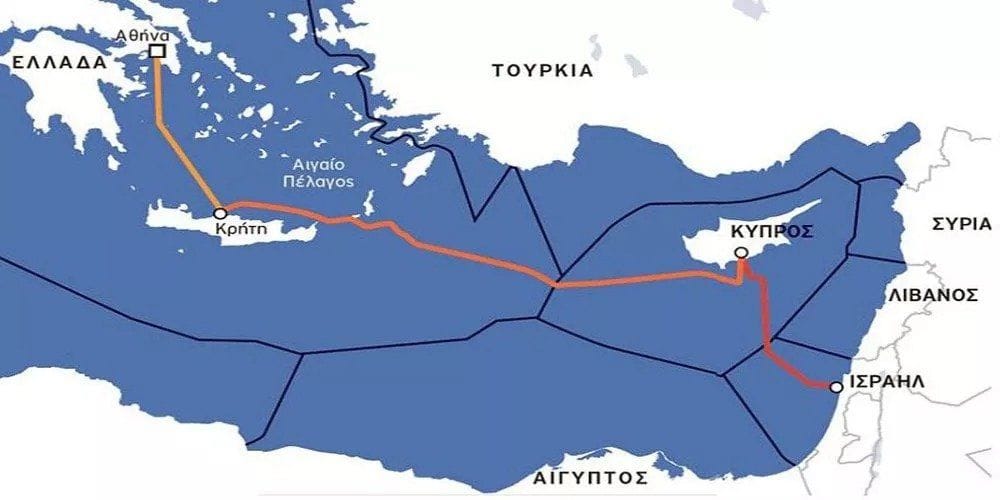
In practice, the project has been stalling for several years at the intersection of maritime law, regional geopolitics, and the simple question of "who will pay" — a rare example of how energy infrastructure becomes hostage to a much broader dispute, Euronews reports.
The gist in brief
- The Great Sea Interconnector (GSI) project, worth €1.9 billion, which is intended to connect the power systems of Greece, Cyprus, and Israel via a submarine cable approximately 1,200 km long, has been repeatedly delayed due to maritime disputes in the Eastern Mediterranean.
- The cable route is supposed to pass through waters that Greece claims based on the UN Convention on the Law of the Sea; Turkey, which is not a party to this convention, contests this position, and in 2024 Greece already postponed survey work after Turkish Navy vessels appeared in the area.
- Beyond geopolitics, the project has faced financial difficulties: the European Commission has allocated €657 million, but Greece and Cyprus have been unable for years to finally agree on the division of the remaining costs (63% and 37% respectively), and the European Investment Bank is conducting a reassessment of the project's viability.
- For the European Union, the cable is fundamentally important not only as infrastructure — Cyprus remains the only EU member state without an electrical connection to the community's common power grid.
The maritime dispute as the main obstacle
The GSI route is supposed to pass through waters to the south and east of the Greek islands of Crete and Kasos — Greece asserts sovereign rights over the continental shelf and exclusive economic zone in these areas. Turkey contests this position, insisting that islands should not automatically be granted rights to full maritime zones where their boundaries intersect with the continental shelf of the country's mainland. Professor of geopolitics at the University of London, Klaus Dodds, noted in a comment to Euronews that Turkey views the project as a challenge to the maritime borders claimed by Greece and Cyprus, and that if implemented, GSI would become not just a cable for transmitting electricity, but a demonstration of the close rapprochement between Greece, Cyprus, and Israel — a geopolitical alliance viewed with suspicion by Ankara.
The Turkish alternative
The Turkish side also has its own alternative vision of how the region's energy connectivity should be organized: Ankara would prefer to implement a competing project — a submarine power line connecting Turkey with the Turkish Republic of Northern Cyprus, a self-proclaimed state recognized only by Turkey. The European Commission, however, has made it clear that it supports politically and financially exclusively GSI, and has publicly criticized Turkey's plans for a separate cable to Northern Cyprus. EU Energy Commissioner Dan Jørgensen emphasized the importance of adhering to the norms of international law and multilateral cooperation for stability in the Eastern Mediterranean.
Who will pay
Even without geopolitics, the project has plenty of purely financial difficulties. The initial financing scheme — EU grants, European Investment Bank loans, and funds from the project's initiators — was not fully implemented, and the bank had previously expressed doubts about its financial viability. In April, Athens and Nicosia asked the EIB to reassess the project's viability and its cost; if it turns out that the initial estimate of €1.9 billion has increased, additional sources of funding will need to be found. A bank representative told Euronews that discussions are ongoing, but a decision on financing has not yet been made.
Why this matters for Kazakhstan
The story of GSI clearly highlights how differently the fate of similar submarine cable projects can unfold depending on the geopolitical context. While the Greek-Cypriot cable has been stalling for years due to the maritime dispute with Turkey, Kazakhstan and Azerbaijan have relatively calmly completed the laying of their own submarine fiber-optic cable along the bottom of the Caspian Sea — without clashes of warships or disputes over maritime borders, although the status of the Caspian itself as a body of water was for a long time the subject of separate multilateral negotiations among the five Caspian states. The difference is telling: an infrastructure project can be technically equally complex in both cases, but it is precisely the state of relations between neighboring countries that determines whether implementation proceeds without political obstacles or drags on for years.
Author's conclusion
Great Sea Interconnector is a clear example that for a truly integrated energy system, money and engineering solutions are not enough: the route of a submarine cable inevitably passes through areas where maritime borders are either clearly defined and recognized by all parties, or remain a matter of dispute. While Brussels insists on GSI as the only supported option, and Ankara promotes its own alternative, Cypriot consumers remain in limbo — without access to the EU's common power grid and without clarity on when that access will appear.
Comments ()