Eight EU countries provided a quarter of government contributions to the UN system
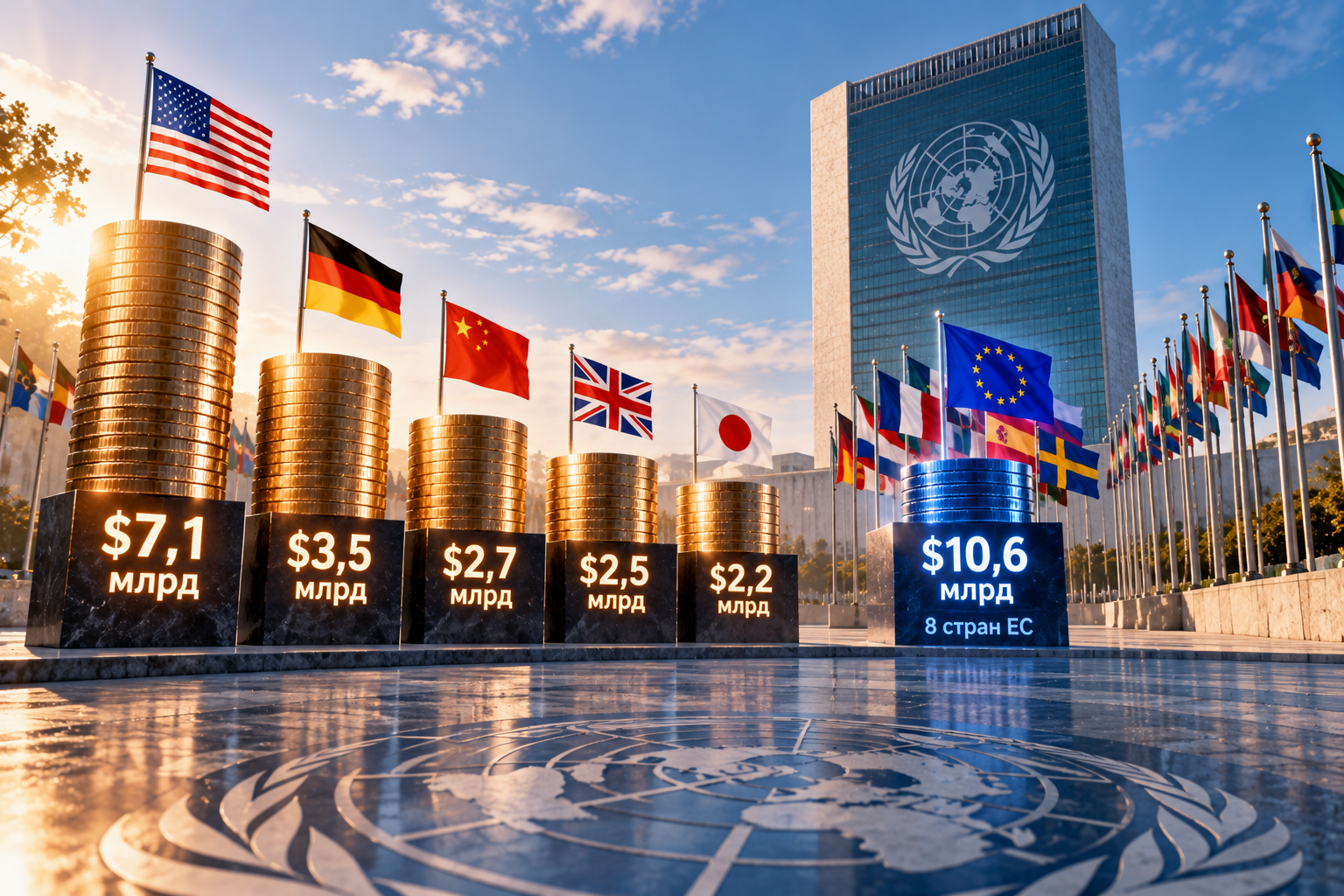
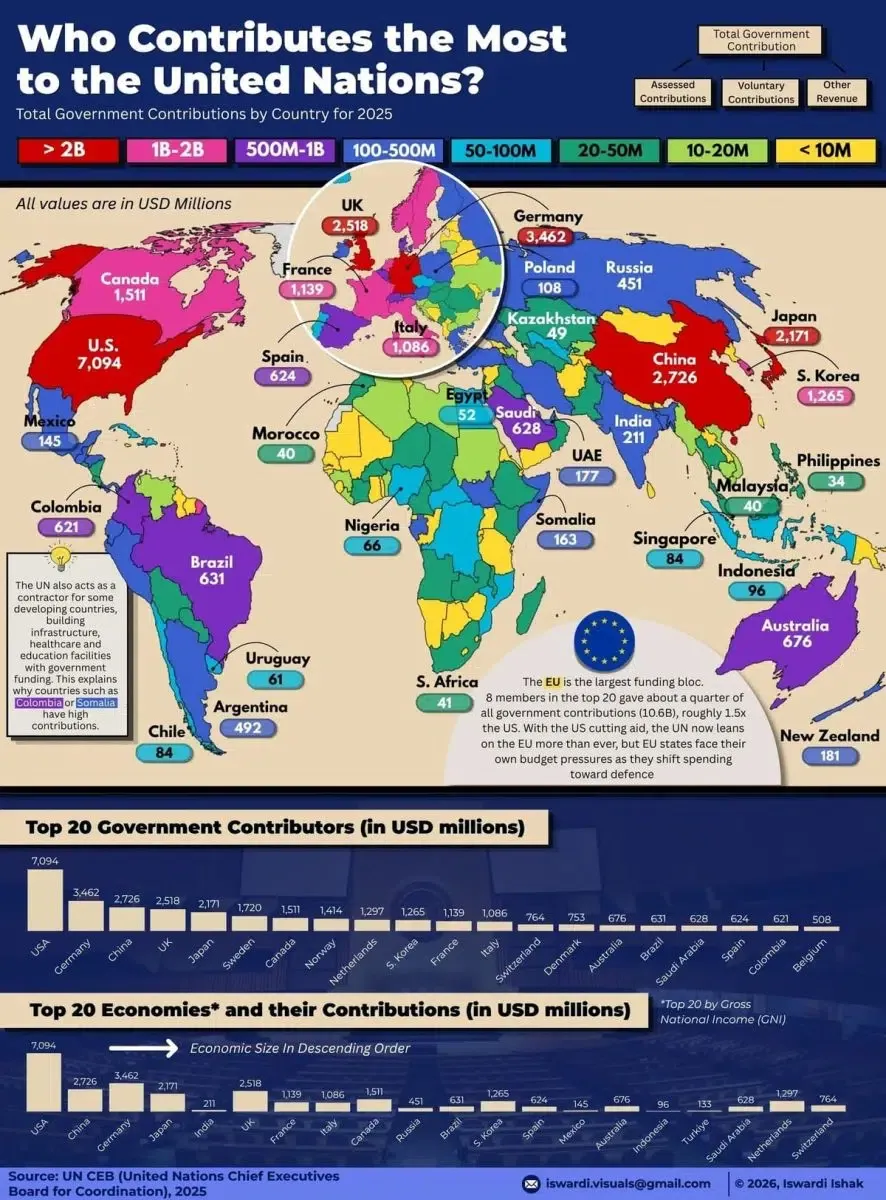
In 2025, the largest UN contributors were the US ($7.1B), Germany ($3.5B) and China ($2.7B). Eight EU countries in the top 20 together provided about a quarter of all government contributions, $10.6B.
This is data from the UN System Chief Executives Board for Coordination (CEB) for 2025, compiled into an infographic by Iswardi Ishak, Naked Science reports. The sum includes mandatory and voluntary contributions, as well as other receipts.
The gist in brief
- Eight EU countries from the top twenty contributed $10.6 billion, about a quarter of all government contributions.
- More than $2 billion was contributed by five countries: the US ($7.1 billion), Germany ($3.5 billion), China ($2.7 billion), the UK ($2.5 billion) and Japan ($2.2 billion).
- Kazakhstan contributed $49 million, Russia - $451 million, India - $211 million.
- US contributions fell from $14.4 billion in 2024 to $7.1 billion in 2025, according to AEI.
What the contributions include
The infographic shows a government's total contribution: mandatory contributions under the UN scale of assessments, voluntary contributions (for example, to UNICEF and the World Food Programme) and other receipts. The size of a contribution does not affect votes in the General Assembly: each state has one vote. For the US, there is a cap on the mandatory contribution to the UN regular budget of 22%, and it has reached it. But of the US total, according to AEI, $3.8 billion consisted of voluntary contributions that the country is not obliged to make.
Who is in the top twenty
After the top five come Sweden ($1.7 billion), Canada ($1.5 billion), Norway ($1.4 billion), the Netherlands ($1.3 billion), South Korea ($1.3 billion), France ($1.1 billion) and Italy ($1.1 billion). Then Switzerland ($764 million), Denmark ($753 million), Australia ($676 million), Brazil ($631 million), Saudi Arabia ($628 million), Spain ($624 million), Colombia ($621 million) and Belgium ($508 million).
Among major economies, contributions vary noticeably. India, one of the world's largest economies, contributed $211 million, less than Sweden, Norway or the Netherlands. Russia contributed $451 million, Mexico - $145 million, Indonesia - $96 million. The authors explain the high contributions of Colombia and Somalia by the fact that the UN acts as a contractor for some developing countries: it builds infrastructure, hospitals and schools with their funds.
What this means for Kazakhstan
Kazakhstan contributed $49 million in 2025. But the country's participation in the UN system is not limited to contributions. With the Food and Agriculture Organization of the UN (FAO), the Ministry of Agriculture, according to its data, is running 10 projects worth $9.5 million, including on monitoring soil organic carbon. And a farmer from the Kostanay region, Gulnara Kuanyshbayeva, was named among the 100 women recognized by FAO for their contribution to rural development.
There is also Kazakhstan's own initiative: for almost a year the country has been promoting the creation of an International Water Organization under the UN. Launching it requires a decision by the General Assembly.
Author's conclusion
The list of UN donors is broader than one might expect: the top twenty includes Colombia ($621 million) and Saudi Arabia ($628 million), while India, with $211 million, contributes less than Sweden, Norway and the Netherlands.

Comments ()