Energy storage systems will be deployed in all regions of Uzbekistan
As neighbors ramp up solar and wind power, every country faces the same question: where to put surplus energy when there's too much, and where to get it when there's too little.
Uzbekistan is formulating its response on a nationwide scale all at once, UzDaily reports.
The gist in brief
- Uzbekistan's Minister of Energy Sherzod Khodjayev announced that the authorities plan to deploy energy storage systems in all regions of the country, adapting their parameters and operating modes to the needs of large industrial enterprises.
- The development of such infrastructure is being considered by the authorities in the context of ensuring the country's energy security; the selection of investors for new projects will be carried out exclusively on the basis of transparent competitive procedures.
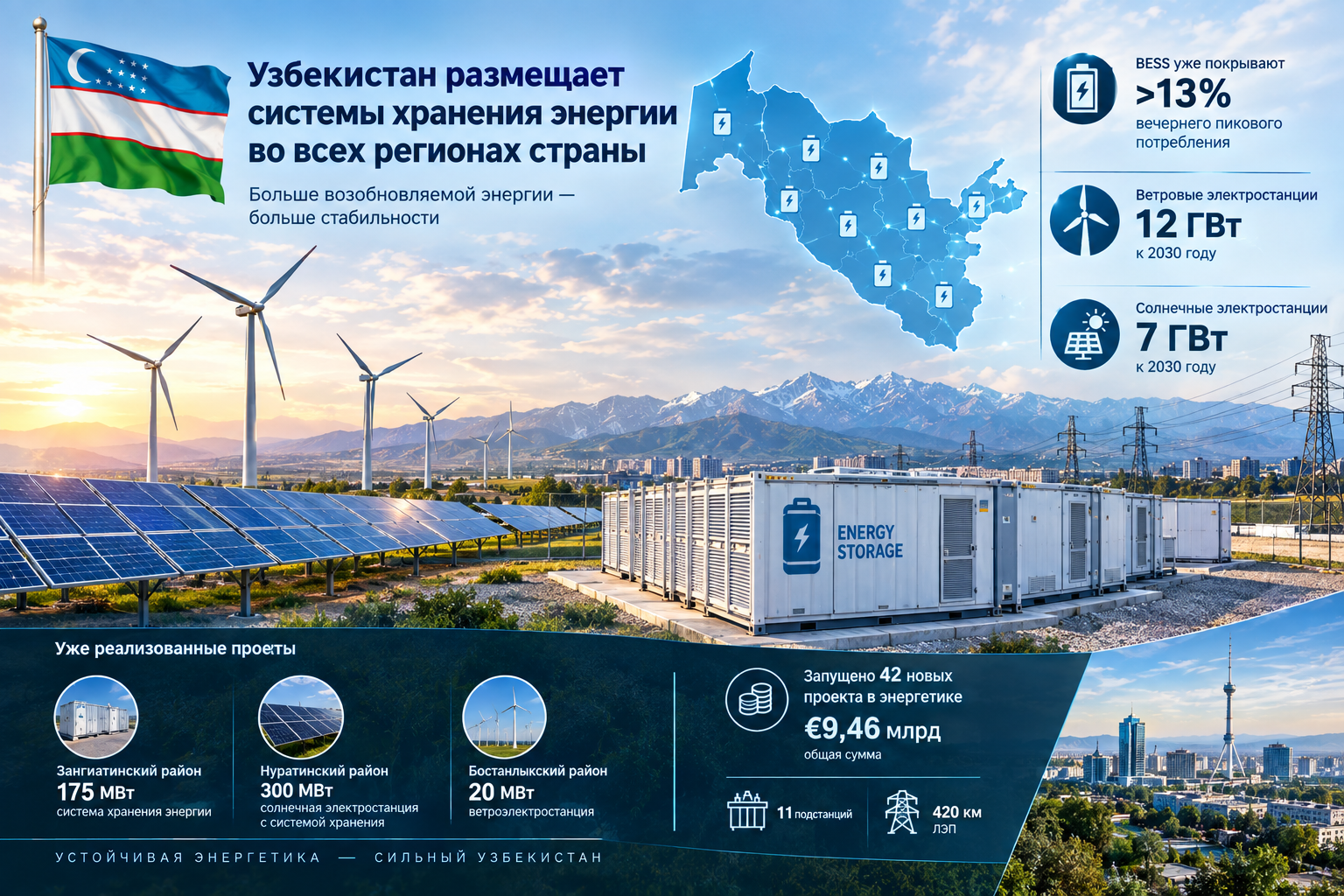
- Battery energy storage systems (BESS) already cover over 13% of Uzbekistan's evening peak energy consumption — a figure that is planned to be increased as new facilities are commissioned.
- At the same time, the authorities intend to increase wind power capacity to 12 GW and solar capacity to 7 GW by 2030, meaning that the development of storage is proceeding in parallel with a manifold increase in renewable-based generation itself.
Concrete facilities instead of general declarations
The minister's statement is already backed by implemented projects, not just plans for the future. In the Zangiota district, a 175 MW energy storage system has been connected to the grid; in the Nurata district, a 300 MW solar power plant with its own storage system has been launched; and in the Bostanlyk district, a 20 MW wind power plant has been commissioned. In the first seven months of 2026, the country produced 54.3 billion kWh of electricity. Back at the end of 2025, 42 new energy projects were launched worth a total of €9.46 billion, including not only generating facilities and storage systems but also 11 substations and 420 km of high-voltage transmission lines — meaning that alongside the storage units themselves, the infrastructure capable of delivering stored energy to the end consumer is also being built.
Part of an already familiar regional picture
Uzbekistan's approach to storage logically echoes what we have already examined with regard to neighboring countries. We wrote that Kazakhstan is preparing a law on average energy savings — against the notable backdrop of accelerating solar and wind capacity deployment without the gradual development of industrial production. The scale of Uzbekistan's ambitions in this area is confirmed and investments have already been attracted: we wrote that Saudi Arabia's Acwa and South Korea's KOWEPO signed a memorandum to study renewable energy and energy storage projects in Uzbekistan, and Acwa's investments in the country alone could require 15 billion dollars. Development is also happening at the opposite, household level: the "Solar Home" program pays residents of the country subsidies for generating electricity from home solar panels, and the payouts themselves are growing 9-fold per year — meaning that the energy transition in Uzbekistan is happening simultaneously on an industrial scale and at the private level.
Author's conclusion
The formulation about deploying storage "in all regions" sounds ambitious, but its practical value will be determined precisely by the linkage to specific industrial consumers that the minister speaks of — universal storage systems without consideration for the specifics of local demand risk being less effective than facilities designed from the outset for the load of specific enterprises. The already achieved 13% coverage of the evening peak is a solid starting base for further scaling, but the parallel growth of generation to 19 GW of combined wind and solar capacity by 2030 will require a manifold increase in storage capacity itself if Uzbekistan wants to avoid the problems already familiar to other countries with a more developed renewable energy sector.

Comments ()