EU launches tender for construction of seven AI gigafactories
The European Commission launched a tender for seven of Europe's largest AI training data centers, aiming to catch up with the US and China in the computing power race.
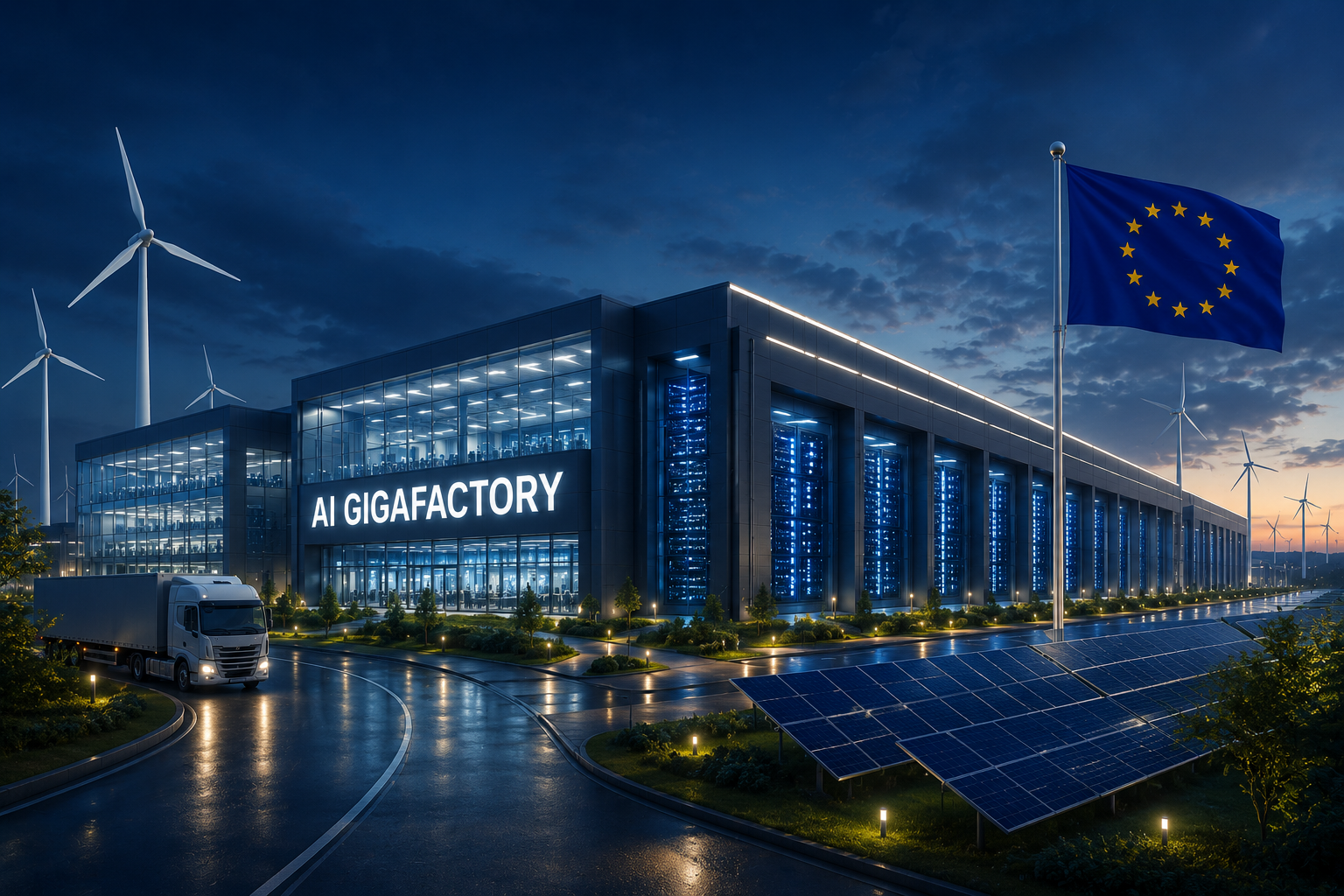
Behind the impressive figure of €30 billion lies the same question that US states have already faced and that Hunn.kz readers know well: where to get enough electricity and water to make all this infrastructure work.
The gist
- The European Commission has announced a tender for the construction of seven AI gigafactories — large data centers with cutting-edge chips for training the next generation of large language models.
- The project's total budget is around €30 billion: approximately €5 billion from the European Commission, €5 billion from member states, and €20 billion from private investors.
- 76 companies have expressed preliminary interest in participating in the tender; ten countries want to host gigafactories — Germany, Italy, France, Poland, the Czech Republic, Denmark, Finland, Greece, Portugal, and Spain.
- Physical construction is set to begin in early 2027, with commissioning scheduled for mid-2028.
What are AI gigafactories and why does the EU need them
AI gigafactories are large computing centers equipped with highly specialized chips for training the most advanced artificial intelligence models capable of processing trillions of data units. The idea was announced by European Commission President Ursula von der Leyen at the AI Action summit in Paris in February 2025, hoping to replicate the success of CERN's Geneva laboratory — but this time for computing infrastructure. The initiative aims to reduce the European Union's dependence on foreign cloud services and chips amid the fact that large-scale data center projects are already actively underway in the US and China. Industry interest proved so high that the European Commission expanded its initial plan from four or five to seven gigafactories, Euronews reports.
How financing works
The procurement procedure is divided into two sequential phases designed for the gradual scaling of capacity over six and a half years — largely due to a shortage of available funding. Initially, the European Commission stated its readiness to allocate €20 billion to the project, but over time it reduced its commitments: the share of public funding fell to about a third of the total amount, and the Commission itself will provide only half of that share. Under the current EU budget, only €1 billion can be guaranteed; the rest depends on the next multiannual financial framework, which remains a matter of negotiation among member states. The initiative is already being criticized for repeated delays — even though the rhetoric around the project is built on the urgent need to catch up with competitors.
Who gets access and on what terms
In exchange for public investment, the EU and participating countries will receive a proportional share of access to computing capacity — for government projects, research centers, and AI laboratories. All operating costs, meanwhile, will fall on private participants: in the Commission's design, gigafactories should be financially sustainable through their own commercial services. A separate sore point is technological dependence: despite the goal of creating sovereign infrastructure, the European Union still relies on foreign chip suppliers, and the European Commission has already signed memorandums with Nvidia, AMD, and Qualcomm, while simultaneously building measures against single-supplier dependence into the bid selection criteria.
Why this matters for Kazakhstan
Kazakhstan is playing a similar game in scale and logic — the "Data Center Valley" in Ekibastuz is billed as Central Asia's largest campus with capacity of up to 1 GW, with negotiations underway to host data centers for Google, Microsoft, Amazon, and Presight AI. In parallel, the country is structuring financing for its AI ecosystem along a mixed model similar to Europe's — the World Bank is discussing a loan of up to $75 million to Kazakhstan for an AI Center, cloud platforms, and a venture fund for startups, with the total program cost of $149 million half-covered by the Kazakh side — the same logic of shared responsibility as in the EU tender. The difference in approach to energy is telling: the EU is raising money for gigafactories for technological sovereignty, while Kazakhstan is betting on cheap coal-fired generation from the Ekibastuz GRES — inevitably facing the same question that has already triggered the first-ever US moratorium on data centers: New York authorities banned the construction of large facilities due to rising electricity bills and strain on water resources. We have also written about how AI infrastructure in general consumes enormous amounts of water for cooling — an issue especially sensitive for a country with water stress levels above the UN threshold. Both the EU and Kazakhstan are now at the same crossroads: scale up computing capacity as fast as possible, or first build standards that prevent infrastructure from outpacing the capabilities of the power grid and water balance.
Author's conclusion
The €30 billion tender looks like a purely European story, but in essence it is the same choice Kazakhstan already faces in Ekibastuz and New York recently faced: the race for AI computing capacity is never free — it is always paid for either with money, or energy, or water. For Kazakhstan, which is simultaneously expanding coal generation and staking claims to regional IT-hub status, the European experience is worth keeping in view not as a distant technical news item, but as a benchmark for which questions need to be resolved in advance.


Comments ()