Europe bets on 'iron' batteries: Why the new technology could change the renewable energy market
Europe debuts a 1 GWh multi-day iron-air battery storage system. The Ore Energy and Budget Thuis project tackles a key renewable energy challenge.
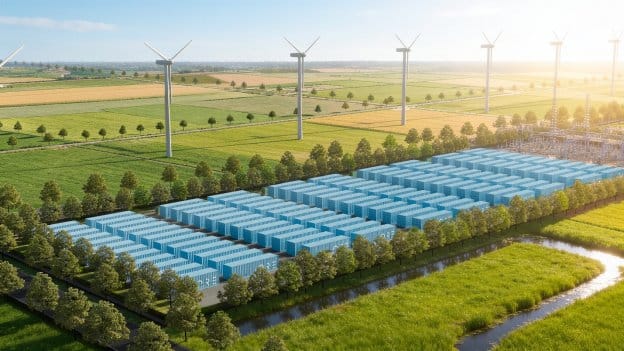
While the world continues to ramp up solar and wind generation capacity, the main obstacle to the energy transition remains electricity storage. Lithium-ion batteries handle short-term energy storage well, but they cannot power the grid for several days without sun or wind. IRWpress reports that this is precisely the problem that the Netherlands intends to solve, where energy company Budget Thuis and startup Ore Energy have announced the construction of the largest long-duration energy storage system based on iron-air batteries in continental Europe.
The project involves deploying storage units with a total capacity of 1 GWh, making it the largest contract of its kind in Europe and the first agreement between an iron-air battery developer and a European electricity supplier. The first phase, with a capacity of 400 MWh, is scheduled to be commissioned as early as 2028.
In Brief
· The Netherlands will build Europe's largest long-duration energy storage system based on iron-air batteries.
· The total capacity of the project will be 1 GWh, with the first phase at 400 MWh.
· The new technology can store electricity for up to 100 hours, significantly exceeding the capabilities of most lithium-ion systems.
· Iron-air batteries use cheap and widely available materials — iron, water, and air.
· For Kazakhstan, such technologies could become an important element in the development of solar and wind energy.
Why Lithium Batteries Are No Longer Enough
Most modern storage systems are designed to operate for two to four hours. This is sufficient for smoothing short-term load peaks, but not enough if there is no wind or it remains cloudy for several consecutive days.
It is precisely these periods that become the main problem for power systems with a high share of renewable energy. As a result, operators have to start up gas or coal power plants, which reduces the environmental benefits of developing renewables.
Ore Energy offers an alternative — batteries capable of delivering stored energy for up to 100 hours, i.e., more than four days.
How Iron-Air Batteries Work
Unlike lithium-ion batteries, the new technology is based on the natural process of iron oxidation.
During discharge, the metal interacts with oxygen from the air, releasing electrical energy. During charging, the process reverses: iron oxide is converted back into metallic iron.
The main advantage lies in the materials used. Iron remains one of the most abundant and cheapest metals on the planet, and the system also uses water and air. This makes such storage systems potentially much cheaper than lithium counterparts for long-duration energy storage.
Europe Prepares for a New Energy Landscape
The contract between Ore Energy and Budget Thuis reflects a broader trend.
After the large-scale development of solar and wind generation, European countries are increasingly facing not a shortage of electricity, but the inability to store it until it is needed by consumers.
Therefore, the focus is gradually shifting from energy production to creating storage infrastructure. Long-duration storage systems are now considered one of the key elements of Europe's future energy system.
What This Means for Kazakhstan
For Kazakhstan, this news is particularly relevant.
The country is actively developing solar and wind generation, but the problem of balancing the power system remains one of the main challenges. Electricity production from renewables is highly dependent on weather conditions, while consumption must remain stable.
Today, the main focus is on building new power plants, but global experience shows that the next stage will be the development of energy storage systems.
If the cost of iron-air batteries turns out to be significantly lower than existing solutions, Kazakhstan could use such technologies to integrate large wind and solar parks without the need to build additional backup coal or gas capacity.
Furthermore, the use of inexpensive materials makes such systems less dependent on the global lithium market, which remains one of the most scarce resources in modern energy.
Author's Conclusion
The news from the Netherlands shows that the next competition in the global energy sector will no longer be about producing "green" electricity, but about the ability to store it efficiently. If the 20th century belonged to oil, and the early 21st to solar panels and wind turbines, then the coming decades could be the era of energy storage technologies. For Kazakhstan, this means that the development of renewables must be accompanied by investments in modern storage systems. Otherwise, even the largest solar and wind farms will not be able to fully replace traditional generation.
Comments ()