Farmers in Europe are returning to metal wheels
French company Somac makes open-mesh metal wheels for traction on waterlogged soil where rubber tires fail.
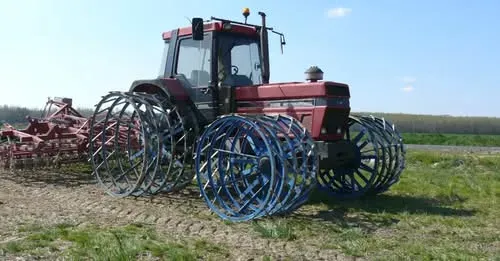
European farmers are returning to a technology that seemed to belong to the past: metal wheels for tractors. The reason is not nostalgia, but an attempt to reduce the pressure of heavy machinery on the soil and preserve crop yields. For Kazakhstan, where the problem of soil degradation and compaction is also becoming increasingly noticeable, this trend is of practical interest.
The Gist
• Interest in metal wheels and other low soil pressure solutions is growing in Europe.
• The main goal is to reduce soil compaction caused by heavy agricultural machinery.
• Soil compaction impairs water permeability, aeration, and root system development.
• Farms in Kazakhstan face similar risks when using heavy tractors and combines.
Old Technologies Find New Applications
Modern agriculture uses increasingly powerful tractors, seeders, and combines. However, the increase in machinery weight has led to greater ground pressure. As a result, soil structure deteriorates, air and moisture access to plant roots decreases, and crop yields can gradually decline.
Against this backdrop, some European manufacturers and farmers are returning to metal wheels, track systems, and other designs that distribute the load over a larger area. This is not about completely abandoning modern tires, but about finding solutions for working on heavy and wet soils, where the risk of compaction is particularly high.
Why Soil Compaction Has Become a Problem
Soil is not just a substrate for plants, but a complex system of pores, air, water, and microorganisms. When heavy machinery repeatedly passes over a field, the pores are compressed, water infiltration worsens, and the root system receives less oxygen.
The consequences are not immediately apparent. A farmer may see normal yields in the first few years, but gradually the field's ability to retain moisture decreases, and the risk of waterlogging and erosion increases. In conditions of climatic variability, this becomes a particularly sensitive factor.
What This Means for Kazakhstan
For Kazakhstan, the issue of preserving soil structure is no less relevant than for Europe. Large grain farms actively use heavy tractors, seeding complexes, and harvesting machinery. On certain soil types, this can lead to compaction of the topsoil and a reduction in its water permeability.
This topic is especially important for regions with limited moisture. If compacted soil absorbs precipitation and meltwater less effectively, some moisture is lost, and the drought resistance of crops decreases. Therefore, interest in technologies with minimal soil impact is gradually growing in Kazakhstan as well.
Not a Return to the Past, but a Search for Efficiency
It is important to understand that this is not about a literal return to the machinery of the last century. Modern metal wheels and low-pressure systems are created with new requirements for productivity and precision farming in mind. In essence, farmers are trying to solve a problem that the modernization of agriculture itself has made more apparent: how to use powerful machinery without destroying the soil upon which future harvests depend.
Author's Conclusion
The European interest in metal wheels shows that the agricultural sector is increasingly evaluating efficiency not only by the power of machinery but also by the condition of the soil after its operation. For Kazakhstan, this is an important signal: preserving soil structure and moisture capacity could become as valuable a resource as new tractors and combines. In the long term, the farms that learn to combine machinery productivity with careful land stewardship will be the ones that succeed.
Comments ()