Fossil fuels provide 85% of electricity in Kazakhstan, Ember data shows
In 2025, fossil fuels generated about 85% of Kazakhstan's electricity, low-carbon sources 15%, and wind and solar combined 6%.
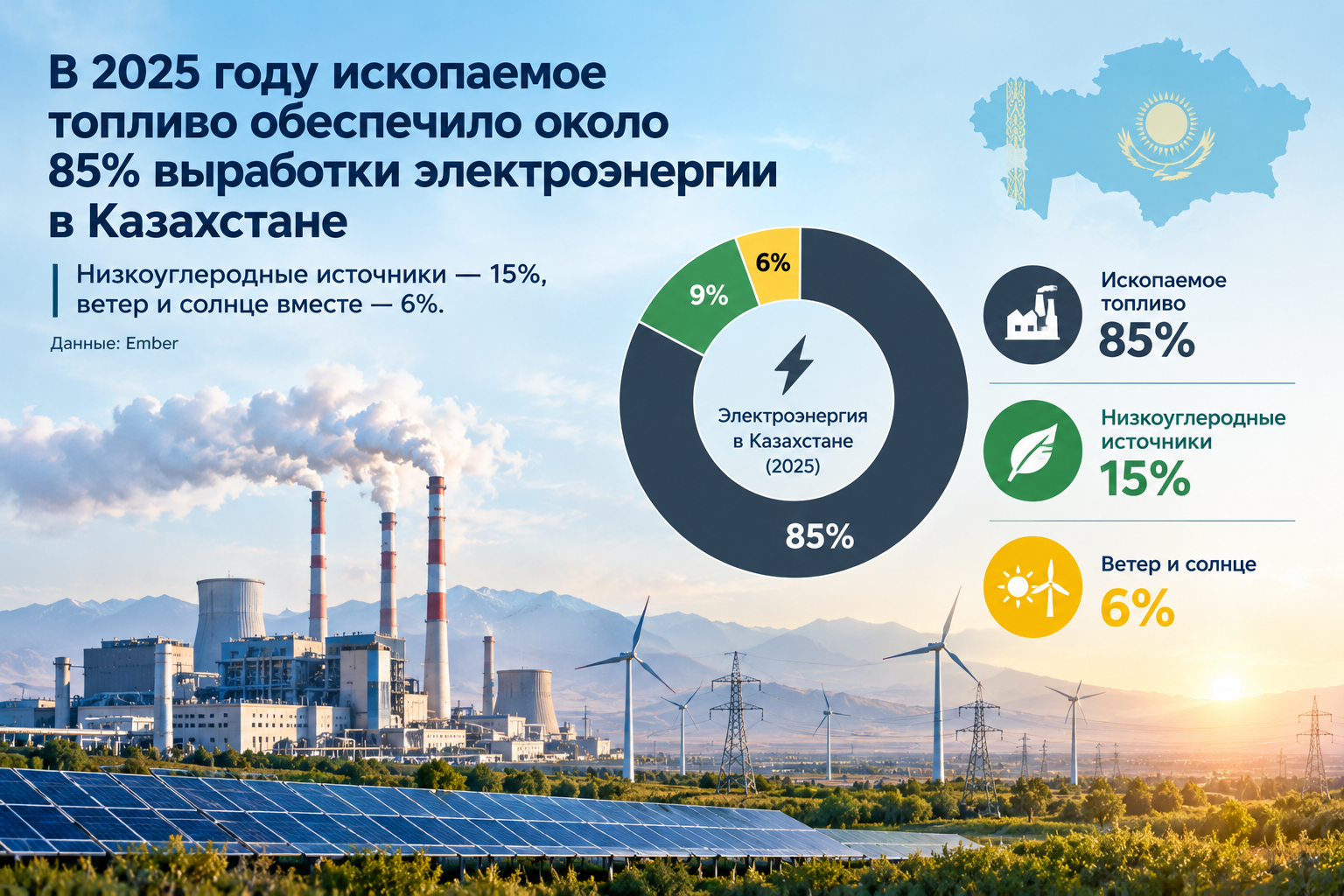
The data was published on the website of the Ember analytical center, which prepares an annual review of global electricity. For comparison, globally low-carbon generation provided 43%, and renewable sources in 2025 surpassed coal for the first time.
The essence in brief
- In Kazakhstan, fossil fuels provide about 85% of electricity, low-carbon sources - 15%, wind and solar - 6%.
- Per capita electricity consumption is 1.6 times higher than the global average, per capita emissions are 2.7 times higher.
- Globally in 2025, renewable sources provided 33.8% of generation, coal - 33.0%, wind and solar together - 17.3%.
- According to data for the last 12 months (April 2025 - March 2026), in Kazakhstan coal provides 54% of generation, gas - 29%.
What the data on Kazakhstan show
Ember assesses the structure of the electricity sector by the share of each source in annual generation. For Kazakhstan for 2025, the figures are as follows: fossil fuels about 85%, low-carbon sources 15%, including wind and solar 6%. The remaining approximately 9% comes from other low-carbon sources, mainly hydropower. The global average for low-carbon generation is stated in the page header as 43%.
Per capita electricity consumption in Kazakhstan is 1.6 times higher than the global average, per capita emissions are 2.7 times higher.
By total per capita energy consumption, including fuel for industry and transport, Kazakhstan ranks 22nd among 40 countries, 157 GJ per person.
A more detailed structure is provided by the LowCarbonPower project, which uses data from Ember, the Energy Institute and the IEA. Over the last 12 months, from April 2025 to March 2026, coal provided 54% of generation, gas - 29%, hydropower - about 8%, wind - almost 5%, solar - slightly less than 2%. This is a rolling period, not a calendar year, so the figures differ slightly from Ember's annual data.
What the global backdrop is
According to Ember's Global Electricity Review 2026, in 2025 renewable sources provided 33.8% of global generation (10,730 TWh), coal - 33.0% (10,476 TWh). For the first time in 100 years, renewables surpassed coal. Wind and solar together provided 17.3% of generation, and solar generation grew by 636 TWh, that is, by 30%. Electricity demand grew by 2.8%, and wind and solar covered 99% of that increase. Fossil generation meanwhile declined by 0.2%. Kazakhstan is not mentioned in the review.
Coal nonetheless remains the largest source in China, although there solar capacity as of the end of July 2026 surpassed coal capacity for the first time: 1.286 billion kW versus 1.285 billion kW. In terms of generation, coal still leads, while solar provides about 13% of the country's electricity consumption. At the UN summit, Turkey, which is hosting COP31, proposed raising the share of electricity in global energy consumption from 23% to 35% by 2035; the goal is voluntary.
What this means for Kazakhstan
New capacity is appearing in the country. The Ministry of Energy reported that in 2026 7 of the 10 planned renewable energy facilities were commissioned with a total capacity of 212 MW. A separate law is being prepared for energy storage; no deadline for its adoption has been given. In the energy sector, 24 investment agreements worth 3.8 GW are being implemented, and by 2035 they plan to add at least 8.4 GW of renewable capacity. The Development Bank of Kazakhstan approved about 54.5 billion tenge for the first phase of a 1 GW project: 60 MW of solar stations for Kazatomprom and 185 MW for KEGOC.
Coal remains the basis not only of generation but also of heating. The Ministry of Energy has launched a digital platform with AI elements that tracks coal supplies from extraction to sale to the public. For the 2026-2027 heating season, the public and the municipal household sector need 7.5 million tonnes of coal; 4.2 million tonnes have been accumulated in the warehouses of energy enterprises.
Author's conclusion
The gap is clearly visible in a single indicator: the world in 2025 received 17.3% of its electricity from wind and solar, Kazakhstan - 6%. New projects are not yet changing the structure: coal and gas still form the basis.
Comments ()