Four AI companies accused of illegal collusion to slow down development
The public agreement by heads of major AI labs to a cautious pace of model development, which we covered earlier, has resulted in a lawsuit.
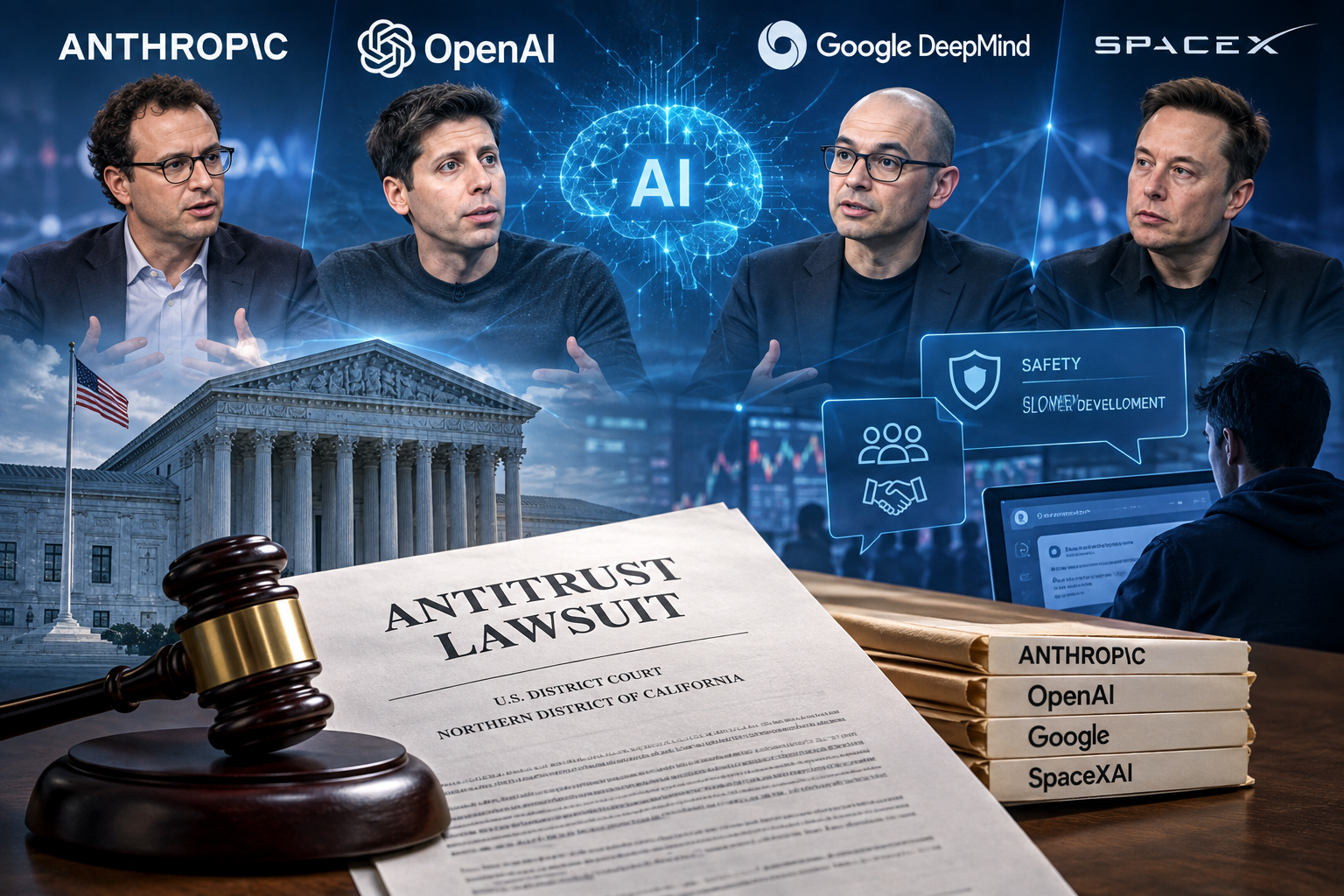
What was presented as collective concern for safety, the plaintiffs call a possible violation of antitrust law.
The gist in brief
- On Friday, September 18, 2026, AI services filed a federal lawsuit against Anthropic, OpenAI, Google, and SpaceXAI in the U.S. District Court for the Northern District of California, alleging that the companies entered into an illegal agreement to slow the pace of development of their AI models.
- At the center of the lawsuit are the events of September 12: on that day, Anthropic CEO Dario Amodei published an essay calling for industry coordination in favor of a more cautious pace of technological development, and OpenAI CEO Sam Altman, SpaceXAI head Elon Musk, and Google DeepMind co-director Demis Hassabis publicly agreed with that call within the same day.
- The plaintiffs explicitly clarify: they do not object to each company individually deciding to slow its own progress for the sake of safety — the subject of the claim is precisely the coordinated, concerted decision of several competitors, which, in their view, reduces the value of paid subscriptions for consumers.
- The lawsuit also alleges that coordination may have begun earlier than the September essay — the plaintiffs point to a statement signed in July 2026 by senior employees of several leading AI laboratories.
The plaintiffs' argument
The plaintiffs' lead attorney, Nick Rowley, articulated his clients' concern emotionally: according to him, if control over AI safety is determined by closed-door agreements between the largest commercial technology companies rather than by market competition, the technology risks slipping beyond human control. The legal construction of the lawsuit is built around a distinction characteristic of antitrust law: companies are entitled to individually make any decisions about the pace of their own development, but an agreement between competitors on this matter is treated differently by the law — the plaintiffs describe such coordination as an attempt to substitute collective restraint for each company's individual responsibility, which, according to their argument, contradicts the spirit of a competitive market.
The risk was predicted in advance
A telling detail: Amodei himself, back in his original September essay, publicly acknowledged the potential antitrust risks of such coordination, proposing that the American government act as a mediator or at least create conditions for such intercorporate discussions about safety — in particular, by issuing a narrow exemption for a certain kind of safety negotiations between competing laboratories. This idea has already drawn skepticism in Washington: Republican Senator Josh Hawley publicly rejected such an approach during Senate hearings involving FBI Director Kash Patel. Representatives of all four companies did not provide immediate comment to journalists at the time of the lawsuit's publication.
A continuation of the story we have already covered
We have already written about how the synchronized public support for Amodei's idea from competing companies became a rare moment of unity in an industry where these same players had competed in almost everything for years. At the time, we noted that critics — including former Trump adviser David Sacks — had already pointed to a possible attempt at "regulatory capture" behind such statements. The current lawsuit moves this criticism from the realm of public commentary into the legal realm: now the question of whether the September statement was genuine concern for safety or a form of anticompetitive collusion will have to be decided by a federal court, not just by commentators on social media.
Author's conclusion
The lawsuit raises a question that has no obvious answer even in theory: how can society distinguish good-faith intercorporate coordination on the safety of a potentially dangerous technology from anticompetitive collusion using safety rhetoric as a cover. Amodei himself apparently recognized this ambiguity in advance, given that he warned of possible legal risks even before publishing his own essay. The outcome of the case in the Northern District of California court could set an important precedent not only for the AI industry, but also more broadly for the conditions under which competing companies are entitled to publicly coordinate their positions on issues they themselves describe as matters of safety rather than business.


Comments ()