Four Central Asian countries entered the global top 30 most air-polluted
Kazakhstan ranks 29th in IQAir's global PM2.5 air pollution ranking—the best among its regional neighbors, yet harmful particle levels remain 4 times above WHO limits.
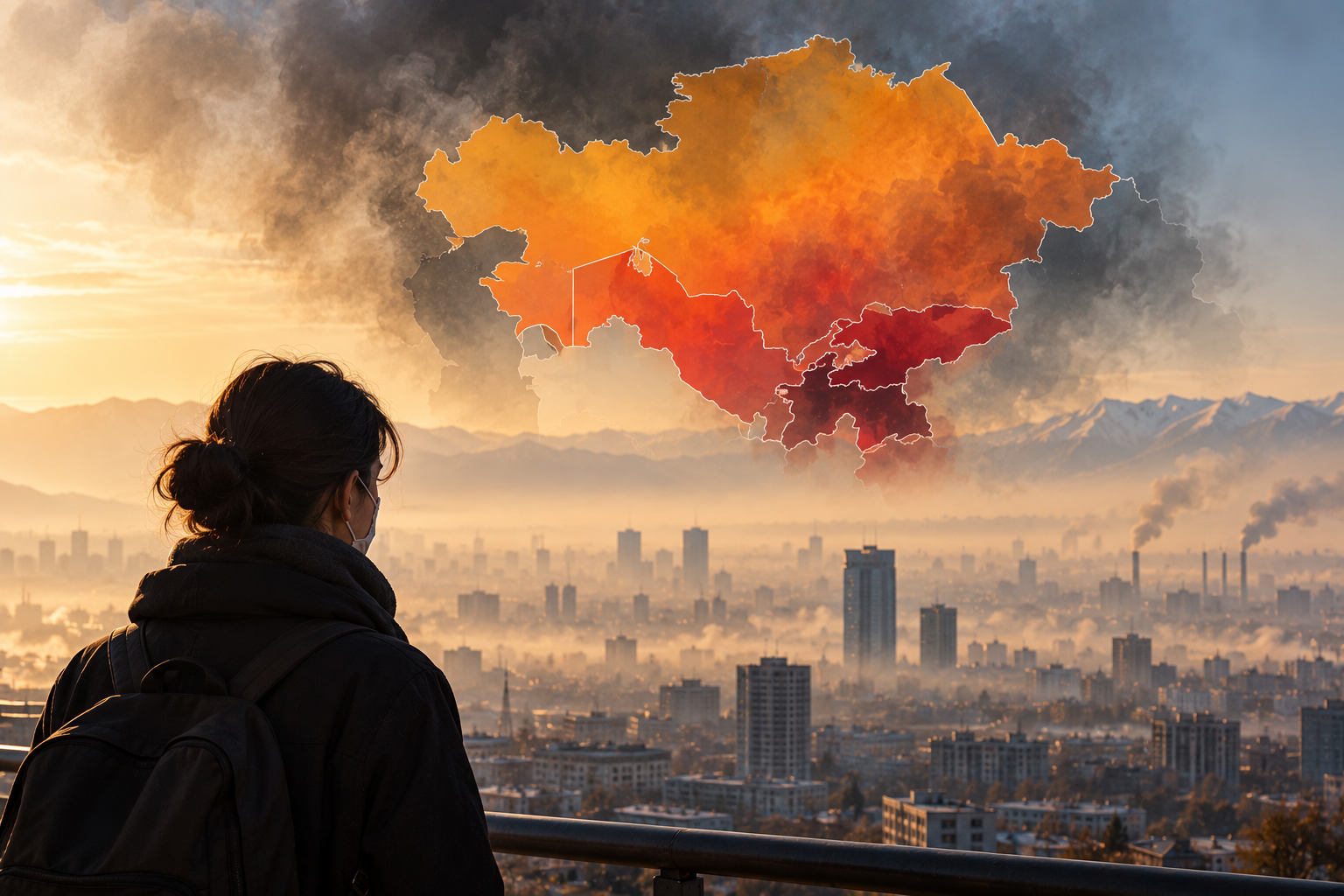
In three Central Asian countries, the situation worsened over the year, reports EnergyProm.kz . A new study adds to the list of consequences of dirty air one more, less obvious than asthma or heart disease.
The gist in brief
- In the IQAir ranking for 2025, Kazakhstan took 29th place in the world (23.4 µg/m³ PM2.5 — 4 times above the WHO norm), Uzbekistan — 10th (38.1 µg/m³), Kyrgyzstan — 19th, Tajikistan entered the global top five worst — 57.3 µg/m³.
- Over the year, pollution increased in Tajikistan by 23.8%, in Kyrgyzstan by 40.8%, and in Kazakhstan by 55%.
- World Bank experts estimate the damage to Central Asia's economy from PM2.5 pollution at $15.2–21.7 billion per year.
- A new scientific analysis linked polluted air to an increased risk of suicidal thoughts and behavior — for now, this concerns one of the factors, not a direct cause.
Who turned out to be the worst of all
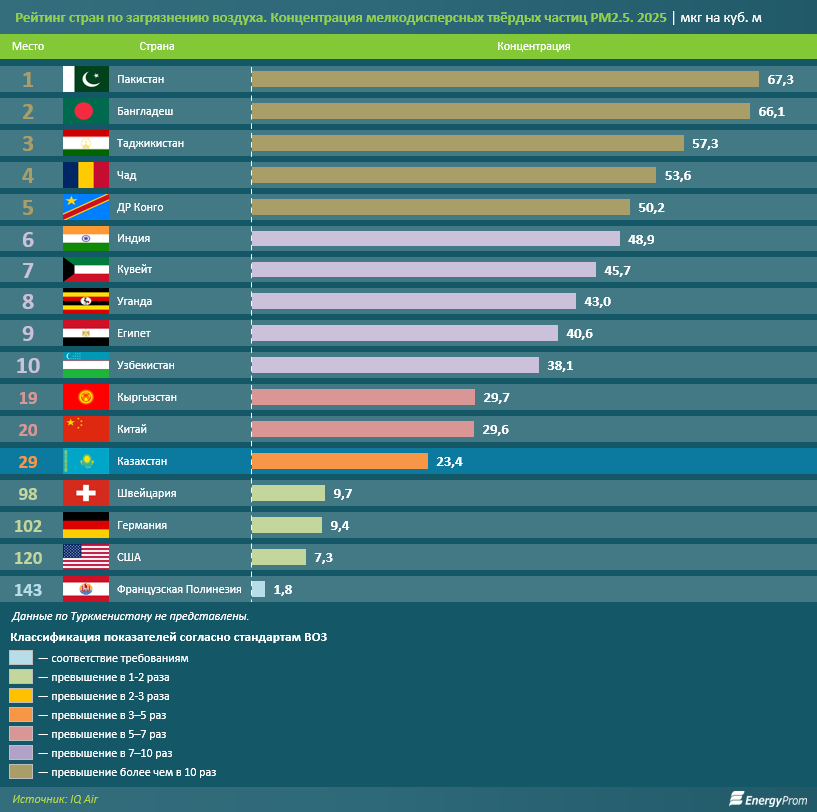
The international company IQ Air summed up the results of global monitoring of air pollution by PM2.5 particles for 2025. These are the finest suspended dust particles with a diameter of up to 2.5 microns — they freely penetrate the lungs and blood, which is why they are considered one of the most health-threatening air pollutants. The anti-ranking was topped by Pakistan (67.3 µg/m³ — 10 times above the WHO norm), followed by Bangladesh, Tajikistan, Chad, and the Democratic Republic of the Congo. The best indicators are in the economically developed countries of Europe and the United States; the first place for air cleanliness was taken by French Polynesia with a result of 1.8 µg/m³.
Against this background, Mongolia stands out: since 2019, the country has consistently reduced the concentration of fine particulate matter from 62 to 17.8 µg/m³ — it is still far from the WHO standard (5 µg/m³), but many could envy such dynamics.
Kazakhstan — the best among the worst in the region
Of the 143 countries monitored by IQ Air, four representatives of Central Asia at once made it into the list of the 30 most environmentally disadvantaged. Against their background, Kazakhstan looks relatively well-off, taking 29th place with an indicator of 23.4 µg/m³ — 4 times above the WHO norm. Uzbekistan was in 10th place (38.1 µg/m³, an excess of 8 times), Kyrgyzstan — in 19th (an excess of 6 times). The worst in the region is Tajikistan: 57.3 µg/m³, which is 10 times above the WHO standard — and this is one of the five worst indicators in the world. Data on Turkmenistan is not presented in the report.
An alarming point is the dynamics. While Uzbekistan kept the situation at its previous level, the other three countries worsened: in Tajikistan pollution increased by 23.8%, in Kyrgyzstan by 40.8%, and in Kazakhstan by as much as 55%. For Kazakhstan this is especially indicative, since since 2021 the country had been steadily reducing this indicator and was close to sustained positive dynamics — the dust concentration rose from 15.1 to 23.4 µg/m³ in one year.
What pollutes the air in the region
From 50% to 80% of air pollution by PM2.5 particles in Central Asian countries comes from anthropogenic impact — transport, burning of solid fuel, and local emission sources. The remaining share — from 20% to 50% — is formed by soil and desert dust, and this natural factor is most noticeable in Uzbekistan (50%) and Tajikistan (60%), whereas in Kazakhstan and Kyrgyzstan it does not exceed 30%.
Large industrial cities suffer the most. In Kazakhstan, the worst result is in Karaganda — 72.6 µg/m³ in 2025, although a year earlier the indicator was even higher, 104.8 µg/m³. In Tajikistan the worst is in Dushanbe (57.3 µg/m³), in Uzbekistan — in Fergana (68.8 µg/m³, almost 14 times above the WHO norm), while in Samarkand and Tashkent the excess is 7-8 times.
The hidden cost of dirty air: not only lungs and heart
The usual list of consequences of air pollution — asthma, cardiovascular diseases, stroke, cancer — has been supplemented by one more item, a less obvious one. A new analysis published in the journal Journal of Epidemiology & Community Health and summarizing more than 40 studies showed that short-term exposure to fine particles PM2.5 and PM10, as well as long-term exposure to nitrogen dioxide, are associated with an increased risk of suicidal thoughts and behavior. The authors explicitly emphasize: there is no single cause of suicide, motives are always multifactorial, and air pollution is only one element of a more complex picture that shapes a vulnerable social environment as a whole.
The researchers' practical conclusion concerns not clinical care for individuals, but urban and environmental policy: air quality is proposed to be considered a modifiable risk factor in suicide prevention programs on par with access to green spaces and noise levels. For Central Asia, where air pollution is already a systemic problem, this is an additional argument in favor of the fact that investments in clean air pay off not only through reduced morbidity.
This topic is sensitive in nature. If you or someone close to you has experienced thoughts of suicide, in Kazakhstan you can contact the unified contact center "111" or the national helpline "150" free of charge and anonymously — both operate around the clock.
Why this is important for Kazakhstan
Experts from the International Bank for Reconstruction and Development estimate the annual damage from PM2.5 air pollution in Central Asia at $15.2-21.7 billion — this is 3-5% of regional GDP. The main part of the losses is related to the burden on the healthcare system, but there are also less obvious consequences: reduced competitiveness of large cities and migration losses among residents leaving in search of cleaner air.
The World Bank has already calculated scenarios for Almaty and Astana for the period up to 2030. If current policy is maintained, the PM2.5 concentration in Almaty by 2030 will rise to 63 µg/m³, in Astana — to 32.5 µg/m³. But with targeted measures — replacing coal-fired thermal power plants with gas turbine units, tightening emission standards, converting the private sector from coal to gas, and moving transit heavy trucks outside cities — the indicators could decrease: to 8 µg/m³ in Astana and 18 µg/m³ in Almaty.
One of the most accessible and underestimated tools on this path is urban greenery, but not just any kind. MIT's global urban greening ranking showed that for a real effect, what matters is not parks on the city map, but trees directly along sidewalks — it is they that cool the air, reduce pollution, and retain rainwater where people spend time every day. Kazakh studies of the urban heat island have already confirmed the same logic using their own data: the temperature difference between buildings in Astana and Almaty on the same day reaches 16-19°C, and in both cases the hottest areas turn out to be those without a single tree.
Author's conclusion
The IQ Air ranking records an unpleasant trend for Kazakhstan: a country that for several years in a row gradually improved air quality lost almost all of its accumulated progress in a single year. At the same time, the gap between the best and worst scenario for Almaty and Astana by 2030 is a difference of several times, not percentages, and it depends not on the weather, but on specific management decisions: gasification of the private sector, modernization of thermal power plants, organization of traffic flows, and even on where exactly trees are planted in the city. And new data on the link between dirty air and mental health remind us that the cost of inaction is higher than commonly believed: it is not only lungs and heart, but also less noticeable, long-term consequences for the population as a whole.
Comments ()