France triples purchases of Kazakh uranium, becoming top buyer
Uranium exports earned Kazakhstan billions of dollars. France became the main buyer, replacing China.
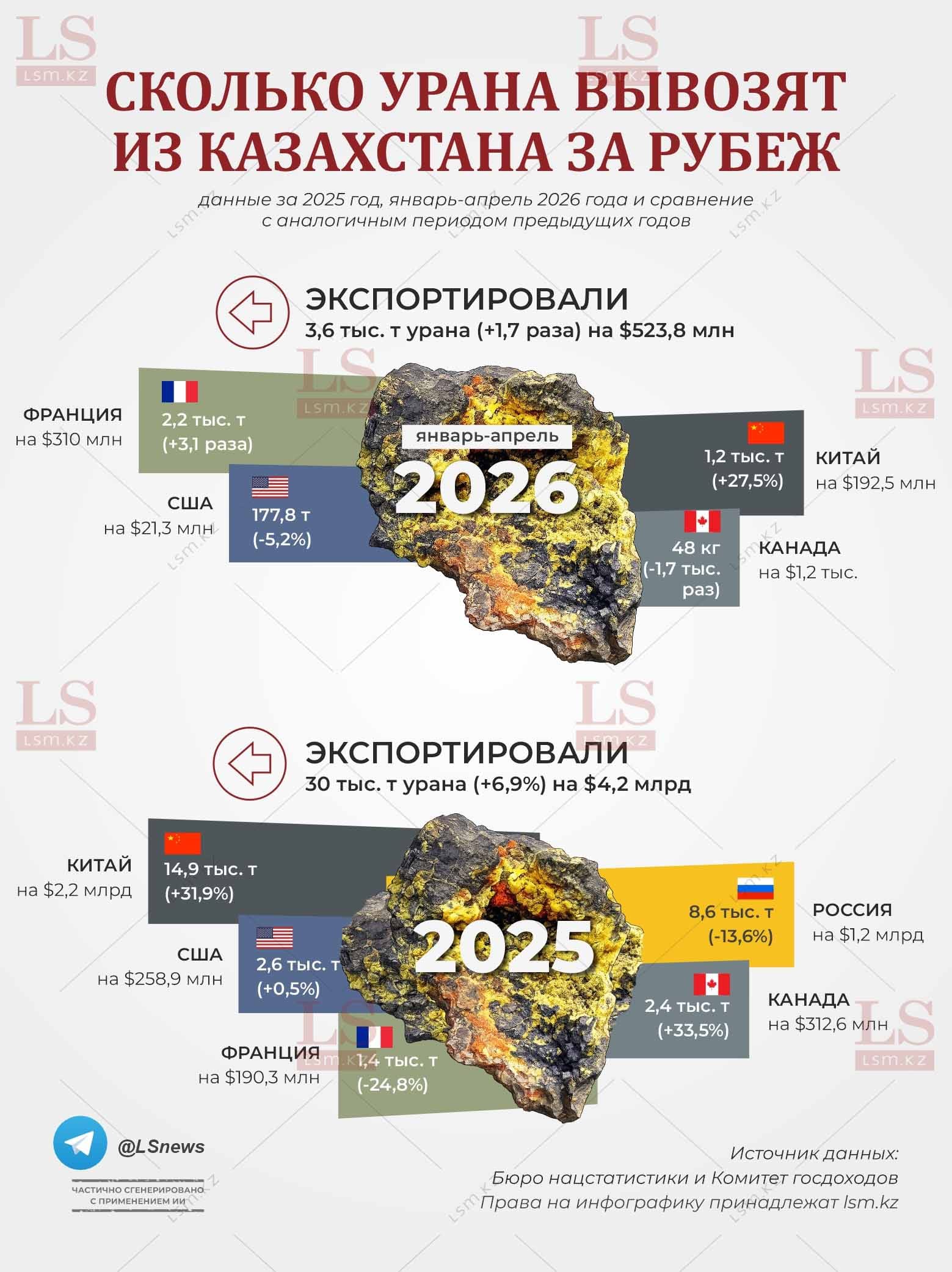
In January–April 2026, Kazakhstan exported 3.6 thousand tons of uranium worth $523.8 million — 1.7 times more than in the same period last year, reports LSM.kz. The main surprise was France: the country tripled its purchases and took first place, displacing the traditional leader — China. Behind these figures lies a global shift in uranium geopolitics: Europe is reorienting its nuclear fuel supply chains.
The gist in brief
- Uranium exports from Kazakhstan for January–April 2026 amounted to 3.6 thousand tons worth $523.8 million — a 1.7-fold increase compared to the same period last year.
- France became the largest buyer: 2.2 thousand tons, a 3.1-fold increase. China came second: 1.2 thousand tons, up 27.5%.
- The US reduced purchases by 5.2% — to 177.8 tons. Canada cut imports by a factor of 1.7 thousand — to 48 kg.
- For the full 2025 year, uranium exports reached 30 thousand tons (+6.9%). China led with 14.9 thousand tons (+31.9%). France and Russia, on the other hand, reduced purchases in 2025.
- The sharp increase in French purchases at the start of 2026 is a direct consequence of European policy to reduce dependence on Russian nuclear fuel.
A 180-degree turn in one quarter
Data for 2025 and the first four months of 2026 look almost opposite — and this is not a statistical anomaly, but a reflection of a geopolitical turning point. In 2025, France was reducing purchases of Kazakh uranium (-24.8%), Russia was doing the same (-13.6%), while China and Canada were aggressively increasing volumes.
In 2026, the picture flipped: France sharply increased purchases — by a factor of 3.1 — and took first place. Canada effectively zeroed out its imports. The explanation is obvious: European countries are accelerating the replacement of Russian uranium and enriched fuel with alternative sources. Kazakhstan — the world's largest producer of natural uranium — finds itself in a winning position.
French nuclear power looks east
France is Europe's largest nuclear energy operator: 56 reactors provide about 70% of domestic electricity generation. The country has historically depended on Russian uranium enrichment — through the company TENEX/Rosatom. Reorienting towards alternative raw material suppliers is part of a broader strategy of decarbonization and energy independence that France has been consistently implementing since 2022.
A threefold increase in purchases of Kazakh uranium in a single quarter demonstrates how quickly the geography of uranium flows can change when political will exists. However, Kazakhstan supplies natural uranium, which then undergoes enrichment — and this is where the question remains: with whom will Europe enrich Kazakh raw materials if not Russia.
Canada: exit or pause
The dramatic drop in Canadian imports — from several tons to 48 kg — requires explanation. Canada itself is a major uranium producer (Cameco is one of the global mining leaders), so its need for Kazakh raw materials is situational. The sharp decline in early 2026 is most likely related to logistical and contractual cycles, rather than a structural exit from the market. Significantly, in 2025, Canada, on the contrary, increased purchases by 33.5%.
China's stability as a strategic benchmark
Against the backdrop of turbulence in other directions, China demonstrates steady growth: +27.5% for January–April 2026 following +31.9% for the full 2025 year. The PRC continues its massive construction of nuclear power plants — with plans for more than 100 new reactors by 2035 — and is systematically increasing uranium purchases from reliable partners. Kazakhstan, linked to China through long-standing joint ventures in uranium mining, remains a key supplier.
Context: Kazakhstan between two poles of demand
The situation Kazakhstan finds itself in is unique: two of the world's largest consumers of nuclear energy — China and Europe — are simultaneously increasing demand for Kazakh uranium, driven by diametrically opposed geopolitical logic. China, for reasons of diversification and growth of its nuclear program. Europe, for reasons of abandoning Russian supplies.
This creates a rare negotiating position for Kazakhstan: the country is in demand from both sides at once, providing an opportunity not just to sell raw materials, but also to set conditions — regarding localization of processing, joint ventures in enrichment, and technology transfer. It is in this context that Kazakhstan's recent entry into Pax Silica with its focus on critical mineral processing takes on practical significance.
Author's conclusion
France's rise to first place among buyers of Kazakh uranium is not trade statistics, but a geopolitical indicator. Europe is reorienting its uranium supply chains, and Kazakhstan is at the center of this shift. The question is no longer whether demand will exist — it does and is growing. The question is whether the country can convert its position as the largest supplier of natural uranium into a position as a participant in higher value-added stages: enrichment, fuel pellets, reactor components. The raw materials window is open. The technological window is only just beginning to open.
Comments ()