From cancer drugs to blue topazes — what Kazakhstan's Institute of Nuclear Physics earns on
How a nuclear physics institute is gradually moving from state funding to self-sufficiency.
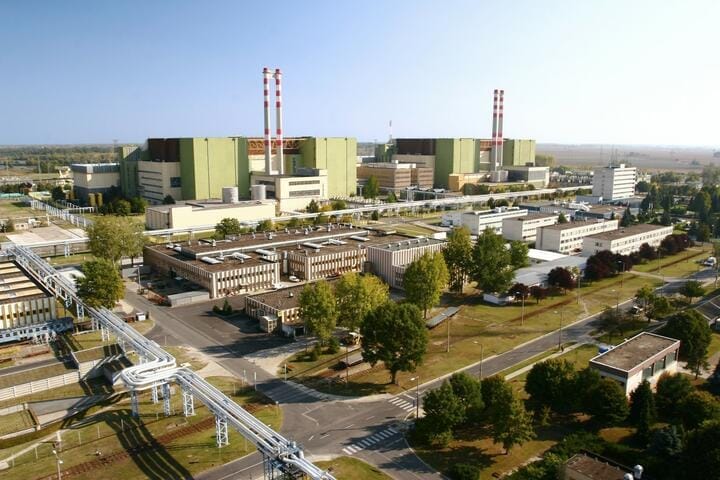
The reactor near Almaty will turn 60 next year, and outwardly it looks as though it belongs in a museum. But it is precisely around this Soviet-era facility that a modern commercial production has grown — from cancer-treatment drugs to blue topazes and the examination of the hair of the Romanov family. Forbes.kz published a detailed report on the activities of this unique institute.
The gist in brief
- The 60-year-old VVR-K reactor of the Institute of Nuclear Physics (INP) near Almaty does not generate electricity, but it provides the institute with growing commercial revenue — over the past four years, output has increased 5–5.5 times.
- The share of self-earned funds has grown from 20% four years ago to 35–45% today; the institute's tax payments over five years have more than tripled — from 188.1 million to 648.5 million tenge.
- The institute is the only GMP-certified manufacturer of radiopharmaceuticals in Kazakhstan, covering 85–90% of the domestic market; a separate export product is high-purity cobalt-57, which is purchased by Russia's RITVERC, France's Orano, and Germany's Eckert & Ziegler.
- Beyond medicine, the institute also earns from unexpected areas — the radiation "coloring" of topazes (up to 900 kg per year), archaeological examinations, and hydrogel dressings for treating burns.
From state funding to self-sufficiency
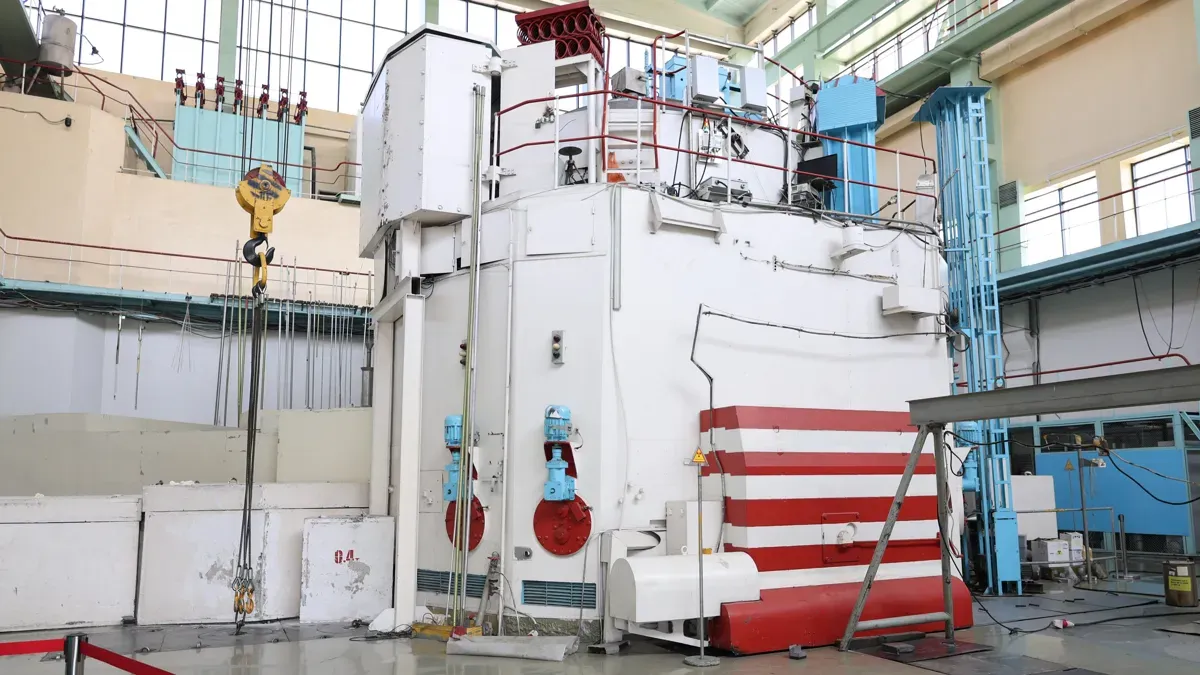
The INP's Director General Sayabek Sakhiyev outlined the trajectory briefly: the institute is gradually moving "toward financial independence." Just four years ago, the ratio was roughly 80% state funding to 20% own revenue — today the state provides 50–60%, while the institute earns 35–45% on its own, including individual projects financed by the IAEA. The VVR-K reactor itself is fundamentally different from nuclear power plant units: its current capacity is 6 MW (reduced from 10 MW in 2016 after switching to less enriched fuel), whereas one modern nuclear power unit generates from 1,000 to 1,700 MW, and two units of 1,200 MW each are planned for the future Kazakh plant.
Medicine against cancer — the main source of income
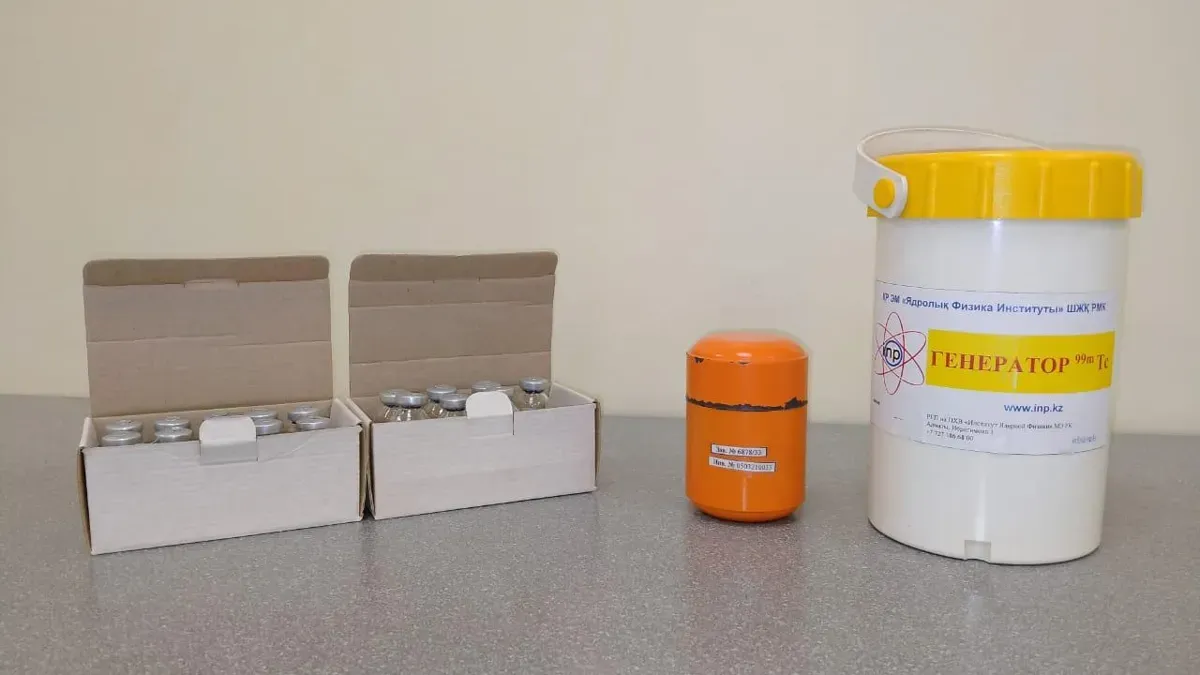
The main commercial flow comes from radiopharmaceuticals. Sodium iodide based on iodine-131 is used for treating thyroid diseases — in 2025, the drug was produced for approximately 900 procedures. Technetium-99/molybdenum-99 generators for diagnosing heart disease provided about 3,000 procedures. Both drugs cover 90% of the Kazakh market, and since 2023 the institute has been supplying them to Bishkek while negotiating with China. The most in-demand product is fluorine-18 (FDG) for early cancer diagnosis, produced on a Cyclone-30 cyclotron and requiring extremely complex logistics due to a shelf life of only about 10 hours. Andrey Gurin, deputy head of the Scientific and Technical Center of Radiochemistry, explained the specifics of delivery: after receiving the solution, "only a couple of hours remain for using the drug," and after that time the residual activity becomes too weak for a quality image. Air transport of FDG became possible only in 2024 thanks to an agreement with Air Astana, and this year the institute plans its first delivery to Kyrgyzstan.
Export cobalt and other isotopes
In addition to medical drugs, the institute produces industrial radioisotopes — iridium-192 for inspecting welded joints in the oil and gas industry and antimony-124 for mineral exploration. But the most notable export product has become cobalt-57: the state allocated 266.3 million tenge for launching production, the institute added another 107.64 million, and in 2025 exports of the isotope amounted to about 200 million tenge. The institute is among the leading suppliers of high-purity cobalt-57 for the medical market of Europe and the CIS — currently about 5 curies per year are exported, with a production base of 10 curies and a potential of up to 30 curies, although scaling up volumes is still difficult: the same cyclotron is simultaneously needed for the higher-priority production of FDG.
Unexpected side directions
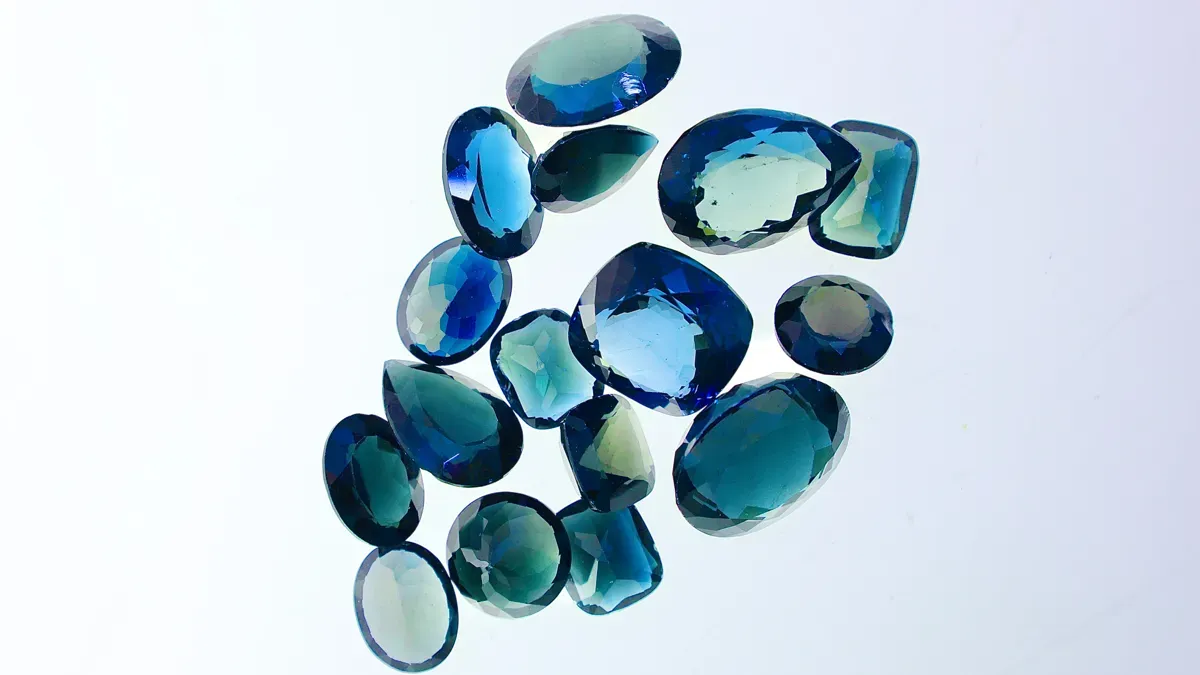
Some of the institute's commercial activities seem at first glance only weakly associated with nuclear physics. Every year, the INP irradiates up to 900 kg of natural topazes, turning them into stones of a rich dark blue shade known as London Blue. Nuclear physics analysis methods are also used in archaeology — the institute examined hair samples of members of the Romanov royal family brought from Russia to test the poisoning theory, passing the results on to Russian historians. A separate direction is Aqua dress hydrogel dressings for treating burns and wounds, which have received two Eurasian patents; production capacity is designed for a million dressings per year, but sales remain modest — about 10,000 units.
Training personnel for the future nuclear power plant
As construction of Kazakhstan's first nuclear power plant approaches, the institute sees growing demand for non-destructive testing — diagnostics of welded joints and equipment without shutting it down. Deputy Director for Production Yevgeny Yermakov explained the significance of this area: the quality of welding and the ability to verify it without destroying the structure become a safety issue for the future plant with kilometers of pipelines and equipment operating at high temperatures and pressure. The institute estimates the volume of such testing for a nuclear power plant at approximately 5% of the cost of the plant itself. At the same time, the INP trains personnel on a critical assembly from 1972 — a training reactor with a capacity of just 100 W, where future specialists can safely experiment with controlling the reactor core. In recent years, the institute has trained more than 5,000 specialists from Kazakhstan and other countries, and the INP's own staff has grown by almost 100 people in two years — about 30% of new employees are under 35.
Connection to the already familiar nuclear cluster
The history of the INP fits logically into Kazakhstan's nuclear landscape, which we have examined from various angles. The institute already today produces and sells products of deep technological processing of radioactive materials — a direction conceptually close to what we wrote about with regard to the IAEA Low-Enriched Uranium Bank in Ust-Kamenogorsk: in both cases, Kazakhstan acts not merely as a raw material extractor but as a technologically mature participant in international nuclear infrastructure. The institute also trains specialists for an industry that is simultaneously expanding in Kurchatov, where a new power plant is being built to supply the scientific center, including the experimental KTM thermonuclear tokamak — both facilities form the same personnel and scientific contour of Kazakhstan's future nuclear energy industry.
Author's conclusion
The history of the INP shows that commercialization of scientific infrastructure of Soviet origin is not a quick process, but a вполне feasible one: the institute has gradually increased its own revenue and reduced dependence on the budget, without abandoning its fundamental scientific mission. Plans for lutetium-177 and especially actinium-225, valued at up to $80 million per gram, show that the institute's leadership is betting on further movement toward the highest-margin niches of global nuclear medicine, rather than merely maintaining already-developed areas.

Comments ()