German Economy Ministry has explored returning coal plants in case of gas shortage
Germany's Economy Ministry has drafted an emergency law to temporarily return old coal plants from the grid reserve to the regular power market.
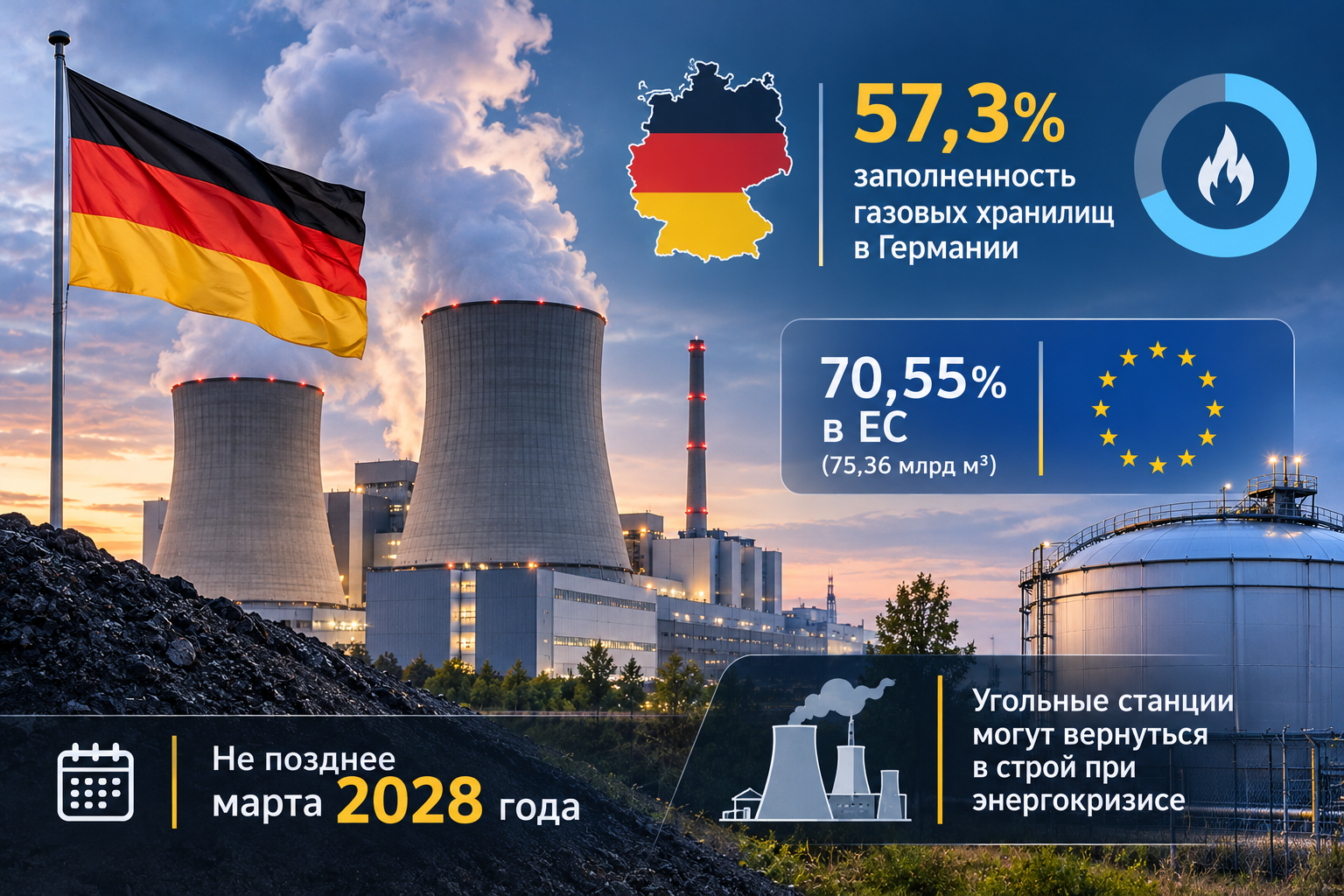
The goal is to save gas and lower electricity prices amid the risk of a gas shortage in winter, writes Der Tagesspiegel. According to Gas Infrastructure Europe, as of November 15, EU gas storage facilities are 70.55% full, and in Germany 57.3%.
The gist in brief
- The Ministry of Economics under Katherina Reiche has prepared a draft emergency law but has not yet decided whether to launch the legislative process.
- Old plants from the grid reserve could operate on the market no later than the end of March 2028.
- EU storage fullness as of November 15 was 70.55% (75.36 billion cubic meters), in Germany 57.3%.
- The idea is criticized by lawmakers from the Greens and the SPD.
What the ministry proposes
According to Tagesspiegel, the plants would be returned to the market only after the Ministry of Economics declares an emergency. Operators would have to keep fuel and personnel on standby, their costs would be reimbursed and then passed on to electricity consumers through grid fees. The ministry has not yet decided whether to launch the legislative process.
What the critics say
Green Party lawmaker Michael Kellner compared the idea to skiing in summer: the reserve is needed for absolute emergencies, not for market intervention, and the plan could crowd energy storage out of the market. Deputy head of the SPD parliamentary group Armand Zorn said questions about compliance with EU law and climate protection remain unresolved.
What about EU gas reserves
As reported by Neftegaz.ru citing Gas Infrastructure Europe data, as of November 15 EU storage facilities are 70.55% full, which is 75.36 billion cubic meters of gas. EU countries began withdrawing from storage on October 28 at a fullness of 74.96% (80.1 billion cubic meters); since then 4.74 billion cubic meters have been withdrawn, or 9.4% of the volume injected for winter. The average daily withdrawal is about 249.5 million cubic meters, and fullness is declining by roughly 0.21 percentage points per day.
There is wide variation across countries: in Germany storage is 57.3% full, in Austria 63.08%, in France 77.01%, in Italy 87.28%. All countries are withdrawing except Denmark and Belgium, where injection continues, while in Sweden, Portugal and Latvia the dynamics are zero. We previously reported, citing data, that Europe's storage facilities are fuller than at any time in 18 years.
What is happening with gas in the world, Kazakhstan and Central Asia
Global gas demand in 2025 reached a record 4.2 trillion cubic meters, and China is turning from the largest LNG buyer into a competing gas seller. Gas consumption in the five Central Asian countries in 2025 reached 119.6 billion cubic meters, 76% more than in 2015, while the region's exports nearly halved, from 89.6 to 47.4 billion cubic meters. In Kazakhstan, a gas processing plant at Karachaganak will be built by a consortium with Hyundai Engineering. In Kyrgyzstan, Kyrgyzneftegaz found gas at Mailuu-Suu-4 with a flow rate of over 40 thousand cubic meters per day, and in Uzbekistan the volume of seismic exploration grew fivefold, and five gas fields were discovered.
Author's conclusion
The German initiative remains a draft for now: the ministry has not yet decided whether to launch the legislative process, and an emergency must be declared before the plants are returned to the market. But the combination of figures shows where the risk lies: in Germany storage is 57.3% full, noticeably lower than in France and Italy, and withdrawal across the EU is ongoing every day. Whether gas will last until spring can be judged by storage fullness at the end of winter and by whether an emergency is declared.
Comments ()