Solar panels are needed by residents of Tajik villages, but many families cannot afford them
Solar panels, dryers and water heaters help rural families in Tajikistan cope with power outages, but not everyone can afford them.
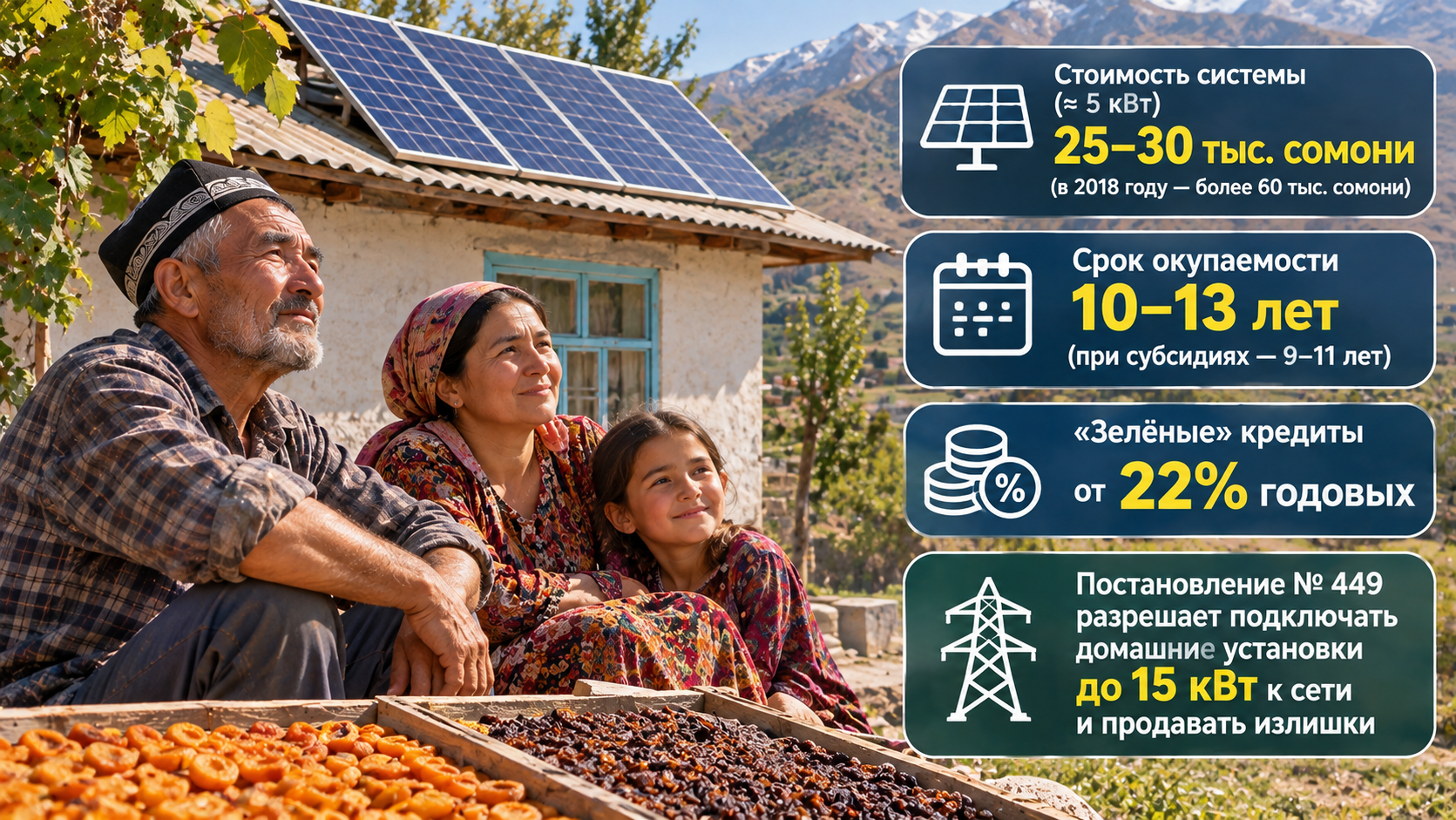
A system with a capacity of about 5 kilowatts currently costs 25-30 thousand somoni; according to calculations by scientists at the National Academy of Sciences of Tajikistan, a home system pays for itself in 10-13 years. Government resolution No. 449 of July 1, 2026 simplified the connection of such installations to the grid, but the issue of price remains open, writes Asia-Plus.
The essence in brief
- A system with a capacity of about 5 kilowatts cost more than 60 thousand somoni in 2018; now similar ones cost 25-30 thousand somoni.
- The payback period for a home system, according to scientists' calculations, is 10-13 years; with subsidies, tariff increases and sales of surplus, it could shrink to 9-11 years.
- "Green" loans for equipment are issued at 22% per annum, and such rates can negate the savings on electricity.
- Resolution No. 449 permits connecting home installations of up to 15 kilowatts to the grid and selling surplus electricity.
Why panels are needed in rural areas
In rural Tajikistan, power outages are regular, and solar installations become a way for many families to cope with them. Failures can be larger in scale too: on August 14, 2026, electricity was cut off for several hours in four countries of the region at once - Kazakhstan, Kyrgyzstan, Tajikistan and Uzbekistan, and in Tajikistan the failure affected Dushanbe. According to the Institute of Water Problems, Hydropower and Ecology of the National Academy of Sciences of Tajikistan, the country has about 260-300 sunny days a year and from 2,500 to 3,100 hours of sunshine per year. Yuri Skochilov, director of the Youth Environmental Center, says that renewable energy in Tajikistan has "enormous potential" and names the main barriers as the high purchase cost and weak service infrastructure: installation, maintenance and repair.
What panels give families
In the village of Labijoy of the Karatag jamoat (Tursunzade), women in 2024 at a practical workshop conducted by the "Little Earth" organization built four solar dryers with their own hands. Now rosehips are dried in three days instead of about a month, which helps sell dried apples and rosehips. The dryers appeared through the environmental organization "Little Earth" with support from the Global Green Grants Fund. The same family's panels provide light and charge phones, but a washing machine cannot be run from them.
In Hissar, a family received solar panels, a 150-liter water heater and a solar stove from the Youth Environmental Center: they have a stable supply of hot water and part of their electricity. In the Dusti district of Khatlon region, panels power lighting, a TV, a refrigerator and phone charging, and during outages neighbors come to the family to charge their phones.
How much this costs
A system with a capacity of about 5 kilowatts cost more than 60 thousand somoni in 2018; now similar ones cost 25-30 thousand somoni. Home systems, depending on capacity and batteries, cost 1,500-2,500 US dollars.
For many this is expensive. In the village of Shaikhmuzaf far (Tursunzade), a family depends on a gasoline generator because the power is often cut off: because of this, two or three batches of eggs were lost in the incubator. A small kit consisting of a panel, battery and inverter for the incubator costs about 5 thousand somoni, while the homeowner's monthly salary is about 4 thousand somoni, so he could not buy it.
When panels pay for themselves
The calculation by the Institute of Water Problems, Hydropower and Ecology of the National Academy of Sciences of Tajikistan (2025) for a household is based on a system cost of 1,500-2,500 US dollars, annual generation of 2,500-3,000 kilowatt-hours and a tariff of about 4 cents per kilowatt-hour. Annual savings in this case amount to 100-120 US dollars, the payback period in the model table is stated as 10-13 years, and the panel service life is up to 25-30 years.
In a separate example for a system costing 2 thousand US dollars with savings of 120 US dollars per year, the payback is about 16.7 years. With government subsidies of up to 30%, tariff increases and sales of surplus to the grid, the period, according to the authors' calculation, could shrink to 9-11 years.
What banks and microfinance organizations offer
The microfinance organization "Azizi Moliya" issues "Green Leaf" green loans for solar equipment at 22% per annum for a term of up to three years. The microcredit fund "MicroInvest" offers green loans from 22% for new clients and about 20% for repeat clients, for a term of up to four years. At such rates, as noted in the material, a loan can negate the savings on electricity. British researchers proposed a "solar bonds" scheme for Europe under which home panels costing from 7,000 to 30,000 euros can be installed without a loan and large savings: the costs are repaid over 25 years through electricity bills.
What the government resolution changed
The Tajik government approved the rules for connecting renewable installations to the grid by resolution No. 449 of July 1, 2026; the Ministry of Energy and Water Resources published them on July 9. Installations are divided into four categories: micro (up to 15 kilowatts), small (from 15 to 100 kilowatts), medium (from 100 kilowatts to 1 megawatt) and large (more than 1 megawatt).
For home systems up to 15 kilowatts, an application is reviewed within 10 working days. Those who use the energy only for themselves need only notify the grid organization; those who want to sell surplus need technical specifications. Connection is free if it is technically and economically feasible in the existing grid; the two-way meter is installed by the supplier. Surplus is sold to the grid through a single buyer. The question of whether ordinary rural residents will be able to take advantage of these rules while equipment remains unaffordable remains open.
What technical limitations home systems have
The company "Nerui Oftob", which works in solar energy, explains: grid-connected systems shut down during outages. To have electricity during a failure, autonomous or hybrid systems with batteries are needed; batteries remain the most expensive component. Equipment is selected for the actual consumption of a home, restaurant or farm: incorrect calculation increases costs. Batteries may need to be replaced over the system's service life.
How solar energy is developing in Central Asia
In Tajikistan itself, in Isfara in the north of the country, a 3-megawatt station with a 500 kilowatt-hour storage unit was built with a grant from the South Korean government: at its design capacity it can supply up to a thousand households. In Dushanbe on October 20, at a session of the majlis of people's deputies, officials were instructed to work out the installation of solar panels at all enterprises in the city: previously such requirements were introduced for new apartment buildings, universities and schools.
In Uzbekistan, the "Solar Home" program since April 1, 2023 has paid 1,000 sum per kilowatt-hour for surplus that systems up to 50 kilowatts feed into the grid. For January-September 2026, 642.1 billion sum were paid out from the budget to 70.7 thousand residents, and in the first half of the year payments grew ninefold compared with the same period last year. To enable the grid to accept more renewable energy, the World Bank approved 100 million US dollars for the modernization of 60 substations: together with 200 million US dollars from the Asian Development Bank and 71 million US dollars from the budget, the program will total 371 million US dollars.
In Kazakhstan, according to Ember, in 2025 fossil fuels produced about 85% of electricity, with wind and solar together about 6%. By August the country had launched seven of ten renewable energy facilities planned for 2026 with a capacity of 212 megawatts out of 245 planned. The law on energy storage systems, as confirmed at the Go Net Zero summit on September 11 by Turar Alimzhan, director of the Department for Renewable Energy Sources of the Ministry of Energy, is under consideration.
Author's conclusion
Solar installations in Tajik villages are already working: dryers, water heaters and panels solve specific family tasks. But this will become widespread only when the gap between the price of equipment and family income shrinks: at a tariff of about 4 cents per kilowatt-hour, a system, according to scientists' calculations, pays for itself in 10-13 years, and loans start at 22% per annum. Resolution No. 449 removed some barriers to grid connection, and the result can be judged by whether equipment becomes more affordable and whether loans on favorable terms appear.

Comments ()