Germans hang solar panels on balconies and plug them into the socket
Germany has devised perhaps the world's simplest way to get your own solar power — no roof, no installers, no permits, no ladders.
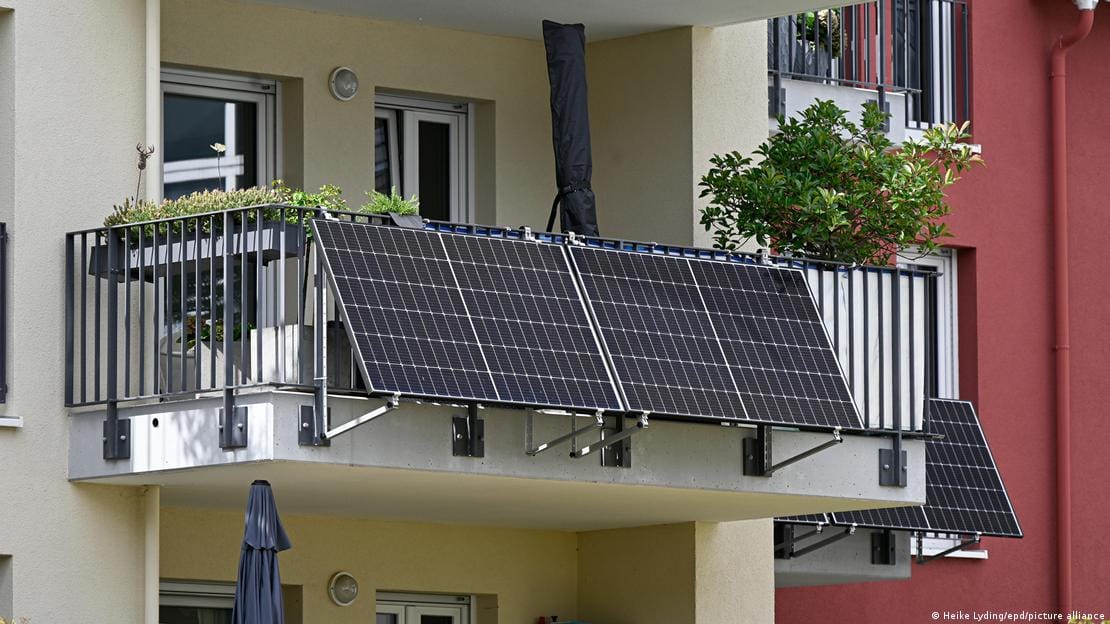
The panel simply attaches to the balcony railing and plugs into a regular socket, like a kettle, writes SPACE DAILY.
The gist in brief
- "Balcony power plants" (Balkonkraftwerk) are sold in German supermarkets for around €500: one or two panels are attached to the balcony railing, connected to an inverter the size of a microwave, and plugged into a socket — from that moment, sunlight begins flowing into the apartment in reverse through an ordinary socket.
- By mid-2025, the country's official registry recorded more than 1 million such installations, and by independent estimates, several times more have been sold.
- The law limits the capacity of each installation to 800 watts at the inverter — enough for roughly a refrigerator and a laptop; the panel itself can be more powerful (up to 2000 W peak), but it is the inverter limit that determines the device's legal status.
- After the 2024 Solarpaket reform, connecting a balcony panel requires neither an electrician nor approval from the grid operator — a free online registration taking less than half an hour is enough, and landlords and homeowners' associations are now restricted in their right to refuse tenants installation.
Why the balcony specifically
The boom becomes understandable only through the lens of the German housing market: about 55% of households in Germany rent their homes — the highest share among EU countries — and the roof by default belongs to the landlord. A tenant cannot drill into it, finance it, or take it along when moving. The balcony is the only territory the apartment renter actually controls, and German legislation, rewritten specifically for this, legally equated a plug-in solar panel not with an electrical installation but rather with a household appliance. When moving, the "power plant" is unscrewed from the railing and moves along with the resident.
The economics of it
The arithmetic adds up quickly against the backdrop of some of the highest electricity prices in Europe — around 32–35 cents per kilowatt-hour — as well as zero VAT on equipment and city subsidies of up to €500 in Berlin and Munich. A typical system produces from 600 to 900 kWh per year, cutting a small household's bills by 10–25% and saving around 300 kg of CO₂ annually. The figure itself is modest, but when multiplied by over a million installations and continued growth, the tally already runs into hundreds of megawatts of combined capacity introduced literally within six months. About a quarter of new kits are now sold with small storage units that allow daytime generation to be used in the evening.
Honestly about the nuances
The system also has objective limitations. A panel connected directly to a socket mainly offsets daytime consumption, while surplus flows back into the grid for free — which is precisely why small storage units are spreading. A balcony facing north somewhere in Hamburg remains a poor power plant regardless of how easy it is to connect. But the fundamental feature of the German approach is a deliberate rejection of ambition per unit of capacity: instead of asking "how much energy can be obtained from a building," legislators asked "which system requires permission from literally no one" — and found the answer at the level of 800 watts.
The Kazakh context
The idea of making home solar generation accessible without major investment and bureaucracy is already familiar to hunn.kz readers from several angles. We wrote about the British concept of "solar bonds", which solves a similar problem of high entry costs through long-term financing tied to real estate rather than to the owner. The Uzbek program "Solar Home" at the same time demonstrates an alternative path — direct state subsidies for generation from home panels. The German balcony option offers a third, simplest model — an almost complete absence of bureaucratic barriers instead of financial incentives. For Kazakhstan, where distributed home generation remains extremely limited in coverage compared to industrial renewable energy projects, and a significant portion of the urban population also rents housing, the German approach is interesting precisely for this — not the scale of an individual installation, but the simplicity that removes the need to own a roof or have substantial capital to start. The contrast in the very structure of ownership is also telling: if the German balcony panel belongs directly to the apartment resident, then a significant portion of major Kazakh renewable energy projects, as an NBK investigation showed, is controlled by Chinese state energy holdings — two fundamentally different approaches to who ultimately owns "green" generation.
Author's conclusion
The balcony power plant is not an outstanding engineering solution but an outstanding regulatory one: the authors of the law deliberately sacrificed capacity to eliminate any barriers to entry, and that is precisely what made solar energy accessible to the group of the population — renters — that had historically been excluded from it in almost all countries. The largest structures of the energy transition are gigawatt power plants; the most democratic is the one that plugs into the socket next to the toaster.

Comments ()