Germany builds the world's tallest wind turbine
In eastern Germany, a structure is rising on a former coal mine site—soon taller than the Eiffel Tower. It's not a monument, but a wind turbine.
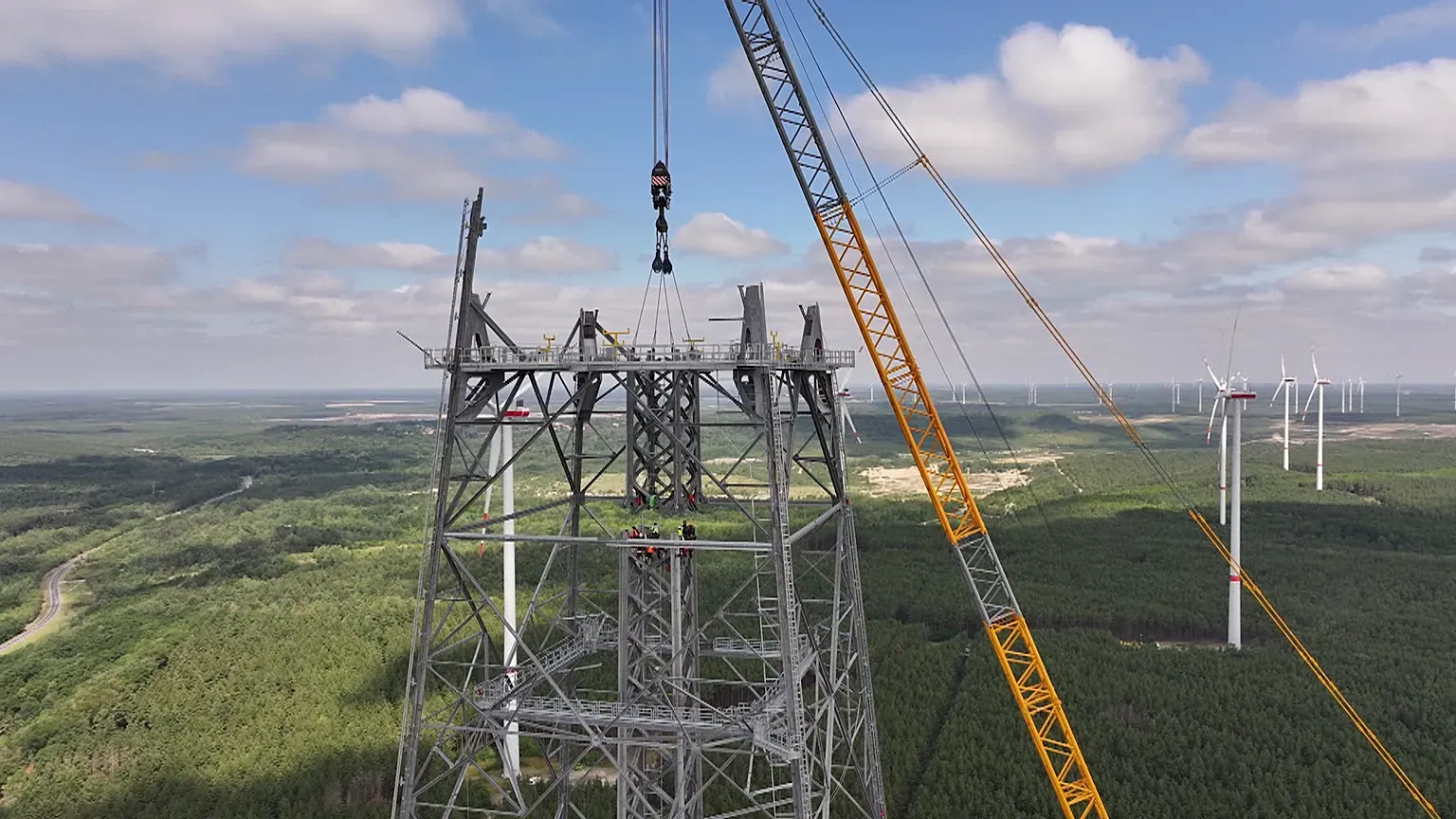
Engineers at GICON are confident that height is not a showy record, but a way to harvest twice as much energy from the same turbine and, in the long run, three times as much energy from the same area of land, EuroNews reports.
The gist in brief
- In the town of Klettwitz in Germany's Lusatia, on the site of a former coal mine, the world's tallest wind turbine is being built, standing 365 meters high — taller than the Eiffel Tower; commissioning is scheduled for autumn 2026.
- According to GICON founder Jochen Grossmann, at greater heights the wind is stronger and more stable — a turbine at such an altitude generates more than twice as much energy as conventional wind turbines standing nearby.
- GICON's concept involves "two-story" wind farms: high-altitude turbines are installed alongside existing standard ones to "harvest" wind at two levels at once and triple output on the same land area.
- The company plans to install 100 high-altitude turbines by the early 2030s, then scale that number up to 1000; upgrading existing German wind farms alone could accommodate another 4000 such installations.
Why height yields more energy
The physics behind GICON's idea is fairly intuitive: the higher above the ground, the stronger and more stable the wind, since friction with the ground surface and the associated turbulence are noticeably weaker at altitude. Grossmann explained the principle to a Euronews correspondent right at the construction site, while a team of high-altitude riggers climbed up and down the structure's steel trusses: this is precisely why modern wind turbines keep growing taller — up there, there is enough wind to generate more than twice as much energy compared with turbines standing at conventional heights around them.
The "two-story" wind farm concept
The most interesting part of GICON's concept is not the record height itself, but how the company proposes integrating high-altitude turbines into existing infrastructure. Instead of building wind farms from scratch, Grossmann proposes retrofitting already operational sites with taller turbines installed alongside conventional ones — effectively creating two levels of generation on the same land area, which could triple total output without expanding the territory occupied. It is this aspect — land-use efficiency, not just height per se — that makes GICON's approach potentially applicable far beyond Germany: according to Grossmann, countries in Africa and Asia, including China, have already shown interest in the technology.
Why this matters for Kazakhstan
The idea of increasing a wind farm's output without expanding the land it occupies resonates with a challenge that Kazakhstan will inevitably face sooner or later as its own wind generation grows. The country is already implementing large-scale projects such as the 1 GW wind farm being built in the Zhambyl region with the participation of the UAE's Masdar — and as similar projects multiply across the Kazakh steppe, the question of land-use efficiency per unit of installed capacity will become just as relevant as the energy output of the turbines themselves. A technology like GICON's "two-story" wind farms, if it proves economically viable at the German site, could in the long run become an interesting reference point for regions where significant land areas have already been allocated for wind generation.
Author's conclusion
The project in Klettwitz is a telling example of how symbolism (a turbine taller than the Eiffel Tower) and practical engineering logic (more efficient land use and more stable wind at altitude) can coincide in a single structure. For now, this is just one pilot installation on the site of a former coal mine, but the company's ambitions — from 100 to 1,000 turbines by the next decade — show that German engineers view high-altitude wind generation not as a one-off experiment, but as the foundation for a new generation of wind farms potentially of interest beyond Europe as well.
Comments ()