Germany presents roadmap for phasing out fossil fuels by 2045
Europe's largest economy has officially set the date by which it expects to fully phase out coal, oil and gas.
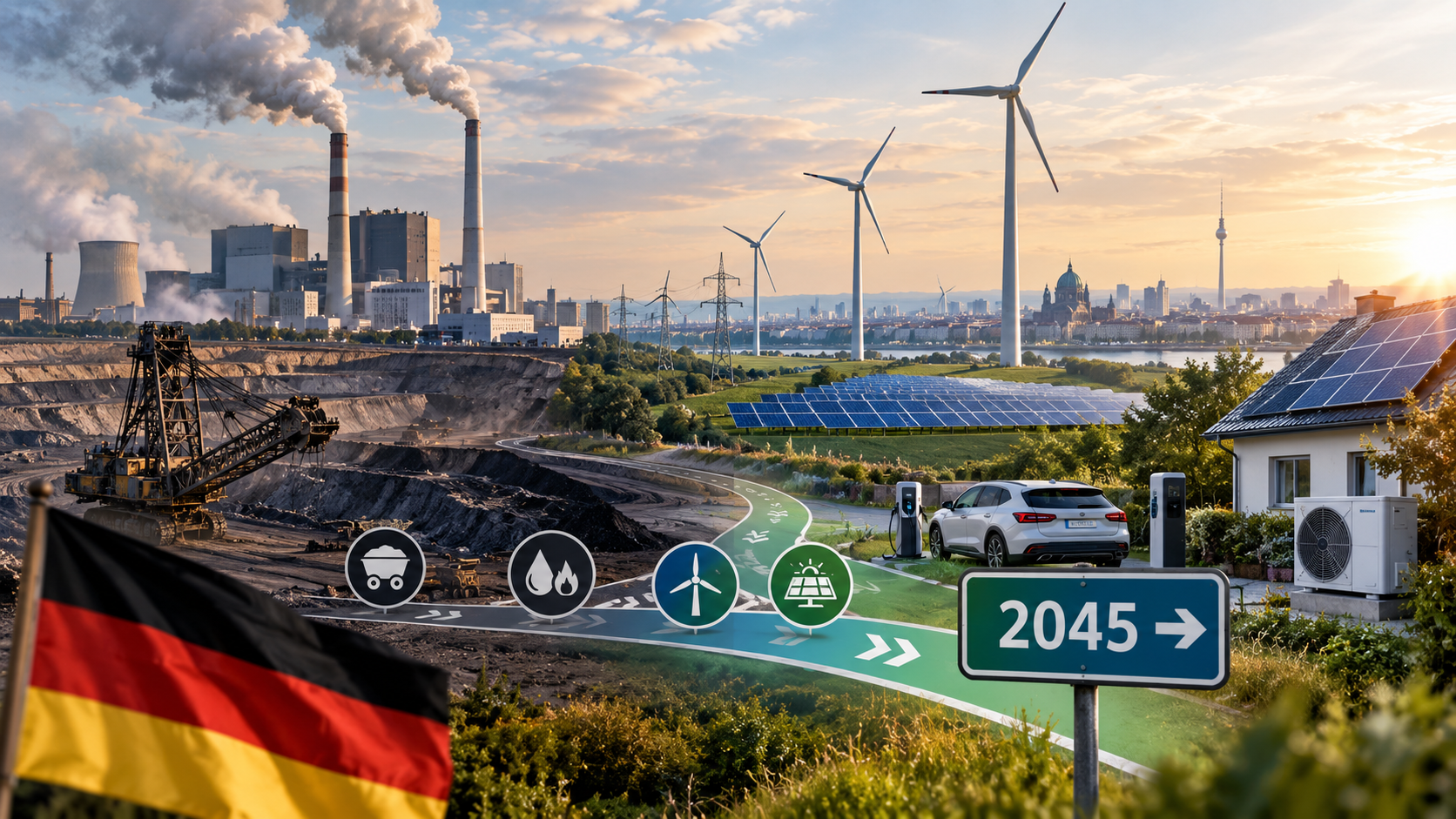
But even experts who welcome the very fact that such a document has appeared consider the stated goals insufficiently ambitious.
The gist in brief
• Germany has presented a national roadmap for a complete phase-out of fossil fuels by 2045, becoming the third country in Europe to do so after France and the Netherlands.
- The document appeared after the UN Secretary-General's Climate Summit, where António Guterres called on all governments to adopt official national fossil fuel phase-out plans with timelines aligned with the Paris Agreement.
- At the COP30 talks in Belém, more than 90 countries supported the idea of such a roadmap for every state, but all mentions of it were removed from the final agreement in the last hours of the summit after a blockade by several major oil-producing countries.
- France made a less ambitious commitment — to phase out fossil fuels by 2050, while the country's last two coal-fired power plants are to close as early as 2027; the Netherlands' plan sets no mandatory end date at all.
What exactly Germany is planning
The country intends to focus on expanding renewable energy capacity and the wider adoption of electric vehicles, as well as to use the European Union's carbon emissions trading mechanisms to gradually push out industrial sources of pollution.
Germany's Environment Minister Carsten Schneider linked the urgency of the transition to the general climate and geopolitical instability of recent years: "It is not only extreme weather events around the world that demonstrate how urgently we need to do more."
"The roadmap is only the starting line"
Former German Special Representative for Climate Jennifer Morgan broadly welcomed the appearance of the document, noting that accelerating the transition from coal, oil and gas to renewable energy sources could strengthen the country's energy independence. But she also emphasized: the roadmap itself is only a starting point, and for a real result the strategy must be backed by a faster and more targeted phase-out of fossil fuels coupled with a large-scale shift to green electricity. Executive Director of the think tank Strategic Perspectives Linda Kalcher drew attention to the symbolic significance of the moment: three economies that together account for about 46% of the European Union's GDP — Germany, France and the Netherlands — are now simultaneously charting their own paths to phasing out fossil fuels, which in itself serves as a powerful signal for the rest of Europe.
Criticism from the other side
Not all assessments are so favorable. A representative of Oil Change International, Laurie van der Burg acknowledges that Germany deserves some credit for its very commitment to phasing out fossil fuels, but believes that the country's government's efforts to present itself as a climate leader do not match the scale of the crisis and its responsibility as one of the wealthiest countries with a long history of accumulated emissions. Kalcher makes a similar caveat — in her view, the goals stated in the roadmaps of France, the Netherlands and Germany are still insufficient to seriously strengthen energy security by reducing dependence on unstable fossil fuel imports.
Part of a broader European picture
The German roadmap logically continues a theme we recently examined — a Danfoss report on how Europe annually wastes huge amounts of already-produced energy in the form of waste heat, and on the need for a far more systemic approach to energy efficiency in general. Both storylines — both the phase-out of fossil fuels and the fuller use of already-generated energy — reflect the same logic: Europe's energy transition is increasingly becoming a matter not only of replacing generation sources, but also of far more rational handling of energy at every stage of its production and consumption.
Author's conclusion
The appearance of three national roadmaps at once from Europe's largest economies is a noticeable shift compared with the situation a year ago, when specific commitments on fossil fuel phase-out timelines remained rare even among countries that publicly support the climate agenda. But the unanimous assessment of the experts surveyed — that even these documents are not ambitious enough — shows that the distance between political statements and the pace actually required to meet climate goals remains significant, regardless of which country names a specific date for phasing out coal, oil and gas.
Comments ()