Green energy corridor Caspian — Europe moves from plans to implementation
The "Green Energy Corridor Caspian Sea – Black Sea – Europe" project completed its feasibility study and officially moved to the implementation phase.
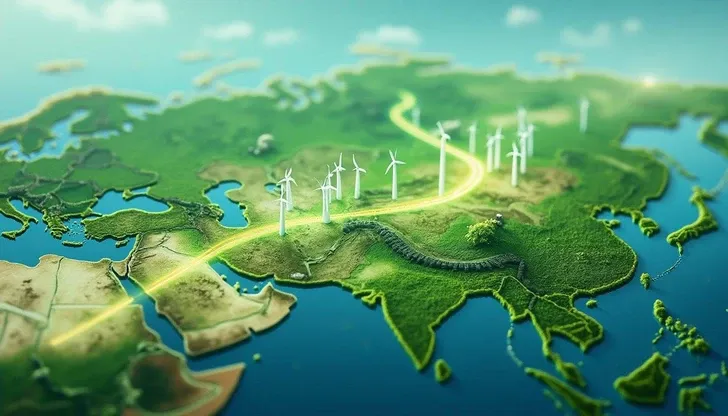
The decision was made at the 12th meeting of the Project Steering Committee, reports the Caspian Herald. For Kazakhstan, which has enormous renewable energy potential and is actively building solar and wind facilities, this is a direct signal: the export route for green energy to Europe is no longer just an idea on paper.
The Gist in Brief
- At the 12th meeting of the Steering Committee, the completion of the feasibility study was announced, along with the transition to the development and practical implementation phase of the project.
- Company GECO has been tasked with developing a detailed roadmap leading up to the Final Investment Decision (FID).
- The parties agreed to establish a dialogue between national regulators in the energy sector to strengthen the regulatory framework.
- A joint letter was signed to the EU Energy Commissioner Dan Jørgensen, requesting the inclusion of the corridor in the third list of EU Projects of Mutual Interest and Projects of Common Interest — this opens access to European financing.
- Meeting participants heard the results of the analysis of routes, business models, power system integration, and procurement strategy.
From Words to a Roadmap
The "Green Energy Corridor" project has existed for several years as a political initiative of four states. Its essence is to create infrastructure for transporting "green" electricity generated in the Caspian region, across the Caucasus and the Black Sea to Europe. The participants are: Kazakhstan, Azerbaijan, Georgia, and Romania — the countries through whose territories the route passes.
The fundamental significance of the current meeting is the transition from declarative to operational. The completion of the feasibility study means that the technical parameters, routes, business models, and financing strategy are now fixed in a specific document. The roadmap leading to the Final Investment Decision is the next step, after which fundraising will begin.
European Status as the Key to Financing
The joint letter to EU Commissioner Dan Jørgensen requesting the inclusion of the corridor in the third list of EU Projects of Mutual Interest and Projects of Common Interest is one of the most important outcomes of the meeting. The status of a "Project of Common Interest" opens access to grant financing from European structural funds, accelerates permitting procedures, and increases investment attractiveness in the eyes of private capital. Without this status, the corridor remains a regional initiative. With it, it becomes part of the official EU energy infrastructure.
Kazakhstan Context
For Kazakhstan, this project is of fundamental strategic importance. The country is actively increasing its renewable energy capacity: the Masdar wind farm in the Zhambyl region with a capacity of 1 GW is under construction, and auction projects for solar and wind generation are being implemented across the country. By 2030, Kazakhstan intends to increase the share of renewable energy to 15% of its energy balance — and with proper planning, part of this generation can be oriented towards export.
The Caspian-Europe corridor is the only realistic route for such exports: overland power lines through Russia are politically blocked, and direct submarine cables bypassing the Caspian route do not exist. The inclusion of the corridor in the European list of projects means that Kazakhstan gains an institutional path to the European electricity market — with its stable prices and growing demand for renewable generation.
Author's Conclusion
The transition of the "Green Energy Corridor" to the practical implementation phase is a moment that can easily be underestimated against the backdrop of the daily news flow. But it is precisely such infrastructure decisions that shape the energy landscape of the region for decades to come. For Kazakhstan, it is now important not only to build renewable energy capacity domestically but also to actively participate in shaping the export infrastructure — while the roadmap is still being drafted, and not approved without Kazakhstan's involvement.
Comments ()