Half of all oil imported worldwide goes to Asia
The 2026 closure of the Strait of Hormuz reminded the world which countries depend most on imported oil.
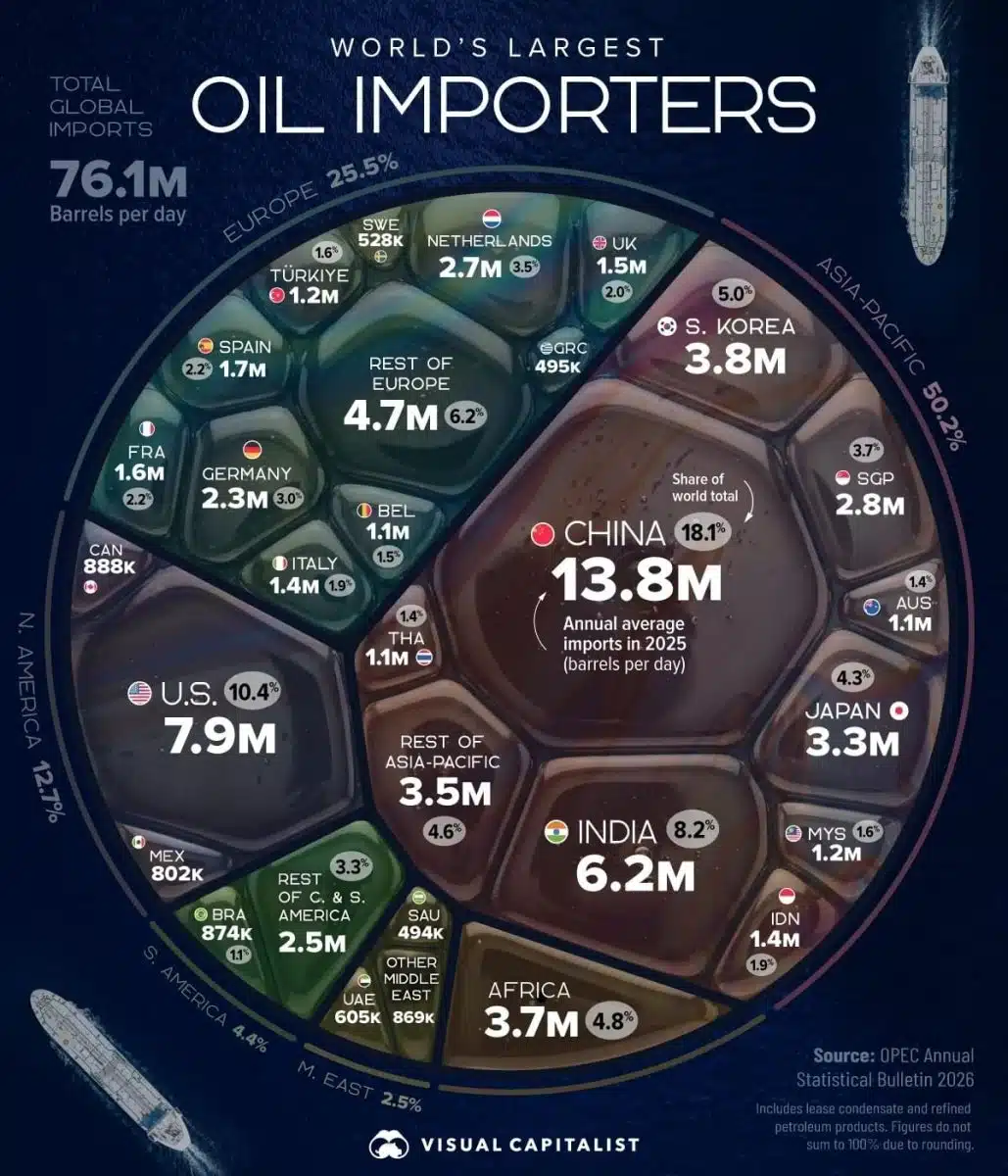
A fresh ranking of the largest buyers, published by NakedScience, shows that vulnerability is distributed extremely unevenly — and Asia bears the brunt of it.
The gist in brief
- According to OPEC's 2026 statistical bulletin, China imported 13.8 million barrels of oil per day in 2025 — nearly twice as much as the second-place United States.
- The top three largest importers are rounded out by India (6.2 million barrels per day), followed by South Korea (3.8 million) and Japan (3.3 million) — together, the top five account for 46% of global import volume.
- Asia-Pacific countries as a whole imported 38.2 million barrels per day — that is 50.1% of the global total, and Asian countries accounted for 89.2% of all crude oil transported through the Strait of Hormuz.
- Japan and South Korea are particularly vulnerable, receiving 77% and 57% of their imported oil from the Middle East, respectively — this significantly limits their ability to quickly find alternative suppliers in the event of disruptions.
Why gross figures distort the picture
The ranking's authors include an important methodological caveat for correctly understanding the data: the figures reflect gross import volume, not net imports minus a country's own exports. This is precisely why such major oil refining and trading hubs as Singapore (2.8 million barrels per day) and the Netherlands (2.7 million) unexpectedly appear near the top of the list — a significant portion of the oil they purchase is re-exported after refining. A similar logic explains the United States' second place: despite its status as a major importer, the country simultaneously exports 10.7 million barrels per day, since many American refineries were originally designed for heavy crude that must be purchased abroad (nearly 57% of U.S. imports come from Canada), while lighter shale oil and surplus fuel are sent for export
Europe is dependent but fragmented
Europe as a whole accounts for about a quarter of global oil imports, but this volume is distributed among many countries with relatively small purchases each — 11 European states are in the top twenty largest importers, led by the Netherlands and Germany (2.3 million barrels per day). It is telling that supply disruptions related to conflicts in the Middle East affect not only Asia: Saudi Aramco warned European buyers about suspending crude oil exports in October after an attack on the East-West pipeline.
Kazakhstan — on the other side of the equation
It is telling that Kazakhstan cannot be found in this ranking — not because the country is insignificant on the global oil market, but because it is on the opposite side of the equation. We have already written that oil remains the main item of Kazakhstani exports, providing over half of the country's total export revenue. Unlike countries dependent on transportation through the Strait of Hormuz, Kazakhstani oil mainly moves along other routes — primarily through the Caspian Pipeline Consortium toward Novorossiysk — which structurally reduces the direct vulnerability of Kazakhstani exports to disruptions in that specific strait, although it does not free the country from dependence on other transit routes and partners.
Author's conclusion
The ranking of the largest oil importers illustrates well the basic principle of energy geopolitics: physical dependence on a specific supply route — whether the Strait of Hormuz for Asian countries or a particular pipeline for Europe — creates vulnerability regardless of the total volume of oil purchased. For exporting countries like Kazakhstan, the same principle works in reverse: resilience is determined not only by production volume but also by the diversification of one's own export routes, which makes the issue of transport infrastructure just as significant for an oil-producing country as for the world's largest importers.


Comments ()