How the global food market works — ranking of the 40 most valuable products
Fresh Visual Capitalist infographic ranks not countries but products — the 40 most valuable food commodities by gross production value in 2024.
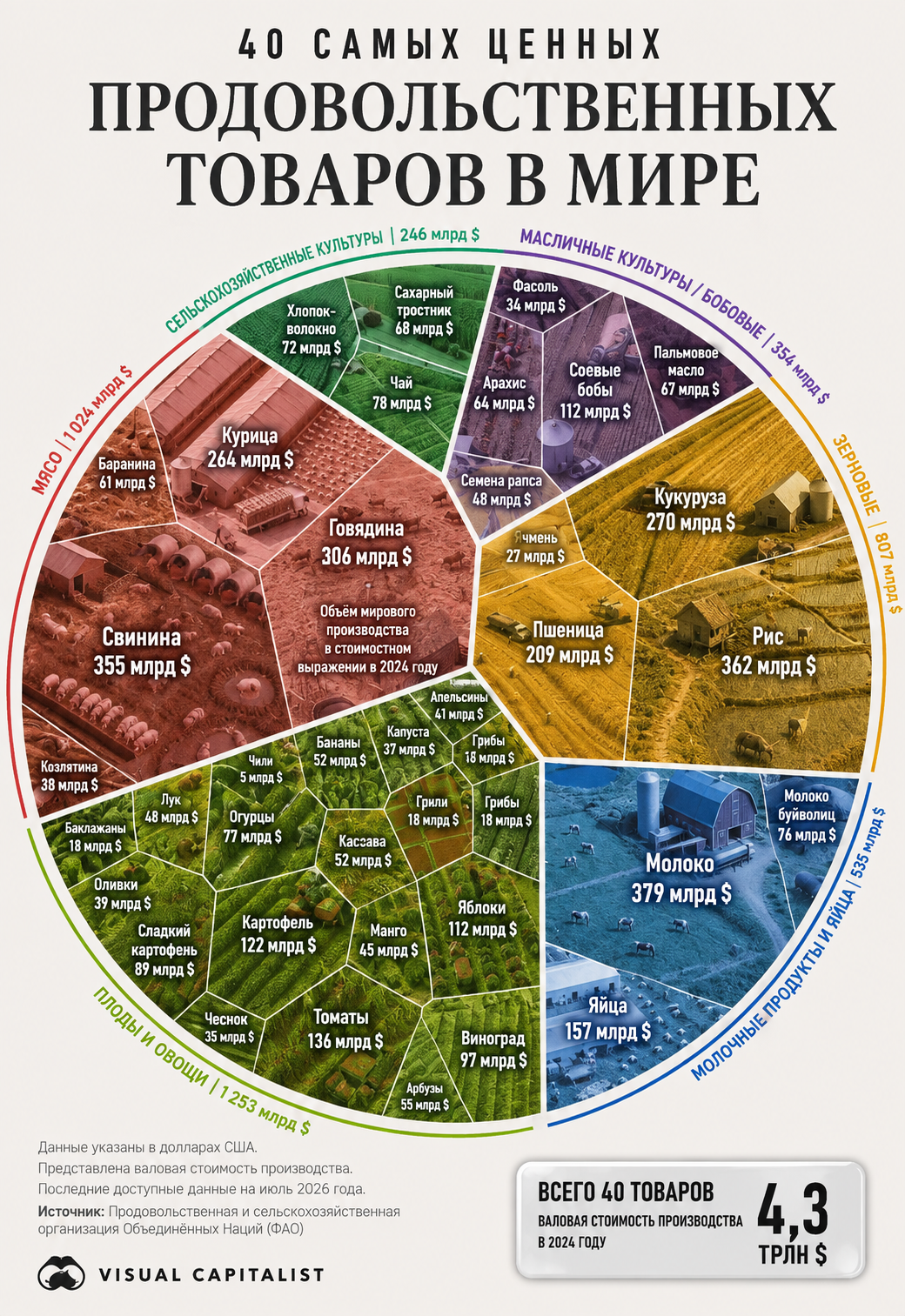
Milk unexpectedly overtook rice and pork, and the total value of the entire list amounted to $4.3 trillion. This is not the only FAO perspective on the agricultural economy: earlier we already analyzed the ranking of countries by production value, where Kazakhstan holds modest positions due to its focus on low-margin grain.
The gist in brief
- Visual Capitalist ranked the 40 most valuable food commodities in the world by gross production value in 2024 based on UN FAO data; the total value amounted to $4.3 trillion.
- Milk topped the ranking with $379 billion, slightly ahead of rice ($362 billion) and pork ($355 billion) — the difference between the top three is just $24 billion.
- Meat overall — pork, beef, chicken, lamb, and goat meat — accounts for $1.02 trillion in combined value; livestock farming is growing faster than crop production and could add another 15% by 2035.
- Vegetables and fruits together generate more than $1.2 trillion, but this value is distributed much more widely: tomatoes ($136 billion) are the only representative of the category in the top ten, while commodities such as mushrooms, watermelons, and cassava each bring in more than $50 billion annually.
Milk overtook rice and pork
Milk's first place in the value ranking reflects not the price per liter, but the colossal scale of global production — 985 million tons in 2024, of which 81% came from cattle, while buffalo also contributed a notable share, especially in Asian countries. The gap between the top three is minimal: milk, rice, and pork are positioned within just $24 billion of each other, which for markets of this scale means near-equality in significance for the global food system.
Meat and crop production diverge in dynamics
Pork took third place in the overall ranking with $355 billion, followed by beef ($306 billion) and chicken ($264 billion). Global meat production reached 374 million tons in 2024, increasing by 7 million tons year-on-year. According to forecasts, livestock farming will grow faster than crop production over the next decade — by 2035, production volumes could increase by 15%, largely driven by rising incomes in middle-income countries, where diets are gradually shifting toward animal-based products.
Diversity instead of concentration
Unlike meat and grains, where leadership is determined by a few major items, the crop sector is structured differently: significant value is distributed across a much wider range of crops. Potatoes rank second among vegetables and fruits ($122 billion), followed by apples ($112 billion), grapes ($97 billion), and sweet potatoes ($89 billion). This is even more evident in less obvious positions in the ranking: mushrooms generate $61 billion, overtaking bananas ($52 billion), while watermelons, cassava, and chili peppers each surpass the $50 billion mark — commodities that rarely make headlines in food security discussions but form a significant part of the global agricultural economy.
Kazakhstani context
Milk and meat, which occupy the top positions in the global value ranking, are exactly the categories where Kazakhstan is expanding its own production: subsidized livestock lending, modernization of dairy farms, and growing live cattle exports form part of the very global industry dynamics captured by the FAO ranking. But the scale of production is not the only dimension of the food picture. According to FAO data, 60 million people in Europe and Central Asia cannot afford a healthy diet, and Kazakhstan is in the risk zone — 14% of Central Asia's population lacks access to an adequate diet, despite the region producing enough food overall. This same gap between production volume and its accessibility to the end consumer is also noted in the latest global FAO report on hunger: nearly a third of the world's population cannot afford a healthy diet not because of a lack of food as such, but because of the high cost of nutritious products at every stage of the chain — from storage to retail.
Author's conclusion
The ranking of the most valuable food commodities reveals the global agricultural economy from a side rarely noticed amid discussions of harvests and export quotas: milk and meat truly account for the lion's share of the planet's food value, while dozens of less visible crops like mushrooms or cassava generate billions of dollars while remaining in the shadow of wheat and rice. But for Kazakhstan, as for the region as a whole, what matters more than a specific product's place in the global ranking is whether the food produced actually reaches the table as an affordable and adequate diet — and that is no longer a question of production volumes, but of the internal economics of supply chains.
Comments ()