In Georgia, artificial intelligence learns to recognize local livestock breeds.
The UN's Food and Agriculture Organization launched a project in Georgia that sounds technical but actually protects the genetic heritage of an entire nation.
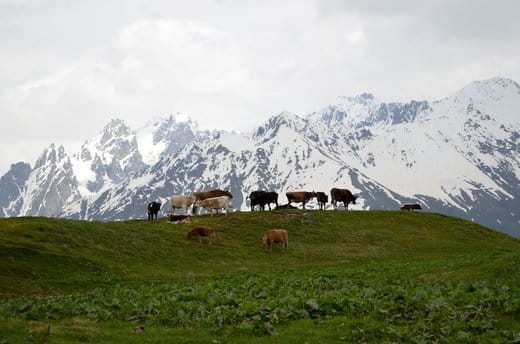
FAO specialists, together with their Georgian colleagues, are collecting data on local cattle breeds in mountainous regions to train an artificial intelligence system to recognize them from photographs.
The gist in brief
- FAO, together with the Agricultural Research Center of Georgia's Ministry of Environmental Protection and Agriculture, is collecting data on local cattle breeds in the country's mountainous regions to develop an AI-based breed recognition tool.
- The information will feed into FAO's global Domestic Animal Diversity Information System (DAD-IS), which tracks nearly 9,000 breeds of 38 animal species worldwide.
- The system already registers 48 breeds from Georgia — 40 local and 8 regional transboundary — but population data is available for only about half of them.
- FAO is developing a mobile application that will allow field specialists to photograph animals for automatic breed identification; initial trials in other countries have already shown high accuracy.
Why a breed database is needed
The problem the project addresses extends beyond Georgia alone. According to FAO estimates, a significant share of the world's livestock breeds is under threat of extinction — and with each breed, a unique set of genes is lost that may be responsible for resilience to local climate, diseases, or poor feed.
FAO livestock specialist Tibor Szűcs noted: "Georgia has a rich livestock heritage and a solid foundation for further work. By improving data on animal genetic resources and strengthening cooperation between institutions, we not only support national priorities but also contribute to the accumulation of global knowledge needed to preserve agricultural animal diversity for future generations."
Without accurate accounting of how many individuals of a particular breed remain, it is impossible either to assess the risk of its extinction or to plan conservation measures.
How photo recognition works
The tool FAO is developing is simple at the user level: a field specialist photographs an animal, and the AI-based system determines its breed by external characteristics — shape, coloring, body conformation. For the application to work for a specific country, a sufficient database of reference images of local breeds must first be collected — which is exactly what specialists are currently doing in Georgia's mountainous regions. The technology has already been tested in other countries and has shown high recognition accuracy, making the Georgian project not an experiment from scratch but an adaptation of an already working solution.
Why this matters for Kazakhstan
Kazakhstan has its own set of locally bred breeds, each of which is the result of decades of adaptation to the country's specific conditions: the Kazakh white-headed and Auliekol cattle breeds, the Edilbay sheep breed, and others. A particularly illustrative example is the arkhar-merino sheep breed, developed by crossing domestic merinos with wild mountain argali sheep specifically for resilience to the local climate and diseases. Kazakh breeds, like Georgian ones, require systematic accounting: without up-to-date population data, it is difficult to assess which breeds need priority support measures and which are developing sustainably. The photo recognition technology FAO is testing could, in the future, simplify Kazakhstan's accounting as well — especially in remote livestock regions where field data collection remains labor-intensive.
Author's conclusion
The project in Georgia shows how modern technologies are increasingly penetrating tasks that until recently were solved exclusively by hand — livestock counting and breed identification were carried out for years by local animal specialists consulting reference books. Automating this process does not replace specialists' expertise but can multiply the speed of data collection where it is currently lacking — and for countries like Kazakhstan, where the local livestock heritage also requires systematic accounting, this direction is worth keeping an eye on.



Comments ()