In Kazakhstan, bribery remains a low-risk bet.
Out of 100 Kazakh officials suspected of bribery, 19 go to prison. 41 pay a fine and go home. 40 are not convicted at all.
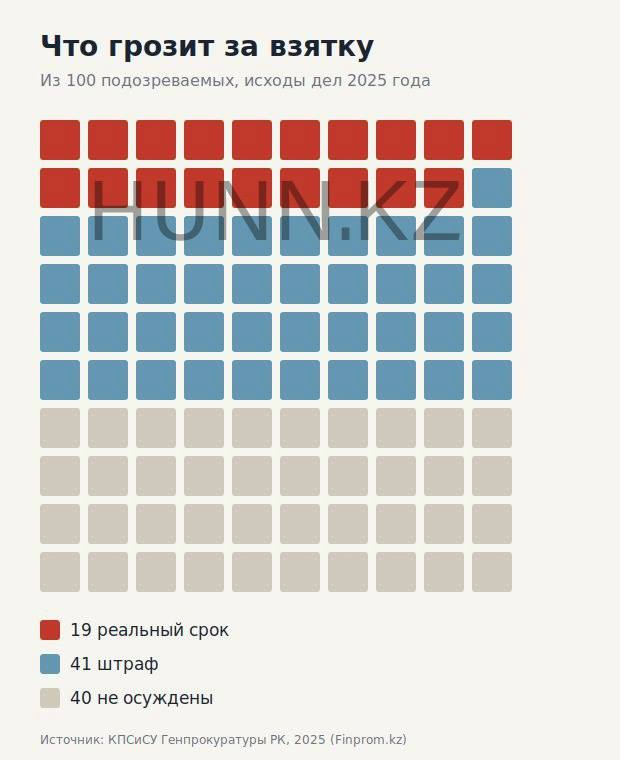
Corruption is traditionally considered one of the main barriers to the development of the economy and state institutions. However, statistics show that in Kazakhstan, the risk of an actual prison sentence for accepting a bribe remains relatively low. This creates a situation where the potential benefit from a corrupt act for many officials may appear higher than the likelihood of serious punishment.
The gist of it
- In 2025, 312 people became suspects under the article "Accepting a bribe."
- 239 cases reached court, and 188 people were convicted.
- Only 58 convicts, or 30.9%, received actual prison terms.
- Calculated from the total number of suspects, the probability of going to prison was about 19%.
The statistics speak for themselves
According to data from analysts at Finprom.kz, in 2025, 312 suspects were registered under the article on accepting a bribe. 239 people reached the trial stage, and 188 defendants received guilty verdicts.
However, the structure of the punishments is most telling. Of all those convicted, only 58 people received actual imprisonment. The rest got off with fines or other types of punishment.
In effect, this means that out of a hundred people suspected of accepting a bribe, only about nineteen end up behind bars.
Corruption arithmetic
If we consider corruption as a rational choice, the key factor is not the severity of the punishment, but the probability of it being applied.
In the case of accepting a bribe, the statistics look unusual. The probability of avoiding a real prison term is about 81%. For comparison, the probability of winning on red in European roulette is less than half, and the chances of a big lottery win are measured in fractions of a percent.
From a risk theory perspective, such statistics send a dangerous signal: a potential corrupt official sees not only the possibility of obtaining illegal income, but also a relatively high chance of avoiding the harshest punishment.
Taking bribes turns out to be safer
A comparison with other corruption-related articles looks particularly interesting.
According to analysts, 80.6% of convicts received real prison terms for abuse of office. Under the article on accepting a bribe, this figure was only 30.9%, and under the article on giving a bribe, it was about 21%.
This creates a paradoxical situation: using official powers in violation of the law is punished much more severely than directly receiving illegal remuneration.
From a prevention standpoint, it is precisely this disproportion that may reduce the deterrent effect of anti-corruption policy.
The cost of corruption continues to rise
The problem lies not only in the number of detected crimes.
According to official data, the damage from corruption offenses in Kazakhstan grew from 8 billion tenge in 2020 to 110.6 billion tenge in 2024. This is an increase of more than 13 times in just four years.
The increase in damage means that corruption is gradually becoming not just a political or social problem, but also a serious economic factor affecting the efficiency of government spending, the investment climate, and business trust in state institutions.
Why it's not severity that works, but inevitability
Global practice shows that the level of corruption depends more on the probability of punishment being applied than on its severity.
Even very harsh sanctions lose their effectiveness if a potential offender considers the risk of them being applied to be low. Conversely, a relatively moderate punishment can have a strong preventive effect if the probability of its inevitability is high.
This is why many anti-corruption systems focus on the digitalization of public services, transparency of procedures, automation of decision-making, and increasing the detection rate of crimes.
Author's conclusion
The 2025 statistics reveal an important feature of the Kazakhstani anti-corruption system: the probability of actual imprisonment for accepting a bribe remains relatively low. When only one out of five suspects ends up in prison, corruption begins to be perceived as a risky but quite acceptable bet. The history of fighting corruption in many countries shows that the situation is changed not by toughening punishments in themselves, but by building confidence that punishment is inevitable. As long as this confidence remains insufficient, corrupt incentives will persist.



Comments ()