World Bank talks about quality jobs — what this looks like in practice in Kazakhstan
The abstract claim that economic growth matters not in itself but in whether it creates good jobs is easy to make at any conference. Far harder to test in practice.
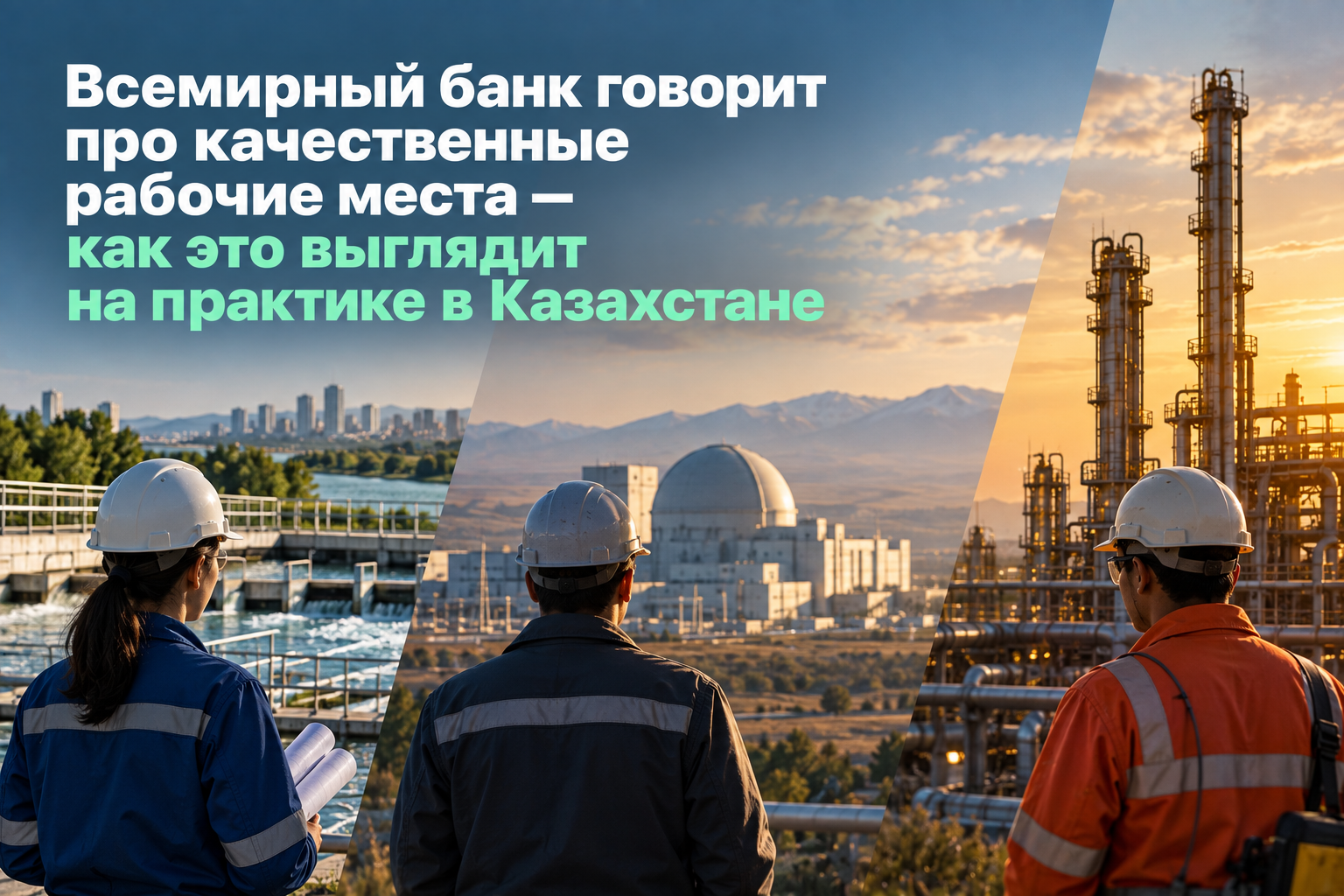
Kazakhstan already has several fresh cases where this can be done right now.
The essence in brief
- The World Bank's Permanent Representative in Kazakhstan, Andrey Mikhnev, stated that the main indicator that economic growth improves people's lives is the emergence of well-paid jobs — this task cannot be solved by government organizations alone; he sees the main potential in private business.
- According to him, the focus of the economy should shift from the oil sector to industries with higher added value — digital technologies, artificial intelligence, export manufacturing; in the coming years, a large number of young Kazakhstanis will enter the labor market, and they will need exactly such jobs.
- Two new high-tech areas that we have been following this year — the water sector and nuclear energy — make it possible to test this thesis in practice right now: both create new highly qualified jobs, but with noticeably different approaches to staffing them.
- The water sector publishes transparent statistics — almost 500 specialists who completed foreign training over three years, broken down by country and program, whereas the nuclear agency, in response to an official request about personnel for the station near Balkhash, gave an evasive answer without specifics about the employment of the 4,500 specialists already trained.
The World Bank's thesis in simple words
Mikhnev's logic rests on a simple observation: high GDP growth rates by themselves do not mean that a country's residents begin to live better. If growth is driven by industries that do not create enough new jobs — primarily the oil sector — it is weakly reflected in the incomes of ordinary families.
"We consider the link between people's well-being and jobs to be the most important," emphasized the World Bank representative.
Demographics give the issue particular urgency: in the coming years, a large young generation will enter the labor market, and whether enough quality jobs can be found for them will determine whether economic growth turns into a real improvement in well-being or remains a figure in reports.
The water sector — an example of a transparent approach
We have already written that since 2023 Kazakhstan has sent almost 500 specialists abroad for training in water management, including internships in Israel — the world leader in water-saving technologies. These data are published with a breakdown by year, country, and specific partner programs — that is, one can trace not only the total number of trained specialists but also exactly where efforts are being invested in training personnel for a sector that is simultaneously receiving billions of tenge for infrastructure modernization and the introduction of water-saving technologies.
Nuclear energy — the same challenge, a different result
A directly opposite picture is demonstrated by personnel training for the future station near Balkhash. We wrote that in response to an official request about the personnel program, the Atomic Energy Agency gave an evasive answer: over 25 years, Kazakh universities have trained about 4,500 nuclear specialists, but the agency did not specify where exactly they currently work, and a comprehensive personnel training plan for 2027–2031 is still only being developed. Funding for practical personnel training is meanwhile included in the EPC contract — that is, it is borne by the station's general contractor, and a separate state budget for this task has not been disclosed. For comparison, the national operator of the Barakah station in the UAE, long before the launch of the first power unit, publicly disclosed detailed hiring and training plans broken down by year.
The oil and gas deal — a rule that bypassed every player
A third variant of the same problem is found in the oil and gas region. We wrote that the new rule on the phased replacement of foreign specialists with Kazakhstani ones in complex exploration and production projects formally bypassed the investor in Tengiz, Kashagan, and Karachaganak — the country's three main projects, around which the question of what share of foreign personnel is involved is heard most often. The formal reason is that these projects operate under subsoil use agreements concluded back in the 1990s, long before the introduction of the new model contract form — that is, the rule publicly presented as a response to the demand for personnel localization does not, in practice, affect precisely those assets where this demand is most acute.
Why this is important right now
Both sectors — water and nuclear — fall into exactly the category Mikhnev is talking about: they are not the oil industry but high-added-value areas requiring qualified, well-paid specialists. But the mere existence of a growth sector does not yet guarantee that jobs in it will actually appear on time and in sufficient numbers — this requires a specific, transparent personnel policy, not general declarations about the importance of human capital. The difference between the water and nuclear sectors shows that even within one country and within one government, approaches to this task can differ dramatically.
Author's conclusion
The World Bank's abstract thesis that jobs are more important than GDP figures sounds indisputable and therefore easily escapes attention. But it is precisely the attempt to test it against concrete personnel programs already underway in Kazakhstan — rather than simply agreeing with the general statement — that shows where talk about new growth points is already backed by practice and where it remains an intention. While the water sector demonstrates what a transparent personnel policy looks like in practice, nuclear energy remains a more vivid example of the risk that Mikhnev himself warns about — quality growth without due attention to who will create jobs on the ground and how.
Comments ()