India and Uzbekistan are preparing a long-term uranium agreement
While Kazakhstan leads global uranium mining, neighboring Uzbekistan is strengthening its market position and preparing to cement a long-term partnership with India through an official agreement.
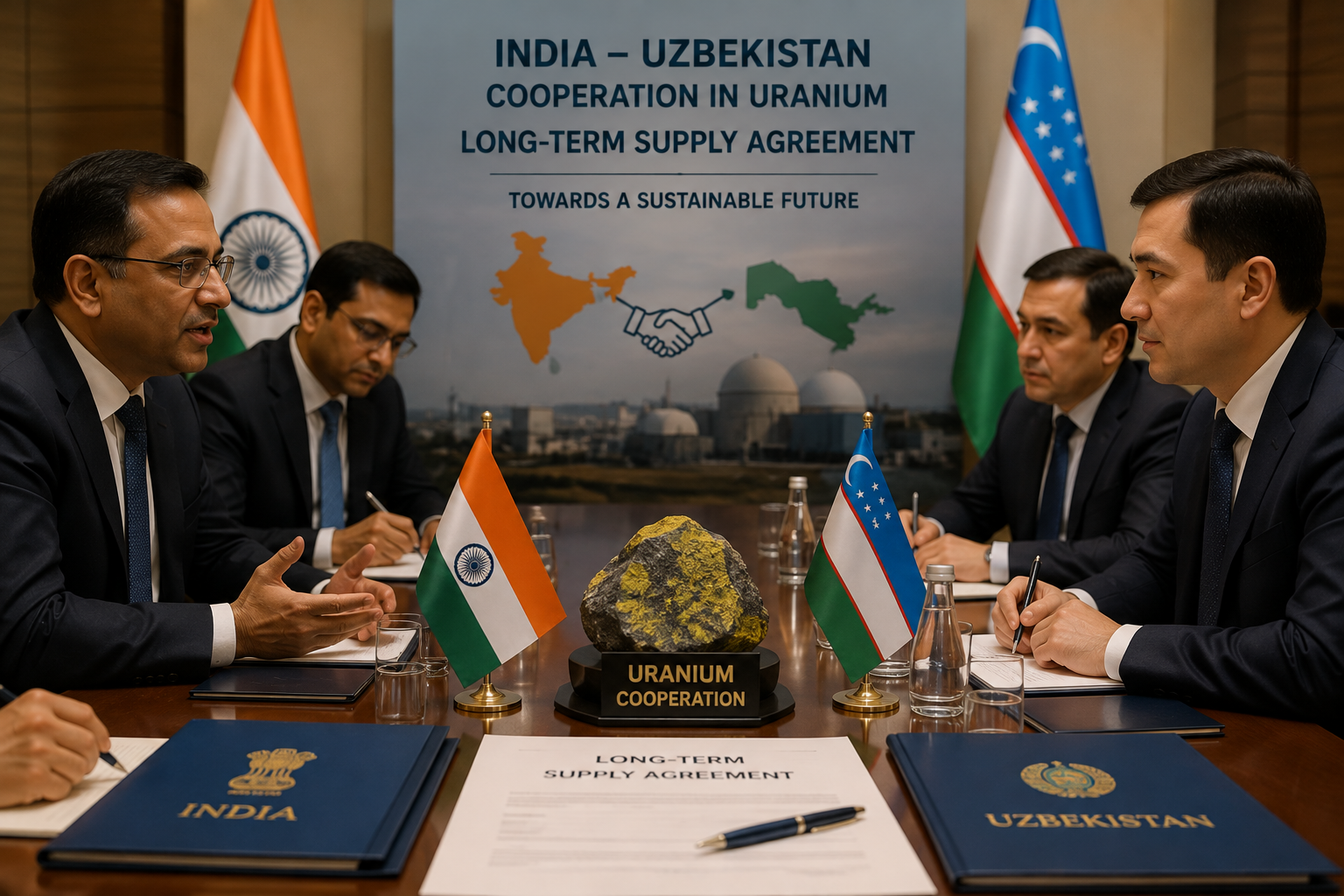
The document could be signed in the very near future, UzDailu reports.
The gist in brief
- India and Uzbekistan are negotiating a long-term mechanism for uranium supplies and expect to sign an agreement in the near future — this was stated by India's Foreign Secretary Secretary (West) Pavan Kapoor following the Indian Prime Minister's state visit to Uzbekistan.
- During the visit, a memorandum of understanding on mining cooperation was signed, which is expected to facilitate partnership on critical minerals, including uranium.
- The negotiations come against the backdrop of bilateral relations being elevated to a comprehensive strategic partnership; two business forums involving mining companies from both countries have already been held this year.
- The parties are discussing an exchange of delegations for the prompt implementation of the memorandum and expect notable progress in the mining sector in the coming months.
Not a first contract, but systemic partnership
India-Uzbekistan uranium cooperation did not begin today: back in August 2014, the Navoi Mining and Metallurgical Combine and India's state-owned UCIL signed a contract for the purchase of up to 500 tonnes of Uzbek uranium per year. The current negotiations on a long-term supply mechanism are the next stage of the same logic: to transform one-off contracts into a systemic, institutionally anchored foundation of bilateral relations. It is telling that uranium is mentioned here not in isolation, but in conjunction with a broader memorandum on mining and critical minerals — that is, the parties are building a partnership across several areas of the raw materials sector at once, rather than focusing solely on one element of the periodic table.
Uzbekistan catching up in the uranium race
Uzbekistan today ranks 10th in the world in confirmed uranium reserves and 5th in production volume, trailing only Kazakhstan, Namibia, Canada, and Australia in output. But the country's ambitions are noticeably higher than its current position: Tashkent plans to double production — to 7,100 tonnes by 2030 — aiming to break into the global top three. To attract investors for this goal, the country has lifted previous restrictions on publishing data on reserves, production, and financial reporting of the state uranium company — transparency has become part of the strategy for attracting capital, including Indian capital.
Part of the global picture of rising uranium demand
India's interest in Uzbek uranium fits into a global trend we have been tracking for several months: demand for uranium is growing faster than traditional suppliers can expand. We have already written that Kazakhstan remains the undisputed global leader in uranium production, and demand for Kazakh uranium is already growing so much that France tripled its purchases this year and took first place among buyers. Meanwhile, Canada's Rook I mine has staked a claim to a third of Kazakhstan's annual production, showing that major buyers are actively seeking diversification of sources. The India-Uzbekistan negotiations are another stroke in the same picture: countries with growing nuclear programs are building long-term relationships with several uranium suppliers at once, rather than relying on a single source.
Why this matters for Kazakhstan
The growing activity of neighboring Uzbekistan in the uranium market does not pose a direct threat to Kazakhstan's leadership — the gap in production volumes between the countries remains significant — but it is gradually changing the regional balance. India, which is ramping up uranium purchases for its own nuclear program, gains two potential suppliers in Central Asia located right next to each other, while Uzbekistan itself is simultaneously developing its own nuclear power industry with Russian participation. For Kazakhstan, this means the region as a whole is becoming an increasingly prominent player in the global uranium market — which rather strengthens Central Asia's overall position in negotiations with major buyers than dilutes the leadership of any single country.
Author's conclusion
The forthcoming agreement between India and Uzbekistan is a small but telling stroke in the overall picture of the global uranium market, which is clearly entering a phase of active redivision and supplier diversification. While Kazakhstan maintains absolute leadership in volumes, neighboring countries like Uzbekistan are consistently building their own export niches — and doing so not by directly competing with Kazakhstan, but by capitalizing on growing global demand, which, by all appearances, will be enough for several major regional suppliers simultaneously.
Comments ()