Kazakh coal left without a route to the Baltic, transit has fallen to almost zero
Transit of Kazakh coal through Russia to Baltic ports is halting: according to Argus, Russian Railways approved no applications for such shipments in October or November.
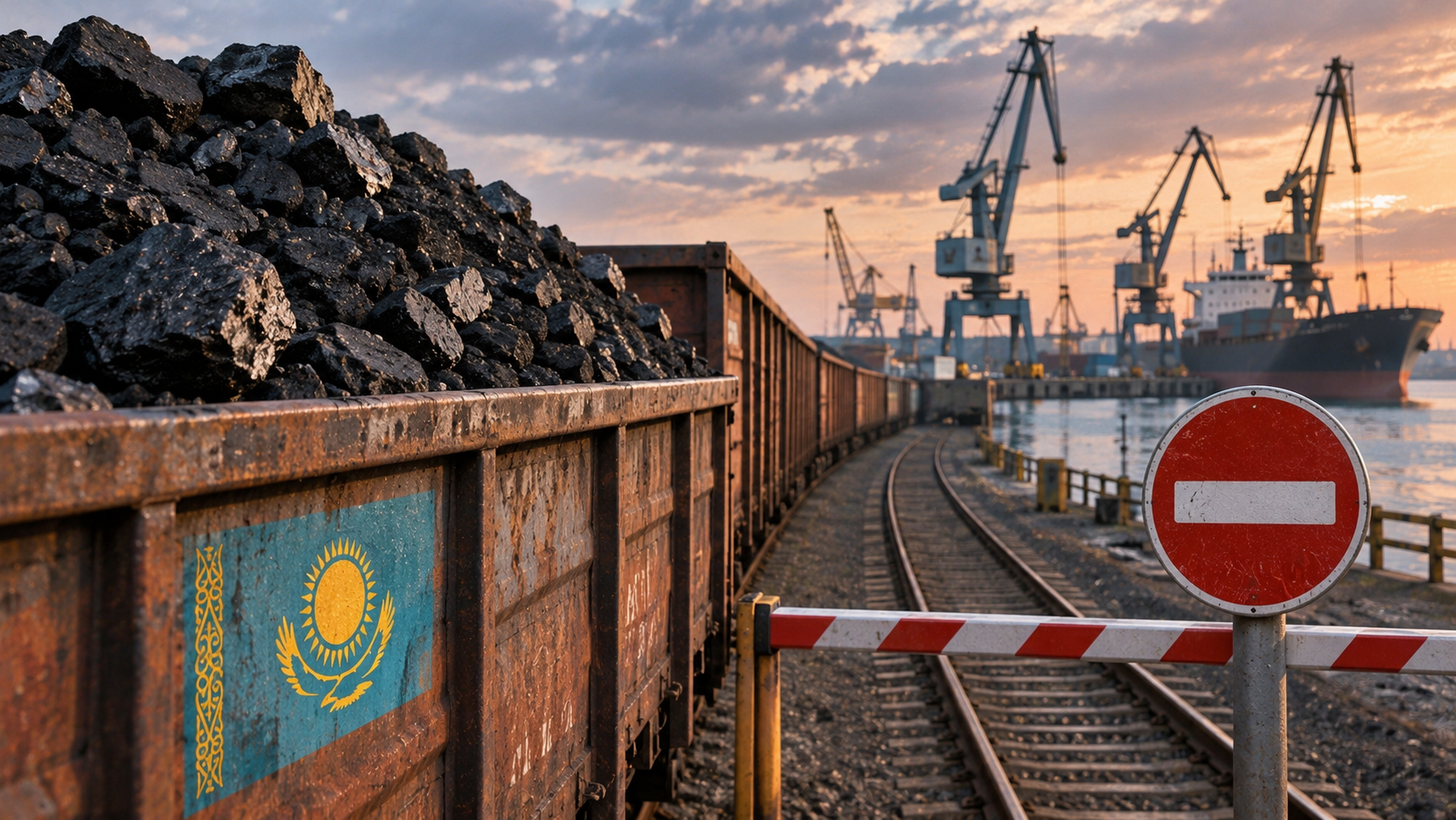
The reason is the congestion of the railway network and the redirection of cargo from southern ports to the north, Vedomosti writes.
The gist in brief
- For October and November, Russian Railways did not approve a single application for railway transit of Kazakh coal to Baltic ports.
- Transit to Baltic ports fell from 1 million tonnes in August to 500,000 tonnes in September and 30,000 tonnes in October.
- Russian Railways planned to cut coal shipments to Baltic ports in October by 80%.
- According to economist Yernar Serik, author of the Tradereport Telegram channel, the shortfall in shipments by the end of the year could reach 3.5 million tonnes, or $400-470 million in export value.
What is known about the applications
Argus received the data that Russian Railways did not approve a single application from market participants. According to the agency, the reason is the redirection of cargo flows from the ports of the Azov-Black Sea basin to the ports of the North-West and the congestion of the railway network. The subheading of the Vedomosti material says that the Baltic ports are occupied by cargo from the south due to restrictions in the Black and Azov Seas.
What Russian Railways planned
Three weeks earlier, on October 19, Kommersant wrote that Russian Railways planned to cut coal shipments to Baltic ports in October by 80%. The issue was discussed at a meeting at the Ministry of Transport in late September, and the publication has the minutes. The material says that a suspension of priority transit of Kazakh coal to North-West ports is being considered, and in October Russian Railways are not approving applications for its transportation. A similar measure was considered in 2022. Russian Railways do not comment on plans by destination. Coal, as the least marginal and highest-volume cargo, inevitably falls under the cuts, Kommersant writes, while demand for the Baltic direction has grown due to disruptions in the operation of Black Sea ports.
How transit changed
According to Kommersant, in the first half of 2026 transit of Kazakh coal grew by 34%, to 6.7 million tonnes. Before the disruptions at southern ports, about 60% of Kazakh transit went through Ust-Luga and about a third through Taman. According to Argus data for January-July, 4.7 million tonnes were exported through Ust-Luga and 2.6 million tonnes through Taman. Then volumes fell: according to Ulysmedia.kz, in August about 1 million tonnes went to Baltic ports, in September 500,000 tonnes, and in October 30,000 tonnes, that is, a 97% drop over two months. Shipments through Taman have been halted since early August, and for November Russian Railways allowed loading of coal for Ust-Luga at only 55% of capacity. Currently, Kazakh coal travels through Russia only to Belarus and Poland.
Who faces the risk of supply disruption
The main buyers of Kazakh coal are EU countries, in particular Poland and the Netherlands, as well as Turkey. In 2025, when the EU imposed sanctions against a number of Russian ports, including Ust-Luga, it made an exception for Kazakh transit. In November 2025, Russia and Kazakhstan signed an intergovernmental agreement on transit transportation: such agreements fall under the high-priority fourth queue of the rules on non-discriminatory access, so it is difficult to circumvent them, but Kommersant does not rule out restrictions, for example approving applications only for Russian railcars.
How much Kazakhstan could lose
This estimate was provided by Kazakh economist and analyst Yernar Serik, author of the Tradereport Telegram channel. He calculated that if the August pace persists, the shortfall in shipments by the end of the year could reach 3.5 million tonnes. At a conditional coal price of $115-135 per tonne, this is equivalent to $400-470 million in export value. The author himself stipulates that these are not direct losses: part of the volumes may be redirected, and the export price includes transport costs. Alternative routes through the Caspian and to the east exist, but their capacity is limited and logistics cost more, the same material notes. The same material says that market participants do not expect normalization before Q1 2027.
Which figures diverge
Data on transit growth differ by period. Kommersant cites 6.7 million tonnes and +34% for the first half of the year, Ulysmedia.kz writes of 7.8 million tonnes and growth of 20%, while in the press review these figures are attributed to January-July. Most likely, these are different periods of the same data series. The result for 2025 (11.7 million tonnes, +27%) appears only in the material with Serik's calculation. Kommersant's words that a suspension of transit is being considered describe a plan, not a decision taken.
What is happening with Kazakh coal
Poland and the Netherlands are among the buyers that increased purchases this year: in January-May exports of Kazakh coal grew by 5%, to 12.6 million tonnes, while the Netherlands increased purchases 11.3 times, to 477,900 tonnes, Malaysia 6.3 times, to 724,800 tonnes, and Poland 1.7 times, to 2.3 million tonnes. On the domestic market, the 2026-2027 heating season will require 7.5 million tonnes of coal; as of September, 4.2 million tonnes were lying in the warehouses of energy enterprises, and supplies are monitored by a digital platform with artificial intelligence elements that the Ministry of Energy launched in August.
Author's conclusion
Russia has not banned the export of Kazakh coal; transit has shrunk through the non-approval of applications, so there is no formal decision that can be appealed or revoked. This means that recovery depends on how quickly Russian ports and railways are unloaded, and market participants say no earlier than Q1 2027. For Kazakh exporters, the main takeaway is that supplies to Europe and Turkey largely rested on a single route, and the size of possible losses so far remains only an analyst's estimate.


Comments ()