Kazakh horse search startup enters Mongolian market
An idea born from a client's random question—could a child tracker find a horse lost in the steppe—is now conquering the global market.

Eight years later, a company that grew out of a chance question is presenting its technology to the government of Mongolia.
The gist in brief
- The Kazakh company iGPS Tech has begun its international expansion with Mongolia, presenting its satellite livestock monitoring system to representatives of the country's government, agricultural sector, business community, and livestock industry.
- The technology is already used by more than 3,800 people in Kazakhstan, who use it to track over 130,000 horses; data transmission does not require cellular connectivity, which is critical for remote pastures with no coverage.
- The company presented a new solution — a satellite tracker with biosensors: a single kit can monitor up to 10 animals simultaneously, transmitting not only coordinates but also data on the temperature and motor activity of each horse.
- After the presentation in Mongolia, iGPS Tech received more than 1,000 inquiries in two days, and videos about the technology garnered over 1 million views; in addition to Mongolia, the company is considering entering the markets of Kyrgyzstan, Uzbekistan, and Russia.
From a student's question to thousands of users
The company's founder and CEO, Miras Baizhigit, sold GPS watches for children while studying at a medical university — and that was when one of his clients asked whether a similar device could be used to track horses. Baizhigit began studying satellite technologies, traveling to farms, and talking to horse breeders directly. The first trackers were installed on a lead stallion — by its coordinates, the owner could tell where the entire herd was. Over time, the team developed its own mobile app and began transitioning from off-the-shelf foreign equipment to its own devices.
Why Mongolia specifically
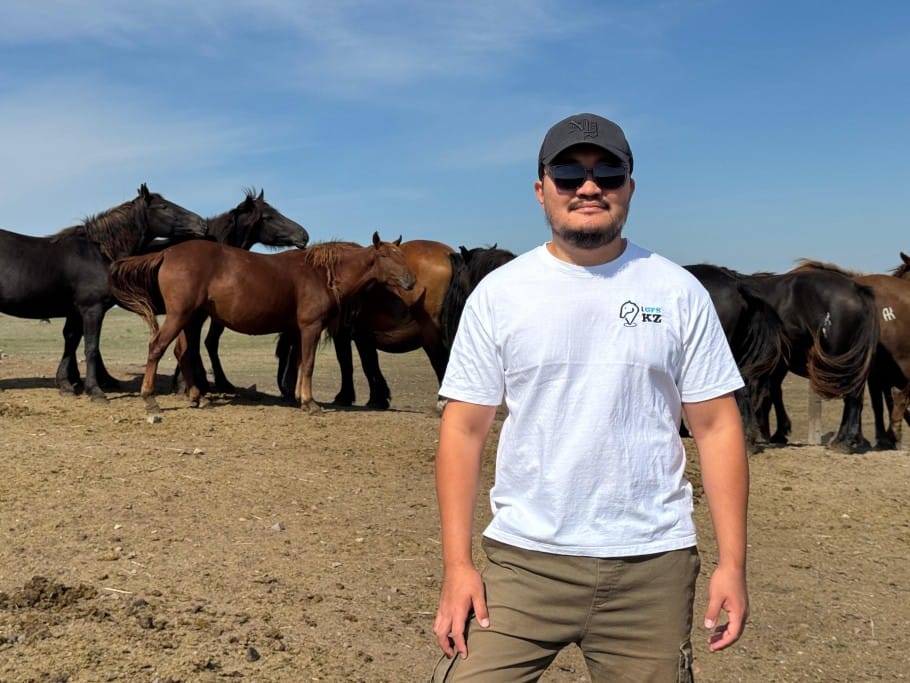
Baizhigit explains the choice of the first foreign market by practical logic — vast distances and the scale of pasture-based livestock farming make Mongolia a convenient venue for applying the technology.
According to him, the company's ambition is broader than simply selling trackers: "We want the technology created in Kazakhstan to become one of the tools for the digitalization of global livestock farming."
During the visit, the team met with the chief adviser to Mongolia's Minister of Industry and Mineral Resources, Chuluunbat Bat-Erdene, first adviser to the Minister of Food, Agriculture and Light Industry Erhembayar Erdenbulgan, deputy head of the Ulaanbaatar Horse Breeders' Association Davaasuren Ochirsuren, and president of Mortin Grand Zagdakhüü Myagmardorj — meaning the talks covered the government, industry, and business levels all at once.
Science also took an interest in horse data
The trip to Mongolia went beyond a single presentation — the parties discussed joint expeditions, exchange of experience, and possible pilot projects.
iGPS Tech's partner for marketing and development, Zhankeldi Gapbasov, explained the essence of this broader interest: "Our countries are very close in culture and attitude toward livestock farming, but at the same time each has its own unique experience."
Over the years of its work, iGPS Tech has also accumulated a large body of data on animal movement under free-range grazing — and this archive turned out to be of interest not only to farmers. The company collaborates with scientists from the German University of Göttingen who study the impact of free-range grazing on natural ecosystems, including the possible role of grazing in reducing the risk of wildfires. The company also plans to involve Kazakh universities and research teams in similar scientific projects.
Connection to a familiar picture
The success of iGPS Tech fits logically into the statistics we have already examined — Kazakhstan ranks fourth in the world by horse population, behind only Mexico, Brazil, and Mongolia. It is telling that Mongolia, which outranks Kazakhstan in this indicator, became the first foreign market for the Kazakh technology — meaning this is not about entering a country with a smaller scale of horse breeding, but one of the few countries in the world where herd-based horse management is even more developed than in Kazakhstan itself. Kazakhstan's leadership in this sphere also manifests in other dimensions: the country has simultaneously proposed developing the world's first international ISO standard for finished horse meat products — meaning it aspires not only to the status of a major supplier of horses and technologies for tracking them, but also to the role of a country that sets global rules of the game in this industry.
Author's conclusion
The story of iGPS Tech shows how a seemingly narrow niche — finding horses lost in the steppe — can grow into a technology with applied, commercial, and scientific value all at once. More than a thousand inquiries in two days after the presentation in Mongolia indicate that demand for such solutions in the region clearly exceeds what the company itself has managed to offer so far — and collaboration with German scientists adds a dimension to the project that goes far beyond an ordinary startup for farmers.



Comments ()