Kazakhstan builds Central Asia's largest AI hub amid its own energy deficit
In Ekibastuz, Pavlodar region, the "Data Center Valley" project launches in January 2026 — Kazakhstan's bid to become a regional AI computing power hub.
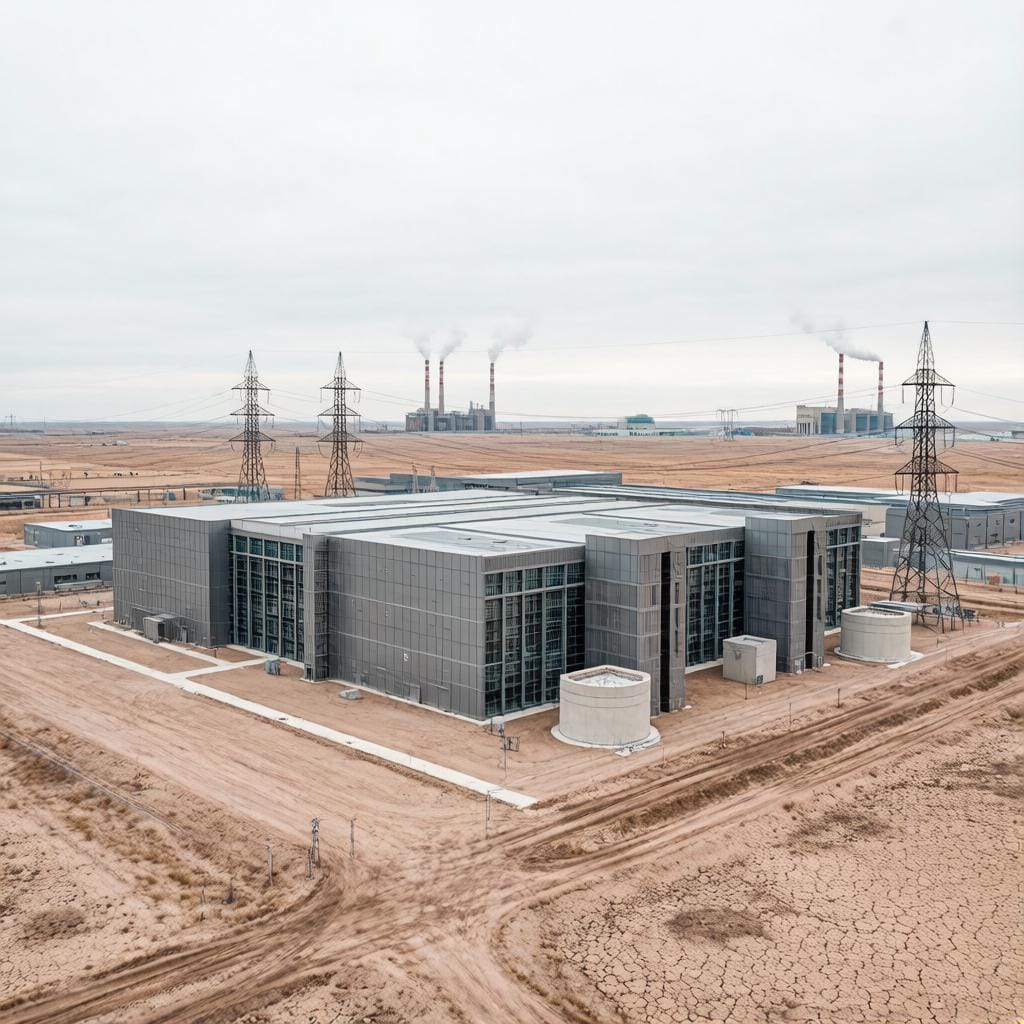
The initial capacity of the first phase — 300 MW — is by itself larger than the country's entire current energy deficit, which Kazakhstan is still covering through electricity imports from Russia, writes nationalbusiness.kz.
The gist
- The "Data Center Valley" project in Ekibastuz is billed as Central Asia's largest data center campus: initial capacity of 300 MW with phased expansion to 1 GW, with announced investments of up to $30 billion.
- The operator is Kazakhtelecom, which is in talks with more than 20 technology companies; the first confirmed partner is the Emirati company Aleria, and preliminary demand already exceeds 100 MW.
- In 2025, Kazakhstan produced 123.1 billion kWh with consumption of 124.6 billion — the deficit was covered by imports from Russia, with Kazakhstan accounting for about 60% of all Russian electricity exports.
- The first phase of the data center project (300 MW) requires more capacity than the country's entire current energy deficit in terms of continuous load (115–140 MW).
What has already been built and planned
The site was not chosen by chance — Ekibastuz has historically been an industrial energy zone with two large Soviet-era coal power plants, GRES-1 and GRES-2. A pilot area of 200 hectares has been allocated, with the possibility of expansion to 1,300–1,400 hectares. In April 2026, a 215 MW substation was purchased for the project, and full-cycle construction work began in June after geodetic and engineering-geological surveys were completed. The first facilities are planned to be launched in early 2027. A mechanism is being developed for investors to lock in a tariff of around 2.5 cents per kWh — roughly half the current industrial tariff — through a separate tariff circuit.
Presidential priority
The project is directly among the state priorities of 2026, declared the Year of Digitalization and Artificial Intelligence, and is part of the national digital transformation strategy Digital Qazaqstan. President Kassym-Jomart Tokayev at a meeting of the National Kurultai in Kyzylorda on January 20, 2026, emphasized that data centers consume electricity like metallurgical plants, so ensuring they have sufficient power sources should be considered a critical part of state policy — a formulation that effectively acknowledges the scale of the challenge before it has even manifested in practice. In parallel with Ekibastuz, computing infrastructure of a different type is also being built: in October 2025, the AI-Farabium supercomputer cluster was launched in Almaty, entering the global TOP500 ranking, and in November 2026, a new supercomputer three times more powerful is expected to launch in Kosshy, combining the networks of the country's four leading universities.
The main paradox — electricity
The formulation "we want to sell computing capacity to our neighbors" sits poorly with the fact that the country itself did not cover its own electricity consumption in 2025. The year's deficit amounted to about 1.5 billion kWh — half as much as the year before, but still real, and it was covered by imports from Russia. The government promises to close this gap by 2027 through new thermal plants and expanded generation in Ekibastuz itself; Deputy Energy Minister Sungat Yessimkhanov at a briefing on May 5, 2026, confirmed the goal of completely abandoning purchases of Russian electricity precisely in 2027. The problem is arithmetic: the first phase of the "Data Center Valley" requires 300 MW of guaranteed capacity — more than the country's entire current deficit in terms of continuous load. Added to this is the structural vulnerability of the energy system itself: the average wear and tear of thermal plant equipment is approaching 56%, and two relevant agencies — the Ministry of Energy and the Ministry of AI and Digital Development — gave different versions in response to an official media inquiry of how exactly electricity would be physically supplied to the data centers, while the Ministry of Energy referred the question of compensating the tariff difference "to the relevant authorized body."
Coal vs. partners' environmental commitments
Of the 26.3 GW of new generating capacity Kazakhstan plans to bring online by 2035, new thermal (predominantly coal) generation accounts for 10.5 GW — more than renewable sources (8.4 GW) and nuclear (2.4 GW) combined. This creates a potential contradiction: among the partners Kazakhstan names in negotiations are Microsoft and Google, which have publicly committed to operating on renewable energy. If coal-fired GRES plants remain the primary power source for the "Data Center Valley," this could become a barrier precisely for the companies the country is trying to attract. Additional context comes from our own track record: Kazakhstan increased coal exports in January–May 2026 amid declining production, and the country is simultaneously implementing a national project to develop coal generation worth at least 7.5 trillion tenge — meaning the bet on coal in the energy mix is being made systematically, not just for the sake of data centers.
The mining lesson
Kazakhstan already has a precedent of playing the role of a cheap computing hub, and it is instructive. In 2021–2022, after China tightened cryptocurrency mining regulations, the country rapidly became the world's second-largest jurisdiction for Bitcoin mining — cheap electricity and proximity to China acted like a magnet. The result was overloaded grids, more frequent power outages in regions, and additional strain on coal generation, forcing the state to sharply tighten regulation of the industry. AI data centers differ from mining farms in that they create more complex technological added value — serving banks, science, and industry rather than just generating cryptocurrency. But the structural risk of overloading the energy system during rapid scaling remains the same as it was three years ago.
Author's conclusion
The key question for the "Data Center Valley" is not whether the data centers can be physically built (they can be), but what exactly Kazakhstan will produce inside them. If it turns out to be simple colocation — placing foreign servers on Kazakhstani land and Kazakhstani electricity — the country will get a share of investment, a few hundred jobs, and additional strain on an already stressed energy system. If Kazakhstani AI models, Kazakhstani engineering talent, and Kazakhstani companies capable of using this infrastructure emerge inside these facilities, the result will be fundamentally different. For now, the project exists in the mode of an announcement with first tangible steps — a purchased substation, one confirmed partner, a tariff being worked out — and it is precisely the transition from memorandums to working infrastructure that usually proves to be the most difficult stage of such ambitions.

Comments ()