Kazakhstan dismissed concerns about exporting tungsten as cheap raw material
At a briefing in Astana, a direct question was raised: will Kazakhstan become a supplier of cheap raw materials for foreign investors mining rare metals?
The response from the representative of the relevant agency was unequivocal, Zakon.kz reports.
The gist in brief
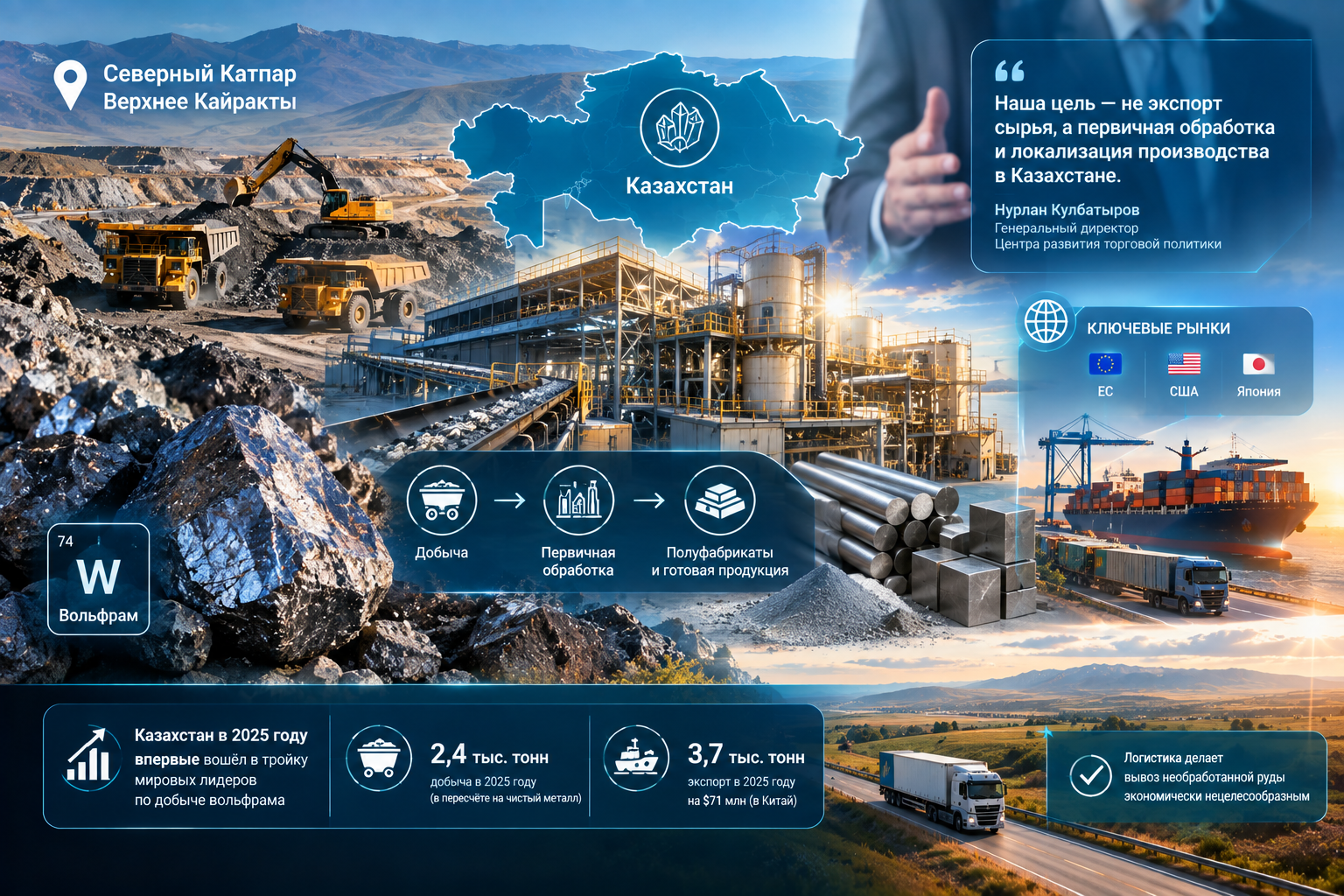
- On September 16, 2026, at a briefing, the Director General of the Center for Trade Policy Development, Nurlan Kulbatyrov, responded to journalists' question about the risks of exporting tungsten as cheap raw material under a foreign investors' mining project at the Northern Katpar and Upper Kairakty deposits in the Karaganda region.
- Kazakhstan's position is not to export raw material, but to carry out primary processing and localize production within the country; the logistics of transporting unprocessed ore to countries interested in rare earth metals (EU, USA, Japan) would be too expensive for exporting raw material specifically to make economic sense.
- In March 2026, Kazakhstan entered the world's top three tungsten producers for the first time — after the launch of the Boguty deposit with reserves of 285 thousand tonnes; according to USGS and SunSirs, in 2025 the country mined 2.4 thousand tonnes in terms of pure metal, trailing only China (67 thousand) and Vietnam (3 thousand).
- In 2025, Kazakhstan exported tungsten ore and concentrate abroad for the first time — 3.7 thousand tonnes to China for $71 million.
The official position and its rationale
Kulbatyrov stated the position bluntly: there is no goal to export raw material from the country, and the priority is "primary processing, localization of production in Kazakhstan." According to him, the logistics of delivering unprocessed ore to countries interested in rare earth metals — the EU, the USA, and Japan — would be too expensive, so producers of semi-finished products will most likely build capacity exactly where they sign the investment contract. He separately cited a purely economic argument — transporting ore over long distances is technically and financially difficult, so such a scenario is not even being seriously considered at present. According to him, rare earth metals are inherently complex products, and any investor will one way or another have to carry out primary processing and prepare semi-finished products before export, regardless of the initial agreements.
How Kazakhstan entered the top three
Kazakhstan's place among the largest tungsten producers did not take shape gradually, but thanks to the launch of one large facility — the Boguty deposit, whose development brought the country into the ranks of the world's leading suppliers of this raw material. In 2025, Kazakhstan exported tungsten ores and concentrates abroad for the first time in its history, sending the entire volume of 3.7 thousand tonnes to China for $71 million. If these data are compared with the figures of other countries, Kazakhstan surpassed all suppliers except North Korea, whose data are estimated only indirectly due to the country's closed nature. International experts expect that Kazakhstan's importance in the global tungsten market will continue to grow, including with the support of American investors.
Connection to the already familiar topic of processing
The Northern Katpar and Upper Kairakty deposits are already familiar to hunn.kz readers: we mentioned them in the context of Kazakhstan's molybdenum industry, where they appeared as major sources of that metal. The fact that the same facilities are now being discussed in the context of tungsten mining shows that complex deposits of this type often contain several valuable metals at once, which means the question of the depth of their processing becomes even more significant — in the future, several types of value-added products can be obtained from the same ore, not just a raw concentrate of one metal.
Kulbatyrov's position also directly echoes what Kazakhstan stated when it joined the global technology alliance Pax Silica in the summer of 2026 as the first in Central Asia: at that time, Deputy Prime Minister — Minister of AI and Digital Development of the Republic of Kazakhstan Zhaslan Madiyev spoke directly about the aspiration to move beyond the role of a raw material supplier and create technological value added within the country. Tungsten, being a critically important mineral for the production of hard alloys and electronics, falls exactly into the category of resources for which the alliance was created — which means the current dispute over the localization of its processing is a practical test of whether this declaration is ready to turn into concrete terms of concrete investment contracts.
Author's conclusion
The response from the representative of the Center for Trade Policy Development is notable for containing not only a political declaration about the unwillingness to be a raw material appendage, but also a quite pragmatic economic argument — simple logistics make the export of unprocessed ore over long distances unprofitable in itself, regardless of state policy. Whether economic logic alone will be enough to guarantee real localization of processing, or whether additional regulatory measures will be required, will become clear as concrete investment contracts at Northern Katpar and Upper Kairakty move from negotiations to practical implementation.
Comments ()