Kazakhstan entered the top 25 global leaders in per capita energy consumption.
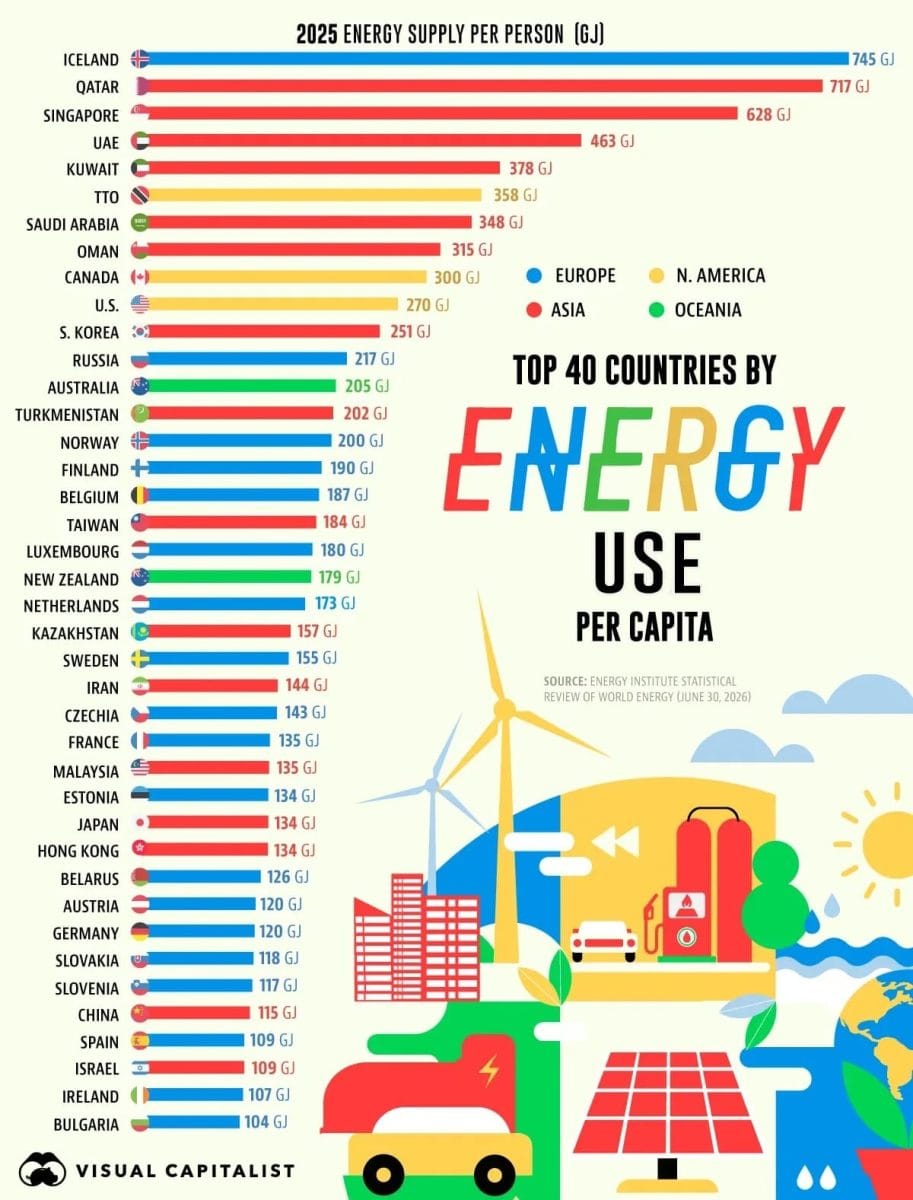
Fresh Visual Capitalist infographic ranks 40 countries by per-capita total energy supply in 2025 — Kazakhstan surprisingly ranks high at 22nd place.

At the top of the ranking is not the world's largest economy, but a small northern country with a population of less than 400 thousand people: the data reveals a pattern that also explains much about Kazakhstan's own position — the leaders are not the richest or most populous countries, but those whose economies are built around energy-intensive production.
The gist
- According to the Statistical Review of World Energy 2026 by the Energy Institute, Iceland ranks first in the world in total energy supply per capita — 745 gigajoules per person, thanks to its own hydro and geothermal resources and energy-intensive aluminum production.
- In second and third place are Qatar (717 GJ) and Singapore (628 GJ): both countries combine energy-intensive processing with a small population.
- The top eight of the ranking consists mainly of major oil and gas producers with relatively small populations: Kuwait, Trinidad and Tobago, Saudi Arabia, Oman.
- Russia ranks 12th (216.6 GJ per person), and the threshold for the top 40 is 104 GJ — the level at which Bulgaria sits.
- Kazakhstan ranks 22nd with 157 GJ per person — almost twice the global average.
Who leads and why
The total energy supply indicator covers the entire volume of energy entering a country's economy — fuel for industry, electricity generation, and transport — meaning it characterizes the energy consumption of the entire economy, not household energy use or the personal energy footprint of individuals. This is precisely why the leaders are not the most populous countries, but those where energy-intensive production is spread across a relatively small number of residents. Qatar processes, liquefies, and exports natural gas on an industrial scale, Singapore hosts some of the world's largest oil refining and petrochemical complexes, and Iceland powers its own aluminum production almost entirely from renewable sources.
The paradox of large economies
The geographic composition of the ranking is notable also for who is absent: no country from Africa or South America made it into the top forty, and the list is entirely made up of states from Europe, Asia, North America, and Oceania. Even more interesting is the behavior of large economies: China, with 115 GJ per person, ranks higher than Spain (109 GJ), even though Spain is noticeably wealthier per capita, while the UK (90 GJ), Italy (94 GJ), and Switzerland (98 GJ) do not make the top 40 at all. The reason lies in the structure of the economy: the world's largest coal consumer outpaces far more service-oriented European economies on a per capita basis.
What the indicator actually measures
The authors of the infographic specifically emphasize a methodological nuance: refining hubs and major fuel-exporting countries, such as Singapore and Qatar, expend significant amounts of energy producing goods and fuels that are then consumed in other nations. This is why small trading and industrial economies can rank higher than the world's largest energy consumers in absolute terms. The indicator reflects the energy consumption of the economy as a whole, not the everyday behavior of the population — a fundamental difference for interpreting such rankings.
Kazakhstan in this picture
Kazakhstan ranks 22nd in the ranking with 157 GJ per person — noticeably above the top-40 threshold (104 GJ for Bulgaria, which closes the list) and almost twice the global average. The logic is the same as for most countries in the upper part of the list: a relatively small population combined with an energy-intensive economic structure tied to the extraction and processing of oil, gas, coal, and metals. The climate factor adds to this — the long heating season at Kazakhstan's latitudes requires significant energy expenditures unknown to tropical commodity exporters like Qatar. Kazakhstan's position among similar resource-based economies shows that high per capita energy consumption in this ranking is not a consequence of the high living standards of ordinary Kazakhs, but a reflection of the structure of the entire national economy.
Author's conclusion
The Visual Capitalist ranking clearly demonstrates that per capita energy consumption is a deceptive indicator of well-being: a place in its upper rows says nothing about the comfort of ordinary citizens' lives, but rather about how energy-intensive the structure of the national economy is. For countries like Kazakhstan, whose economy has historically been built around the extraction and processing of raw materials, high per capita energy consumption is not a sign of excessive resource use, but a direct consequence of the industrial model — the same one that puts Qatar, Kuwait, and Saudi Arabia at the top of the ranking.
Comments ()