Kazakhstan included in US report on risks of re-exporting Chinese goods
The US administration added Kazakhstan and Uzbekistan to a list of countries at risk of re-exporting Chinese goods to bypass American tariffs.
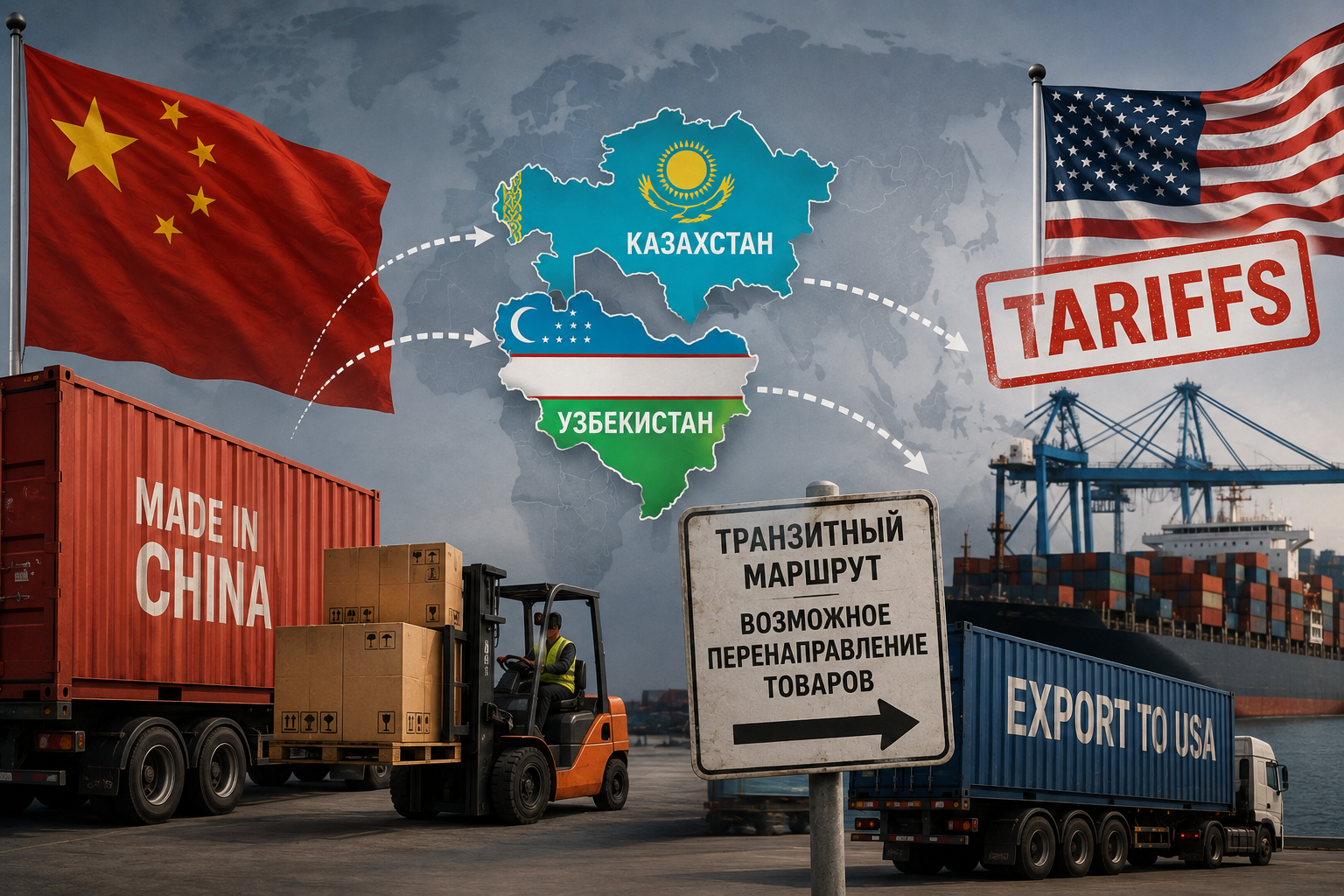
The wording sounds alarming, but upon closer inspection, this is not about an accusation but about risk classification — with specific practical consequences for Kazakh exporters and transit logistics.
The gist in brief
- Kazakhstan and Uzbekistan have been included in the report "The Great Transshipment Scam" published by the White House on August 13, 2026; in total, the document identifies over 40 countries and territories with an elevated risk of illegal re-export.
- Inclusion in the list does not mean an established fact of violation — the document does not name specific Kazakh companies, volumes of suspicious shipments, or proven cases of re-export.
- Kazakhstan and Uzbekistan have been assigned to the third, least severe of the three risk tiers (Tier 3) — unlike Tier 1 (Canada, EU, India, Japan) and Tier 2 (Vietnam, Turkey, Malaysia, and other countries with deeper integration into Chinese production chains).
- Separately, Kazakhstan and Uzbekistan, together with Azerbaijan and Georgia, have been assigned to the category of "land-based Belt and Road Initiative hubs" — that is, transit hubs consolidating cargo on the route from China to Europe.
How the scheme described in the report works
The American side understands illegal re-export as situations where goods from a country with a higher tariff burden are routed through a third state so that upon entry into the United States they appear to be products of a different origin — through repackaging, relabeling, reissuing documents, or minimal processing. At the same time, the report explicitly acknowledges the principle of "substantial transformation": if a genuinely new product with different characteristics emerges in a third country as a result of full-scale production, that country may lawfully be considered the country of origin. Simple assembly or cosmetic finishing does not automatically confer such status — everything depends on the specific production process.
Why Kazakhstan is on the list but not among the main offenders
The report's authors explicitly state: the significance of Tier 3 is determined not by the volumes of already recorded re-export, but by the presence of infrastructural and geographical factors that are theoretically attractive for building new routes — cheap labor, free economic zones, convenient access to ports and borders, and customs warehouses. In this list, Kazakhstan and Uzbekistan are joined by Azerbaijan, Georgia, Argentina, Jordan, Kenya, the UAE, and Singapore — that is, a wide range of countries that made the list more because of their geographical potential than because of already proven violations.
What this means for Kazakh exporters
The practical significance of the report lies not in the mere fact of being included in the list, but in the fact that the U.S. administration describes the Detective Border mechanism being developed, which uses artificial intelligence to identify suspicious shipments: analysis of routes, commodity classifications, corporate ownership structures, and production capacities using anomaly detection algorithms. For Kazakhstan, which is actively developing its role as a land transit hub between China, Central Asia, the Caucasus, and Europe, this means closer future scrutiny of certificates of origin for goods, the value of Chinese components in finished products, the ownership structure of exporting companies, and full documentary support for supply routes — above all for those who work with or plan to work with the American market.
Author's conclusion
The White House report is, in essence, a map of directions for heightened customs attention, not a list of already convicted violators. For Kazakhstan, appearing in Tier 3 does not create immediate trade barriers, but it sends a clear signal to exporters and logistics companies: as transit volumes through the country grow, so do the requirements for transparency of goods' origin. Those building export chains with an eye on the American market should ensure in advance that the documentation for each shipment withstands the "substantial transformation" test, rather than relying on the fact that the scale of Kazakh transit is still smaller than that of countries in more serious risk categories.
Comments ()