Kazakhstan prepares export duty on copper concentrate — Kazakhmys must receive raw materials
Kazakhstan's Ministry of Industry and Construction is considering an export duty on copper concentrate.
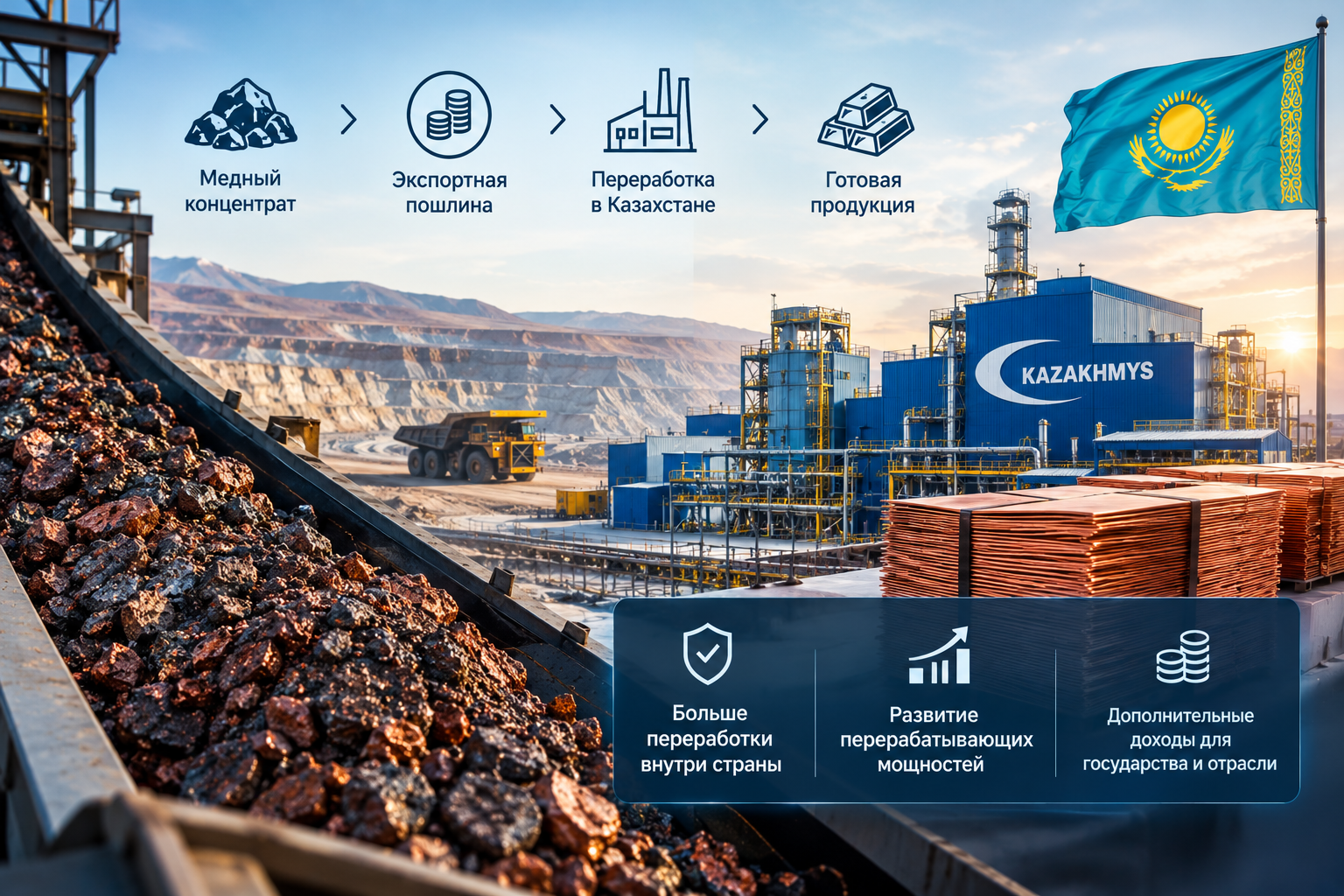
The official decision has not yet been made, and the timeline and the rate have not been determined, Inbusiness.kz reports. But the very fact that the issue has been raised is part of a systemic policy: Kazakhstan is consistently trying to stop the export of raw materials and force them to be processed within the country.
The gist in brief
- The Ministry of Industry confirmed: the issue of introducing an export duty on copper concentrate "is at the stage of elaboration." No final decision has been made, and the timeline and rate have not been determined.
- In parallel, a draft order "On approval of the Methodology for determining the tariff for processing copper concentrate" has been developed - it was posted on the "Open NPAs" portal and is awaiting approval.
- The methodology envisages an investment surcharge, through which it is planned to finance the modernization and construction of new processing capacities of Kazakhmys. Critics point out that it does not take into account the processor's income from by-product metals - gold and silver - or from the production of sulfuric acid.
- According to available data, mining companies have already been "strongly recommended" to send copper concentrate for processing to Kazakhmys rather than export it to China. The Ministry of Industry does not deny this information but emphasizes that decisions are made by producers "independently within the framework of current legislation."
- The cost of processing is determined by London Metal Exchange (LME) quotations and agreements between market participants.
A familiar logic: first a recommendation, then a duty
The current situation with copper concentrate reproduces an already familiar Kazakh scheme. First, informal pressure - "strong recommendations" to send raw materials for domestic processing rather than sell them to China. Then - the development of a regulatory mechanism that makes export economically unprofitable.
This is exactly the logic behind the tungsten story: Kazakhstan rejected concerns about exporting tungsten as cheap raw material and announced its intention to create processing within the country. Similar rhetoric is now being heard with regard to copper - only the instruments have become more specific.
The tariff methodology: who wins, who is unhappy
The methodology developed by the Ministry of Industry for determining the tariff for processing copper concentrate has raised questions among market participants. The essence of the complaints: the tariff calculation formula takes into account the processor's costs but not its income from by-product metals. Copper concentrate contains not only copper - it also contains gold and silver, and during processing sulfuric acid is produced, which is itself a commercial product.
Critics believe that the methodology in its current form creates an economically non-market tariff in favor of Kazakhmys - effectively obliging small concentrate producers to hand it over at below-market prices. Supporters, by contrast, consider this a fair payment for the construction of new processing capacities that will ultimately create added value within the country.
Copper in a strategic context
The story with the export duty is unfolding against the backdrop of broader ambitions. We have already written in detail about the fact that Kazakhstan intends to double copper production by 2030 - the development of the Aidarly, Koksay, Benkala, and Ayak-Kodzhan deposits should bring copper ore production to 300 million tonnes per year. Amid a structural global copper deficit and demand from electric vehicles, renewable energy, and data centers, this is the right moment to ramp up production.
But doubling production while maintaining raw material exports would mean doubling Kazakhstan's role as a supplier of cheap concentrate - primarily to China. This is precisely what the state is trying to stop: the transition from selling rare earth raw materials to processing them is a systemic task that Kazakhstan has set across the entire spectrum of the mining industry. Copper is just one of the fronts of this policy.
Author's conclusion
An export duty on copper concentrate is an instrument that, if applied correctly, can accelerate the construction of processing capacities. The risk lies in the details of the methodology. If the processing tariff turns out to be economically unfair for concentrate producers, it will create a conflict of interests within the industry and may slow down investment in mining. The state's task is to build a system so that domestic processing benefits all participants, not just the largest processor.
Comments ()