Kazakhstan proposes uniting farmers into irrigation condominiums
Half of Kazakhstan's 2.5 million hectares of irrigated land from 1991 has gone out of use, cutting its share in crop output from over 30% to 5–6%.
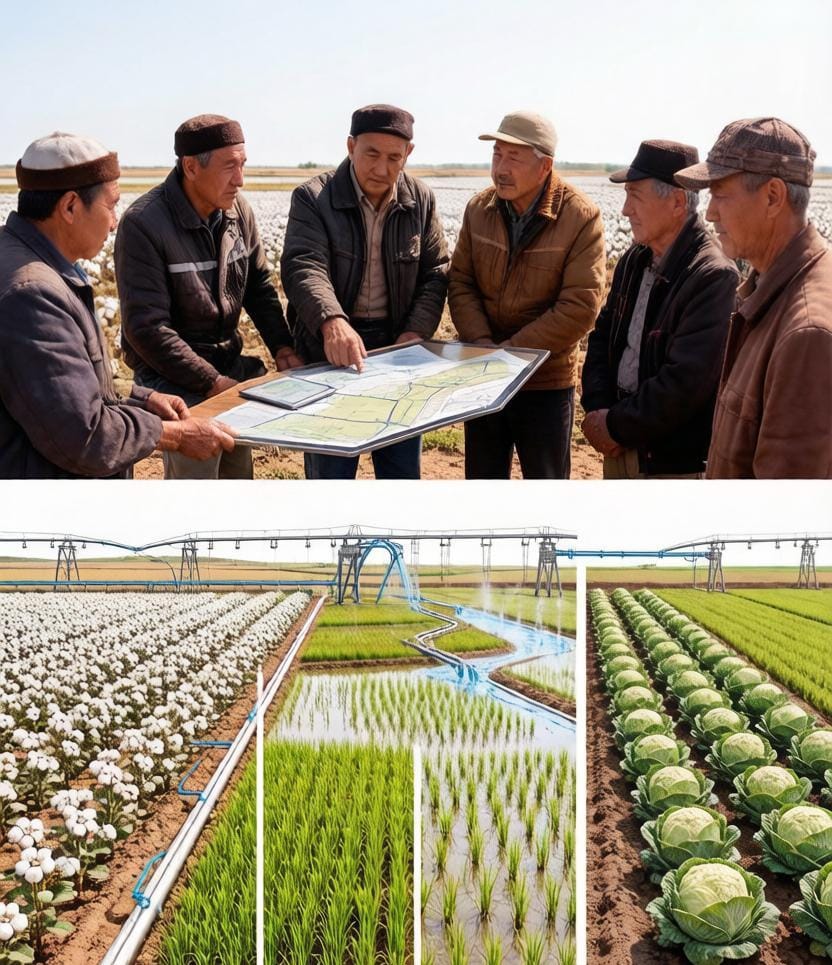
The Ministry of Water Resources and Irrigation proposes to stop this process not with repair funding, but by changing the very model of ownership of irrigation infrastructure — through the creation of irrigation condominiums.
The gist in brief
- The Ministry of Water Resources has published on the "Open NLA" portal a consultative document on regulatory policy for the draft law on amendments to the Land Code regarding irrigation condominiums; public discussion runs until August 26, 2026.
- According to the Supreme Audit Chamber, unproductive water losses in agriculture due to system deterioration reach 50% of water intake volume, and in canals with earthen beds up to 40% of water is lost to filtration into the ground before reaching the fields.
- Agriculture irreversibly consumes 70–80% or more of all the country's water resources — unlike industry and utilities, where up to 75% of water returns to water bodies, irrigation water is lost to evaporation and never returns.
- The model closest to Kazakhstan is Spanish practice — joint ownership of canals tied to land plots; the law is proposed to take effect in 2027.
Why this problem emerged
The reason this particular category of canals ended up in a legal vacuum is the Soviet legacy. The Water Code divides irrigation systems into mainline (interstate and interregional significance, state property), inter-farm (municipal or private property with clearly defined responsibility), and on-farm. The terms "inter-farm" and "on-farm" are inherited from Soviet times, when "farms" meant not today's small peasant farms but large state farms and collective farms. Formally, the Water Code already stipulates that on-farm systems are in shared joint ownership of agricultural water users, but in practice this norm remains declarative — the mechanism for managing, financing, and maintaining such property is not legally defined. As a result, some of these systems remain on the state balance sheet, with budget funds spent on repairing canals that sometimes serve only a few farms.
Climate background of the problem
The document reinforces the economic logic with climate data. According to RSE "Kazhydromet," from 1976 to 2024, the average annual temperature in Kazakhstan rose by an average of 0.36°C per decade, while precipitation is declining almost everywhere — in western and southwestern regions by 3–11% over the past ten years. Central Asia's glaciers are melting faster than anywhere else on the planet: the region has already lost about 44% of its glacier cover, with annual losses of about 1% of the remaining volume. In the annual Ecological Threat Report for 2025, the Institute for Economics & Peace places Kazakhstan in the "yellow zone" of risk for access to clean drinking water and water cycle resilience — meaning the problem has not yet reached a critical level but already requires timely attention. This aligns with the UN assessment, according to which the pressure on Kazakhstan's water resources already exceeds the water scarcity threshold of 34.6%.
How this works in other countries
The document's authors studied the experience of countries with developed irrigated agriculture, and here an important nuance emerges: in most of them, the key issues are not questions of ownership rights over shared canals, but rather their operation and financing. International practice worldwide relies on specialized Water Users Associations — a tool that FAO and the World Bank recommend for improving the efficiency of irrigation infrastructure operation. At the same time, the legal regime of shared co-ownership of canals, similar to the Kazakh model of irrigation condominiums, is not so widespread — it is most thoroughly regulated in Spain, Turkey, Mexico, and several US states.
The closest to the Kazakh model are the Spanish "irrigation communities" (Comunidades de Regantes), where a share in common irrigation property is legally tied to a land plot, and when the land is sold, the share transfers with it. In several US states, canals are managed by corporations or associations (mutual ditch companies, canal companies), and farmers own shares, each of which grants a right to a portion of water. In Mexico, the association itself, rather than users as co-owners, owns the networks, but all are obliged to finance it proportionally to area or water consumption volume.
The Turkish example as a benchmark
Special attention in the document is given to Turkey — an example that the World Bank and FAO regularly cite as a model of "participatory irrigation management." The state organization State Hydraulic Works (DSİ) builds large irrigation systems and remains the owner of mainline structures, but transfers management to irrigation associations (Sulama Birliği), which include all land users receiving water from the system. The associations set water delivery schedules, hire staff, clean canals, and collect payments from water users, while the state continues to finance the construction of new systems and capital repairs of mainline structures. The reform's results are telling: after management was transferred to water users themselves, payment collection rates rose significantly, operating costs decreased, and repair decisions began to be made faster — it is precisely this balance (the state responsible for large infrastructure, users for day-to-day operation) that the Kazakh authors of the document call a desirable benchmark.
Risks and next steps
The document directly names the main risk of the reform — increased costs for agricultural producers, who will have to co-finance the maintenance of systems previously serviced by the state. The only risk mitigation measure mentioned is informational and explanatory work, which in itself shows that the economic side of the reform for farmers is currently less developed than the international legal justification. The responsible body is the Ministry of Water Resources and Irrigation, with the relevant norms to be introduced into the Land Code in 2027. The reform's effectiveness is proposed to be assessed by several indicators, including the share of unproductive water losses in agriculture and the availability of a digital system for forecasting and accounting of water consumption, with indicators reviewed at least once every three years.
Author's conclusion
On-farm canals are the least visible part of Kazakhstan's irrigation system: they do not feature in high-profile statements about modernizing mainline networks and collectors, but it is precisely in them that, according to indirect estimates, many times more water is lost than in the more prominent large facilities. The Spanish, Turkish, and Mexican models show that such a reform can work — but only if the economic conditions for farmers prove manageable rather than becoming an additional financial burden on top of existing costs. The document does not yet provide an answer to this question, leaving it to future public discussion.


Comments ()