Kazakhstan to double agricultural output — goal announced at EAEU council
The 7th EAEU Agro-Industrial Policy Council meeting, chaired by Kazakhstan, was held in Almaty — and the occasion proved far more than ceremonial.
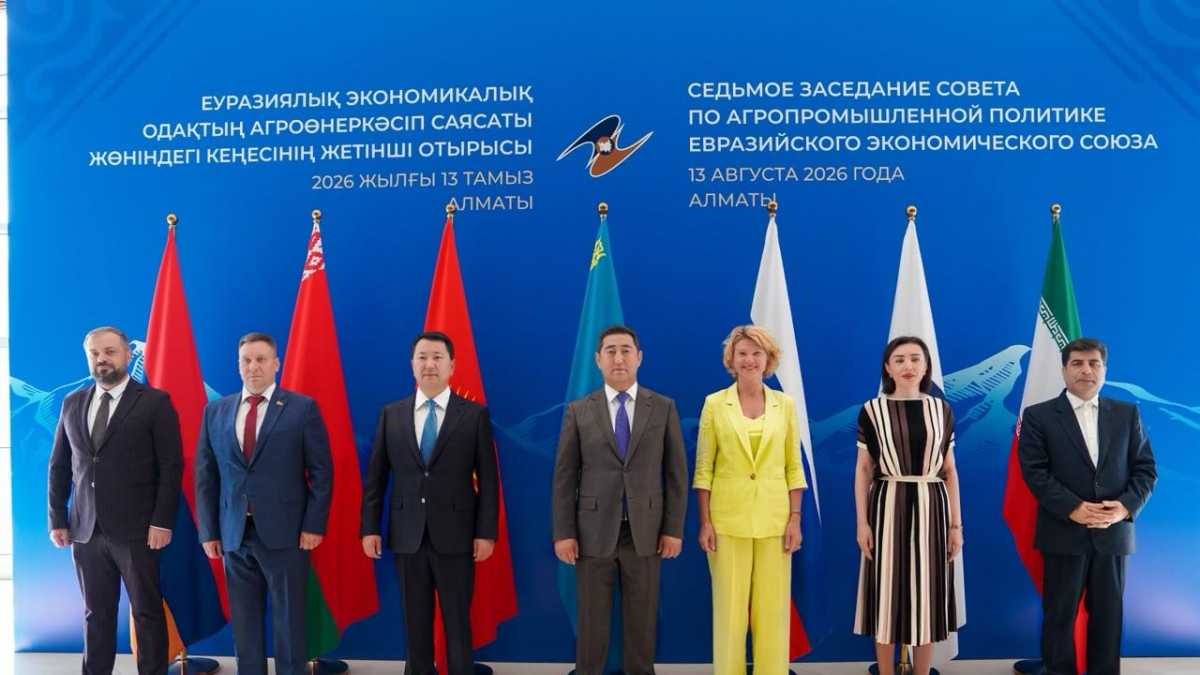
Minister of Agriculture Aidarbek Saparov announced the strategic goal of doubling the country's gross agricultural output, backing it with the impressive dynamics of the last five years, reports Kazlenta.kz.
The gist
- The meeting in Almaty was attended by EEC Minister for Industry and Agriculture Goar Barseghyan, agriculture ministers from Russia, Armenia, Belarus, Kyrgyzstan, and an observer from Iran.
- Over five years, Kazakhstan has increased preferential financing for the agricultural sector by 10 times — to $3 billion in 2025 and about $4 billion in 2026; gross agricultural output grew by 5.9%, to nearly $20 billion, with the strategic goal of doubling this figure.
- Kazakhstan's agricultural exports doubled in five years and exceeded $7 billion; over the past marketing year, the country exported 15.3 million tons of grain — 70% more than a year earlier, and the highest in 20 years.
- In May 2026, the World Organisation for Animal Health recognized Kazakhstan as a foot-and-mouth disease-free zone — the decision was supported by all 193 member countries, opening additional export opportunities.
Kazakhstan's agricultural figures
Minister Saparov outlined the priorities of the new stage of integration: "Today it is important to move from coordinating agricultural policy to implementing concrete joint projects. This concerns investments, deep processing, technologies, scientific developments, and the formation of new production chains."
Behind the growth figures lies a concrete industry structure: wheat production consistently exceeds 18 million tons with a total grain harvest of about 27 million tons, cattle population — over 8 million head, small ruminants — 21 million, horses — 4.6 million, poultry — 49.1 million. Kazakh agricultural products are now supplied to more than 70 countries worldwide, and the recognition of the country as a foot-and-mouth disease-free zone in May opens the door to markets previously closed due to veterinary restrictions.
EAEU as a whole — self-sufficiency and discrepancies in figures
Goar Barseghyan cited indicators for the Union as a whole: the EAEU's gross agricultural output in 2025 reached $167.5 billion, mutual trade grew by a quarter, and the overall level of food self-sufficiency stood at 93.5%. Russia's Minister of Agriculture Oksana Lut in her speech cited a similar but not identical figure — 94% EAEU self-sufficiency at the end of last year, noting that Russia had fully met domestic needs for key food items. The discrepancy of tenths of a percentage point between speakers is a common feature of operational data from different stages of calculation, not a substantive contradiction.
Digitalization and joint projects
A separate block of the agenda was devoted to the digitalization of the industry. Kazakhstan reported that 100% of agricultural land in the country has already been digitized, and state support for farmers is provided in electronic format; the integration of Kazakhstan's and Russia's information systems for exchanging phytosanitary certificate data has successfully passed international testing at the EEC platform. Kazakhstan proposed that its Union partners identify pilot projects for applying artificial intelligence in crop production and livestock farming, so that successful solutions could then be scaled to all EAEU countries. Another practical integration tool is the warehouse receipt system, the agreement on which entered into force on July 1, 2026: the mechanism allows agricultural products to be used as collateral for obtaining loans against grain and other goods. Separately, the parties began preparing an agreement on mutual recognition of halal products within the Union — an initiative put forward by Kyrgyzstan.
What this means for Kazakhstan's exports
The announced figures form an overall picture of the growing export orientation of Kazakhstan's agricultural sector, which we have already tracked piece by piece — from the growth of live livestock exports to China, Afghanistan, and Uzbekistan to the growing domestic demand for meat and milk recorded in consumption statistics. The record 15.3 million tons of exported grain and the recognition of foot-and-mouth disease-free status logically continue this trend — simultaneously opening new sales markets and providing grounds for that very goal of doubling gross output that Kazakhstan announced at the EAEU platform.
Author's conclusion
Behind the protocol wording "7th meeting of the Council on Agricultural Policy" lies a quite concrete claim by Kazakhstan to leadership in the Union's agricultural agenda — not only in terms of market size, but also in the growth rates of investment, exports, and digitalization of the industry. The task of doubling gross agricultural output is ambitious, but it is backed by the real dynamics of the last five years, not a bare declaration — which makes it a convenient benchmark to test in the coming years.
Comments ()