Kazakhstan's oil exports shift to new markets: shipments to Singapore, China, and Egypt surge
In first four months of 2026, Kazakhstan boosted oil and gas condensate exports by 3%, with a notable shift in supply structure.
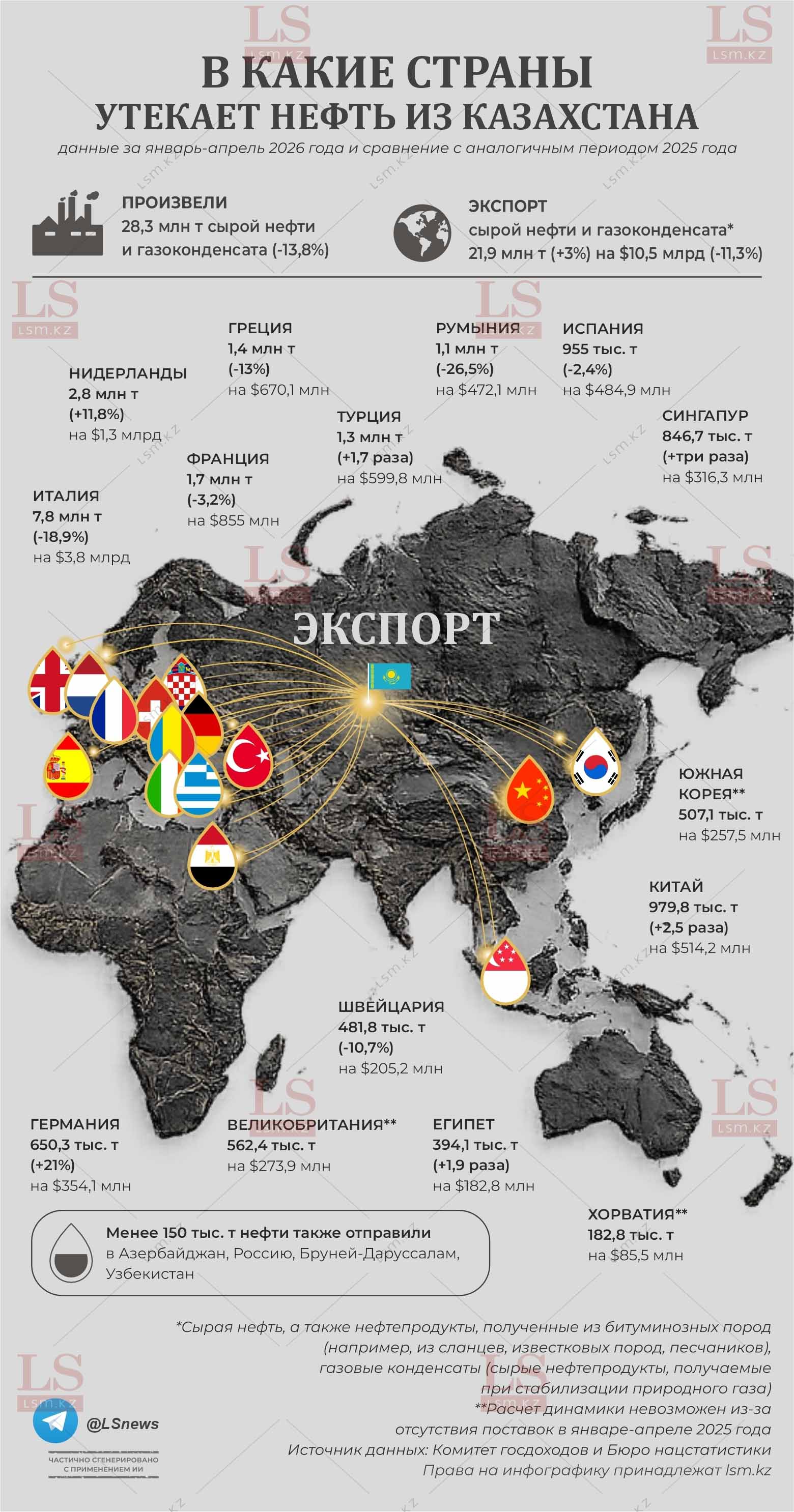
Despite the fact that Italy retained its status as the largest buyer of Kazakh oil, export volumes to this country fell by almost a fifth. At the same time, supplies to China, Singapore, the Netherlands, Turkey, and Egypt increased significantly, indicating a gradual diversification of export destinations.
In Brief
· In January–April, Kazakhstan exported 21.9 million tons of oil and gas condensate.
· The value of supplies amounted to $10.5 billion.
· Italy remains the largest buyer, despite a nearly 19% drop in imports.
· The most notable growth in purchases was shown by China, Singapore, Turkey, the Netherlands, and Egypt.
· New buyers included the United Kingdom, South Korea, and Croatia.
Europe Still Leads, but Demand is Changing
According to LS, in the first four months of this year, Kazakhstan supplied 21.9 million tons of crude oil and gas condensate abroad, which is 3% more than a year earlier.
The largest buyer remains Italy, but export volumes to this country decreased by 18.9% — to 7.8 million tons.
A decline in purchases was also recorded in France (1.7 million tons, -3.2%), Greece (1.4 million tons, -13%), Romania (1.1 million tons, -26.5%), Spain (955 thousand tons, -2.4%), and Switzerland (481.8 thousand tons, -10.7%).
This indicates that the traditional European market remains key for Kazakhstan, but demand within it is becoming less stable.
New Growth Points Emerge
At the same time, statistics show a notable expansion of supplies to other markets.
For instance, exports to the Netherlands increased by 11.8%, reaching 2.8 million tons.
Supplies to Asian countries grew particularly rapidly:
· to Turkey — by 1.7 times (to 1.3 million tons);
· to China — by 2.5 times (to 979.8 thousand tons);
· to Singapore — by three times (to 846.7 thousand tons).
Exports also increased to Germany (+21%, to 650.3 thousand tons) and Egypt (by 1.9 times, to 394.1 thousand tons).
Furthermore, in January–April, Kazakh oil was supplied for the first time in the comparable period of the previous year to the United Kingdom (562.4 thousand tons), South Korea (507.1 thousand tons), and Croatia (182.8 thousand tons).
Kazakhstan Gradually Diversifies Exports
Although Europe remains the primary sales market for Kazakh oil, statistics show a gradual expansion of the supply geography.
The growth in exports to China, Turkey, Singapore, and Egypt reduces dependence on individual buyers and makes the export system more resilient to changes in demand on the European market.
Given the high volatility of the global energy market, finding new destinations is becoming one of the key factors in maintaining export revenue.
What This Means for Kazakhstan
The expansion of the supply geography means that Kazakhstan is gradually adapting to changes in global energy trade.
If just a few years ago exports were primarily oriented towards European buyers, today countries in Asia and the Middle East are beginning to play an increasingly important role.
Earlier, Hunn.kz already reported on Kazakhstan's accession to the international initiative Pax Silica, which involves the development of high-tech industries, artificial intelligence, and deep processing of raw materials.
The growth in supplies to China, Singapore, and Egypt shows that this strategy is gradually beginning to be reflected in oil export statistics as well.
At the same time, the economy's dependence on the raw materials sector remains high. Therefore, for Kazakhstan, it is equally important not only to expand oil sales markets but also to increase the share of products with higher added value.
Author's Conclusion
The statistics for the first four months of the year show an interesting trend: Kazakhstan is not so much increasing its overall oil exports as changing their geography. While European buyers are reducing purchases, countries in Asia and the Middle East are showing increasing interest in Kazakh crude. In the long term, this kind of market diversification could become one of the factors ensuring the stability of oil exports amid the changing global energy landscape.
Comments ()