NBK analyzed who actually owns Kazakhstan's green energy sector.
Kazakhstan reports exceeding the presidential renewable energy target for the second year running. But behind the growth figures lies a question rarely asked in official statistics: who actually owns the new green capacity.
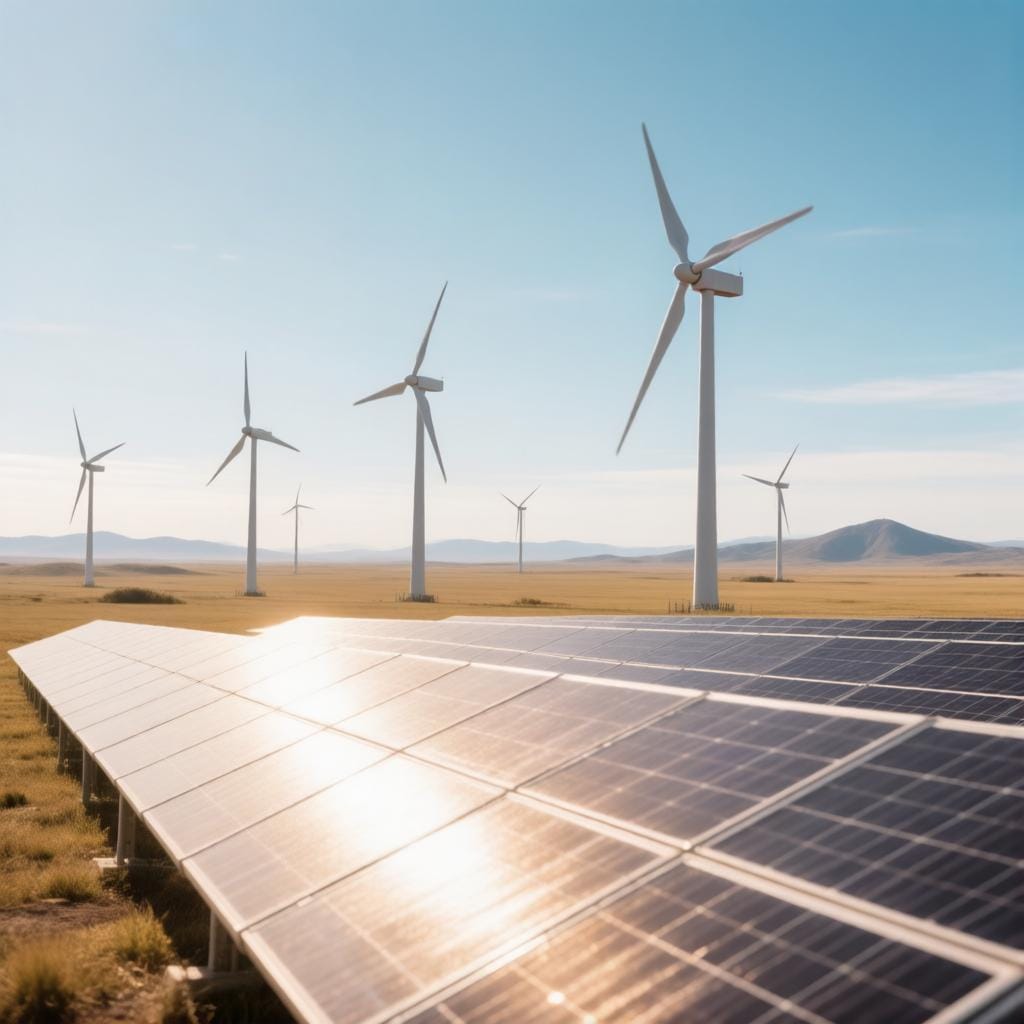
The publication National Business Kazakhstan (NBK) attempted to figure this out in a detailed investigation by columnist Geniyat Isin.
The gist in brief
- According to NBK, the share of renewables in Kazakhstan's energy balance grew from 4.5% in 2022 to 7% by the end of 2025 — while the planned target was a 1.5-fold increase, the actual growth exceeded 1.7 times.
- As the investigation showed, more and more new projects — from wind farms near Ekibastuz to solar fields in Turkistan — are being built and controlled by Chinese state-owned energy holdings, which increasingly act not as equipment suppliers but simultaneously as owners, creditors, and developers.
- Experts interviewed by NBK — honorary power engineer of the Republic of Kazakhstan Marat Kalmenov and former KEGOC president Asset Nauryzbaev — agree that the presence of Chinese capital is not a problem in itself; the question is the terms on which it is allowed into the country.
- The only project where localization has already been implemented in practice is the SANY Renewable Energy plant in Shu with a capacity of 2 GW of turbines per year and a plan for up to 490 permanent jobs; the agreement to build it was signed at the Belt and Road Initiative forum in Beijing.
Renewable growth against the backdrop of coal
NBK draws attention to an important nuance in official statistics: in percentage terms, renewables are indeed growing faster than coal generation, but in absolute figures the picture is different. According to KEGOC data cited by the publication, in 2025 output at thermal power plants grew by 3,273 million kWh, while at renewable facilities it grew by 1,083.3 million kWh. That is, with overall energy consumption rising, new solar and wind plants are so far primarily covering this increase in demand rather than displacing existing coal generation. Additional context provided by the publication: the average wear and tear of equipment at the country's 254 power plants stands at 56%, and it is precisely the combination of an aging fleet and growing demand that makes Kazakhstan especially open to external investors with ready-made equipment and fast construction timelines.
Who is actually building Kazakhstan's power plants
The key part of NBK's investigation is an attempt to build a typology of Chinese participation in Kazakh renewable projects, drawing on data from the research division Kursiv Research, which cross-referenced registries from the Ministry of Energy, the Development Bank of Kazakhstan, and the Asian Infrastructure Investment Bank. The pattern the publication identifies: Chinese companies are increasingly entering projects not just with equipment but acting as direct owners and developers — from Sarkylmas Kuat to projects by China Energy and SPIC. Financing itself is becoming a channel of influence: a significant portion of large projects is financed by Chinese state banks with repayment secured through guaranteed tariffs 15–20 years ahead.
What experts say
Marat Kalmenov, director of the processing and analysis department at the National Center for Energy Saving, frames the essence of the issue as follows: "For Kazakhstan, this is not only a question of dependence on Chinese technology and capital. It is simultaneously an opportunity to use their competitive advantages for our own interests... the question for Kazakhstan is not so much whether to let Chinese capital in, but on what terms it should enter."
Asset Nauryzbaev, who previously headed KEGOC, challenges in his NBK comment the thesis that external capital has no alternative — in his view, the more independent investors work in Kazakhstan's energy sector, including Chinese ones, the lower the systemic risk for the country, and the volume of investment Kazakhstan needs is not so large by the standards of Chinese capital that no room would remain for negotiating terms.
The only example of real localization
NBK notes that no public statistics exist on the share of local content in Chinese renewable projects, and the known data on jobs is modest — typically a few dozen permanent positions after construction is completed. The publication cites the SANY Renewable Energy plant in the village of Shu as the exception — the only project creating not just a power station but permanent industrial production of wind turbine components. The context of its emergence is also telling: the agreement to build the plant was signed not at a bilateral Kazakh-Chinese platform but at the Belt and Road Initiative forum in Beijing in October 2025.
Three requirements proposed by NBK
Based on the investigation's findings, the publication formulates three specific conditions that, in the opinion of its sources, would be worth building into agreements with foreign investors already at the negotiation stage: a mandatory localization threshold with measurable indicators for jobs and contractors, transparency of financing terms so that a guaranteed tariff does not turn into a closed channel for servicing someone else's debt, and a requirement for engineering transfer — training Kazakh personnel rather than just supplying ready-made equipment.
Author's conclusion
NBK's investigation is valuable because it shifts the conversation about Kazakhstan's green energy from the plane of "how many megawatts were built" to the plane of "who owns these megawatts and what will remain in the country after the plants are commissioned." For readers following the energy track on hunn.kz — from the Balkhash NPP to the hydropower plan and growing coal exports — this material adds an important dimension: the ownership structure and terms of capital admission matter no less for the country's energy independence than the very fact of growth in installed capacity.
Comments ()