Netherlands, Malaysia and Poland sharply increased purchases of Kazakh coal.
Kazakhstan's coal output fell in the first five months of 2026, while exports rose.
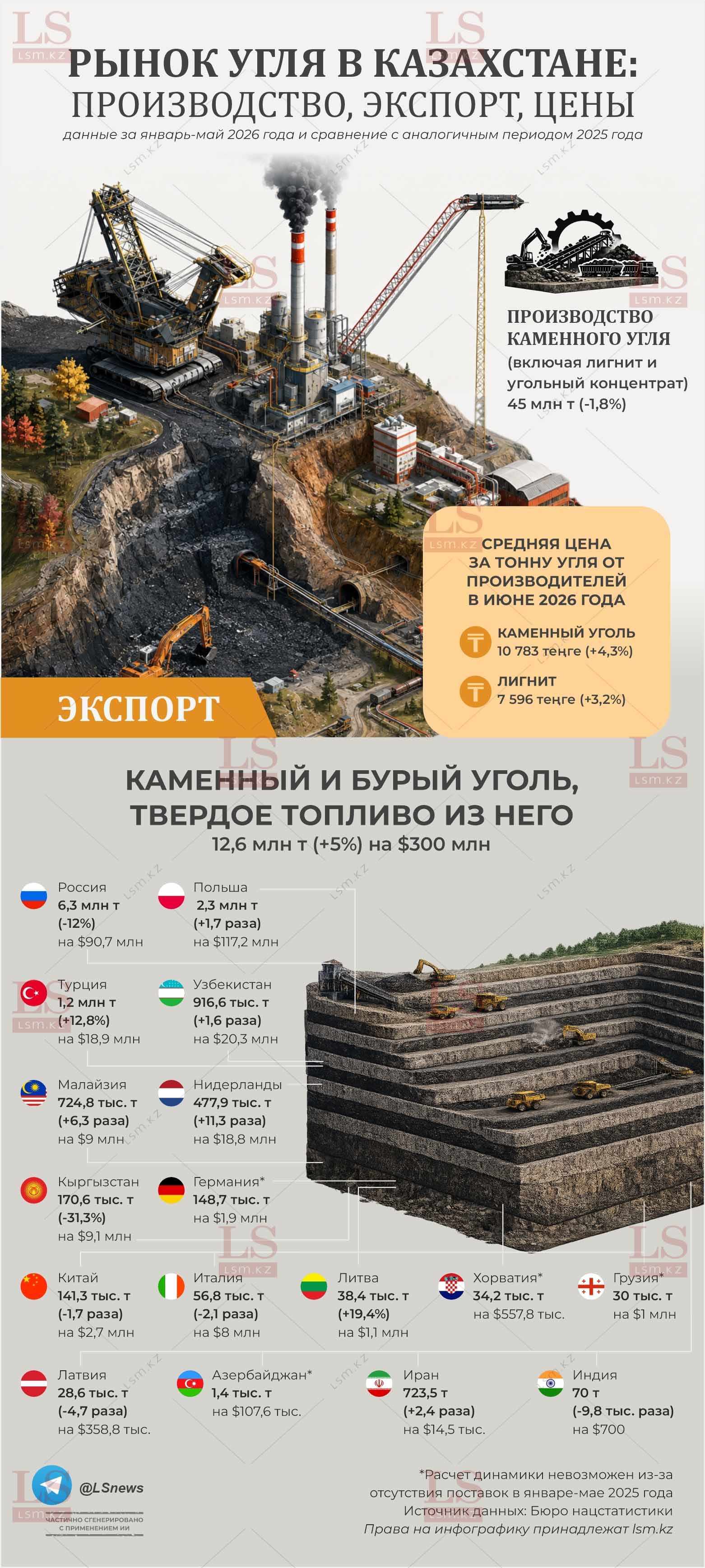
The structure of buyers has changed almost beyond recognition. India, which just a year ago was among the top five largest importers of Kazakh coal, has practically disappeared from the statistics, while the Netherlands and Malaysia have increased purchases severalfold, reports lsm.kz citing the Bureau of National Statistics of the Republic of Kazakhstan and the Ministry of Energy of the Republic of Kazakhstan.
The gist in brief
- In January–May 2026, hard coal production in Kazakhstan amounted to 45 million tonnes — 1.8% less than in the same period of 2025.
- At the same time, exports grew by 5%, to 12.6 million tonnes, bringing suppliers $300 million in revenue.
- Record growth was shown by the Netherlands (11.3 times, to 477.9 thousand tonnes), Malaysia (6.3 times, to 724.8 thousand tonnes) and Iran (2.4 times); Poland increased purchases 1.7 times, to 2.3 million tonnes.
- Exports to India collapsed almost 9,800 times — from 685.4 thousand tonnes a year earlier to just 70 tonnes, although as recently as last year the country was among the top 5 buyers.
Production falls, exports grow
At first glance, the two figures contradict each other: production of hard coal, lignite and coal concentrate in the country decreased by 1.8%, to 45 million tonnes, while the volume of supplies abroad grew by 5%, to 12.6 million tonnes. In practice, this means that with a declining total production volume, the share of coal going for export is increasing — that is, Kazakh producers are reorienting toward more profitable foreign contracts, while the domestic market receives less fuel. This is indirectly indicated by the dynamics of domestic prices: according to the Bureau of National Statistics, in June domestic producers raised the price of hard coal to 10.8 thousand tenge per tonne (+4.3%), and lignite to 7.6 thousand tenge (+3.2%).
Who sharply increased purchases
The geography of growth turned out to be unexpectedly broad. The Netherlands increased purchases the most — by 11.3 times, to 477.9 thousand tonnes, and Malaysia — by 6.3 times, to 724.8 thousand tonnes. Poland (by 1.7 times, to 2.3 million tonnes), Uzbekistan (by 1.6 times, to 916.6 thousand tonnes), Turkey (by 12.8%, to 1.2 million tonnes), Lithuania (by 19.4%, to 38.4 thousand tonnes) and Iran (by 2.4 times, to 723.5 tonnes) also significantly increased their volumes. At the same time, Russia remains the largest importer of Kazakh coal — 6.3 million tonnes were shipped there over the six months, although this is 12% less than a year earlier. Supplies to Kyrgyzstan (by 31.3%), China (by 1.7 times), Italy (by 2.1 times) and Latvia (by 4.7 times) also declined.
India has almost disappeared from the map
The most dramatic change in the statistics concerns India. A year ago, the country was among the top five buyers of Kazakh coal with a volume of 685.4 thousand tonnes over the comparable period. This year, only 70 tonnes were shipped there — a decline of almost 9,800 times, to a symbolic volume that previously could have been dismissed as a statistical error. Neither the original source nor the accompanying data from the Bureau of National Statistics provides an explanation for this collapse — likely reasons could include India reorienting toward other coal suppliers or logistical factors, but the statistics do not give a definitive answer.
New markets and the old leader
In addition to growth among previous buyers, the statistics show countries to which Kazakh coal was not supplied at all a year earlier — Germany, Croatia, Georgia and Azerbaijan. The appearance of Germany on this list is especially curious given the country's overall course toward abandoning coal-fired generation, although one-off contractual supplies do not necessarily reflect a long-term trend. Vice Minister of Energy Yerlan Akbarov previously reported that in 2026 Kazakhstan plans to produce 128.9 million tonnes of coal and sell 29.5 million tonnes abroad — meaning that based on the results of January-May, the country has completed approximately 35% of the annual production plan and 43% of the export plan.
Why this matters for Kazakhstan
Coal remains the backbone of Kazakhstan's energy sector even amid the actively discussed projects to build a nuclear power plant near Balkhash and develop hydropower. Until 2030, the country plans to implement a national project for the development of coal-fired generation worth at least 7.5 trillion tenge — comparable in scale to the amounts the state is directing toward modernizing the energy and utility sectors as a whole. The growth in export prices and physical volumes of coal supplies directly boosts the country's foreign currency earnings, but at the same time raises the question of the balance between export and domestic needs: if producers continue to increase the share of coal going abroad amid declining total production, this could intensify pressure on domestic prices — which are already growing faster than overall inflation.
Author's conclusion
Behind the dry figures of the infographic lies a restructuring of an entire export geography — India has almost disappeared, the Netherlands and Malaysia have grown severalfold, and new buyers such as Germany and Georgia have emerged. For an industry that must simultaneously ensure growing exports and avoid creating a deficit on the domestic market, such a restructuring is not a reason for complacency, but a signal to monitor the balance between these two tasks more carefully than before.

Comments ()