New rule on replacing foreigners with Kazakhstanis bypasses Tengiz, Kashagan and Karachaganak
Kazakhstan's Energy Minister announced new requirements for subsoil users: gradually replace foreign specialists with Kazakh ones on complex projects.
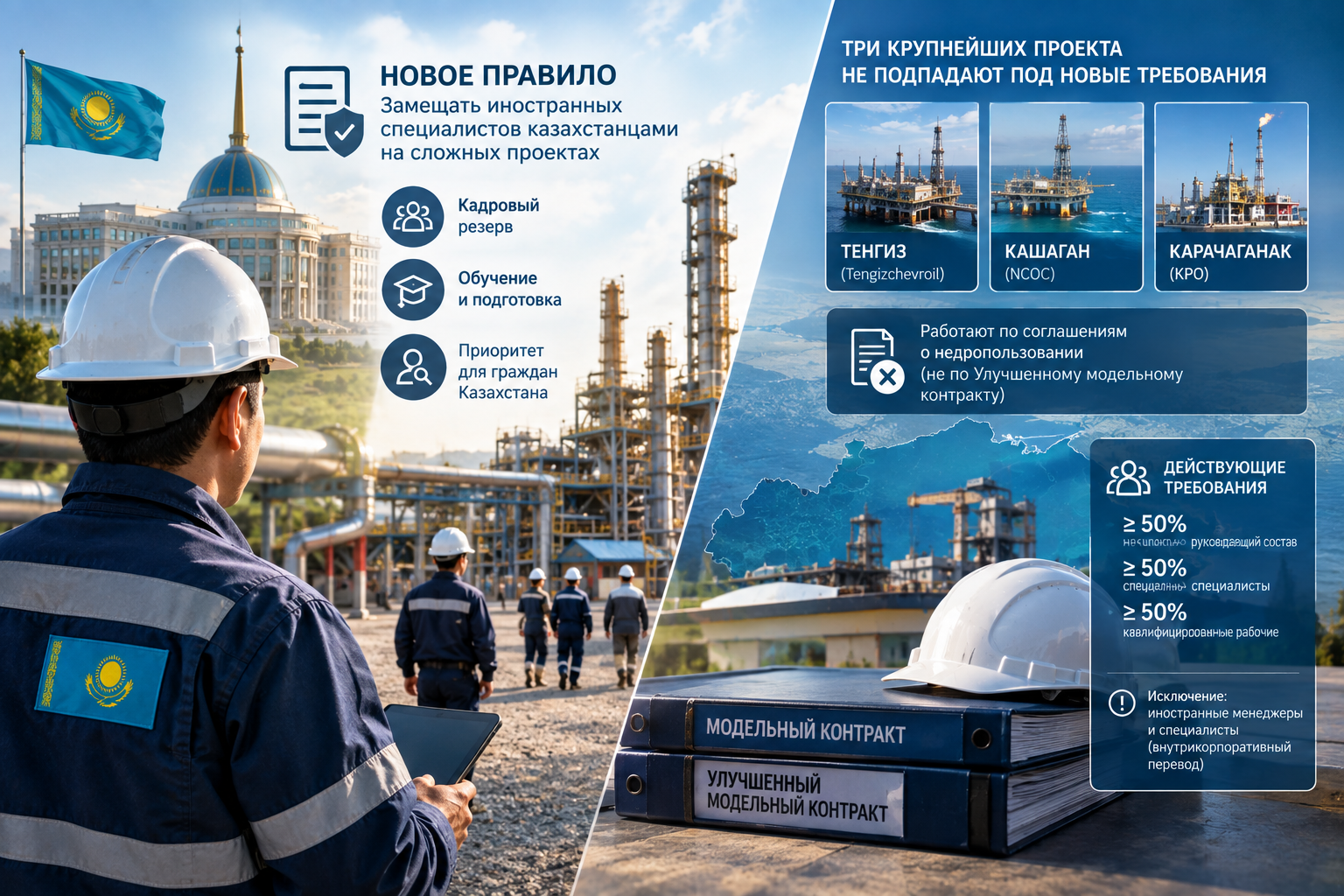
But the country's three largest oil and gas projects, where the issue of the share of foreign personnel is raised most often, do not formally fall under these rules, Kursiv.media reports.
The gist in brief
- Energy Minister Yerlan Akkenzhenov said at a government meeting that subsoil users implementing complex hydrocarbon exploration and production projects will be required to develop and coordinate with the Ministry of Energy programs to replace foreign personnel with Kazakh specialists.
- The requirement is enshrined in the Improved Model Contract (IMC) and envisages the formation of a personnel reserve, the training of specialists, and priority consideration of candidates who are citizens of Kazakhstan.
- The country's three largest oil and gas projects — Tengiz (Tengizchevroil), Kashagan (NCOC), and Karachaganak (KPO) — do not formally fall under the new program: the Ministry of Energy's press service confirmed that it does not apply to them, since these projects operate under earlier subsoil use agreements rather than the IMC.
- Already existing standard model contracts require at least 50% Kazakh personnel among management, specialists, and skilled workers — but with an exception for foreign managers brought in under intra-corporate transfer.
What the new program envisages
According to Akkenzhenov, the replacement program provides for several specific elements: the formation of a personnel reserve, the preparation and training of specialists for the subsequent replacement of foreign workers, and priority consideration of candidates who are citizens of Kazakhstan when hiring. The requirement applies to subsoil users working under the Improved Model Contract — a new form of agreement for complex exploration and production projects — and they are obliged to develop and coordinate the program with the Ministry of Energy on their own.
Why the largest projects remain on the sidelines
A key nuance that remained not fully clarified in the minister's report itself concerns precisely the three megaprojects that generate the greatest public interest — Tengiz, Kashagan, and Karachaganak. Formally, they do not operate under the Improved Model Contract, but under subsoil use agreements concluded back in the 1990s, long before the current model form of contracts appeared. The Ministry of Energy's press service subsequently confirmed directly: the program to replace foreign personnel with Kazakh specialists does not apply to these three projects. That is, the requirement publicly presented as a response to the question of personnel localization in the oil and gas industry formally bypasses precisely those projects around which this question is discussed most often.
Existing requirements and their limitations
This does not mean that Tengiz, Kashagan, and Karachaganak have no requirements for Kazakh personnel at all. Standard model subsoil use contracts already establish a minimum share of Kazakh specialists — at least 50% for management, at least 50% for specialists with higher and secondary vocational education, and at least 50% for skilled workers, including personnel on contract and subcontract work. But this rule has a significant exception: it does not apply to foreign executives, managers, and specialists brought in under intra-corporate transfer — that is, transferred to a Kazakhstan division from another country within the structure of the same international company. It is precisely through this channel that foreign operators can retain foreign specialists in key management positions while formally not violating the share requirements for the rest of the personnel.
The context of broader tension around Kashagan
The news about the personnel program appears against the backdrop of an already known confrontation around one of these three projects: we wrote that the collection of an environmental fine of 2.3 trillion tenge from the Kashagan operator NCOC became one of the most notable disputes between the state and an international consortium in the history of Kazakhstan's oil and gas industry. Against this backdrop, the question of whether new personnel localization requirements apply to such projects takes on additional significance — it is not only about jobs, but also about the broader balance between the state's interests and the terms on which the largest foreign operators operate in the country.
Author's conclusion
The Energy Minister's statement formally expands personnel localization requirements in the oil and gas industry, but the specific scope of the new program leaves out precisely those projects where the issue of the share of foreign specialists is raised by the public most often. This does not necessarily mean bad faith — the agreements on Tengiz, Kashagan, and Karachaganak were concluded on different terms decades ago, and revising them is a far more complex process than adopting a new program for future projects. But the very fact that the country's three largest assets formally remain outside the perimeter of the new requirements is worth keeping in mind when assessing how much the announced measure changes the real picture of employment in the industry.

Comments ()