Solar panels placed on water instead of fields in Ohio
A small town in Ohio found a way to get a solar power plant without using a single acre of farmland.
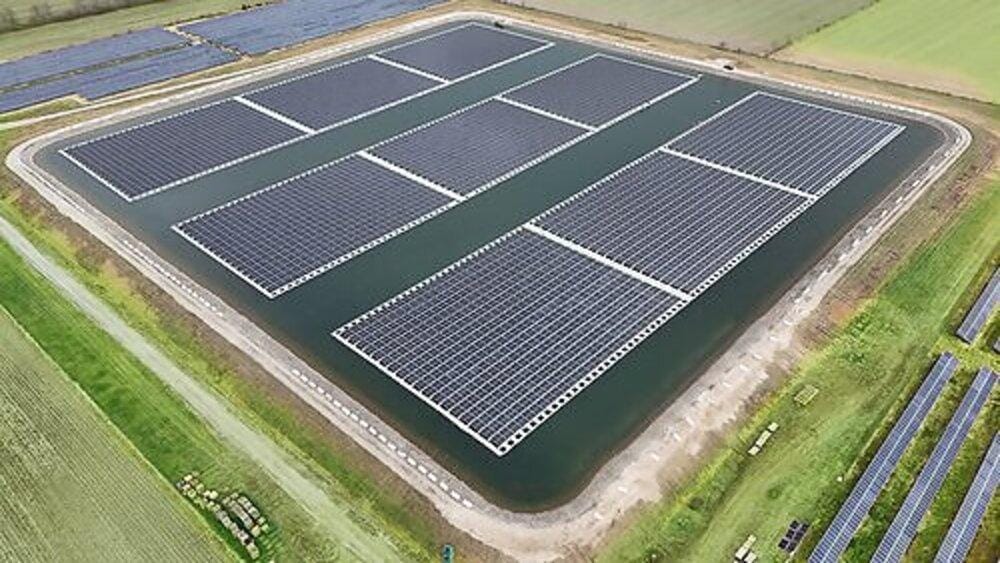
The panels were simply placed on the surface of an existing reservoir.
The gist in brief
- In the village of Monroeville (Ohio), a floating solar power plant with a capacity of 6 MW has been commissioned, consisting of 9,222 panels installed on three floating platforms on the surface of a reservoir.
- The panels occupy about 12 acres of water surface (roughly 4.9 hectares) — if placed on land, a plant of the same capacity would require around 30 acres of land (about 12 hectares).
- Thus, the project made it possible to preserve approximately 18 acres of farmland — more than 7 hectares of arable land that remained available for other purposes.
- This is already the second solar project for the village with a population of about 1,300 people: another 4 MW station has been operating here since 2017, and taking into account the new facility, the installed solar capacity per resident of Monroeville is roughly 13 times the state average.
Water that now serves two purposes
The managing director of the developer company D3Energy, Stetson Tchividjian, summed up the logic of the project briefly: Monroeville already had water performing one task, and now it performs two. The reservoir continues to fulfill its main function — water resource management — while simultaneously generating electricity. It is precisely this combination of functions that makes floating solar energy attractive where there is simply not enough free land for traditional ground-mounted plants, and converting farmland into industrial facilities is undesirable both economically and politically.
The regulatory context matters
The choice of the floating format in Ohio is not a coincidence but a direct consequence of local regulatory restrictions. About a third of the state's 88 counties have introduced restrictions on industrial ground-mounted solar power plants after a 2021 law expanded the powers of local authorities in this area. Monroeville has become D3Energy's third facility in Ohio — the company previously built similar stations for the Del-Co Water utility in the city of Delaware and at the Twin Lakes reservoir in Lima; in total, the three facilities provide the state with nearly 10 MW of floating solar capacity. Notably, in all three cases the stations were placed on water bodies already owned by utility or municipal entities — meaning the project required neither the purchase of new land nor a change in the designated purpose of the territory.
Part of a global trend
Such projects are appearing not only in the US — Naukatv previously reported on the world's first floating solar power plant made of bamboo in China and on the first offshore floating station in Spain. The general logic is the same everywhere: where land is becoming a scarce or politically sensitive resource, and a suitable water surface already exists and is not being used to its full potential, combining the functions of a water body and an energy facility becomes an economically justified solution.
Two solutions to the same problem
The competition between solar energy and agriculture for land is a topic we have already examined using the example of agrivoltaics. In Colorado, an unprofitable family farm became profitable after solar panels were raised above the same crop beds — the harvest and electricity generation share the same plot of land simultaneously rather than competing for it. A similar project has already been implemented in Uzbekistan, where grapes are grown under panels on ten hectares. The Ohio case offers a fundamentally different answer to the same challenge: instead of combining energy and farming on land, the panels are simply moved onto water, completely removing the question of land competition from the equation. For Kazakhstan, where we have already noted our neighbors' interest in agrivoltaics amid the absence of such projects within the country, the Ohio example adds yet another option to the list of potential solutions — especially for regions that have suitable reservoirs and where competition for irrigated farmland is already tangible.
Author's conclusion
The project in Monroeville is a good example of how a station that is relatively modest by global standards (only 6 MW) can become a showcase case thanks not to its scale but to the very principle: instead of competition for land between energy and agriculture, a solution has been found in which water performs two functions simultaneously. For regions with restrictions on using farmland for industrial facilities — whether regulatory, as in Ohio, or climatic and logistical — such an approach can remove one of the main barriers to the further growth of solar generation.
Comments ()