Nuclear power plants, uranium, and new refineries — the energy course of "Adilet
Kazakhstan holds vast oil, gas, coal, and uranium reserves, but the Adilet program insists long-term growth hinges not on extraction volumes but on deep processing and modernizing energy infrastructure.
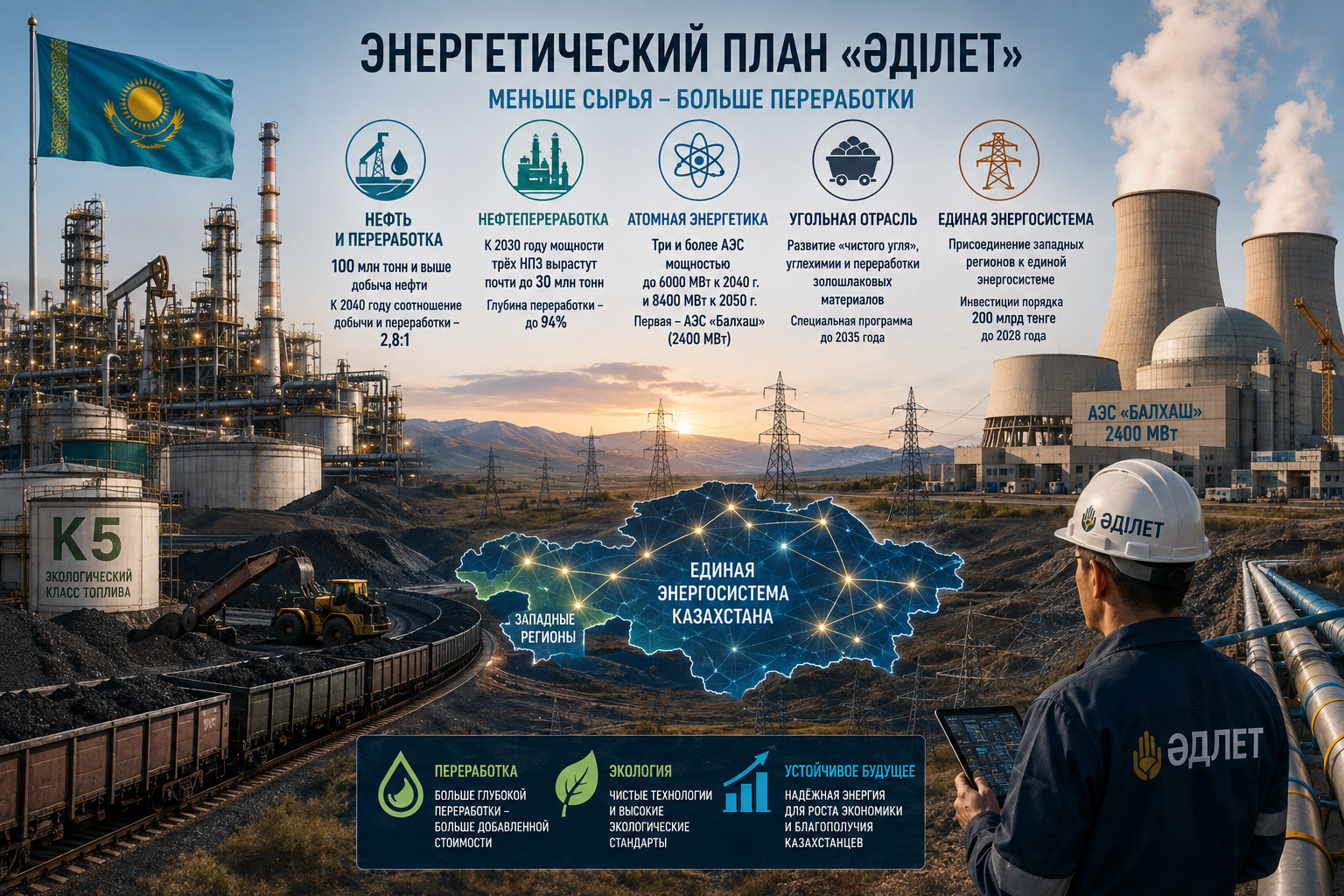
This logic — less raw material, more processing — is already familiar from the agricultural section of the program, where the party proposes a similar shift from exporting grain and livestock to flour and meat products. In energy, the same idea covers almost the entire complex — from oil refining to nuclear generation.
The gist in brief
- The party proposes maintaining oil production at 100 million tonnes or higher, improving the production-to-refining ratio from 5:1 to 2.8:1 by 2040.
- By 2030, the capacity of the three existing refineries will grow from 18 to nearly 30 million tonnes per year, and the refining depth — from 89% to 94%.
- Nuclear generation will receive three or more plants with a combined capacity of up to 6,000 MW by 2040 and 8,400 MW by 2050, starting with the Balkhash NPP with a capacity of 2,400 MW.
- The western regions of the country will be connected to the unified power grid — investments of about 200 billion tenge until 2028, so that no city depends on a single source of electricity supply.
From extraction to processing
The key source of commercial gas growth in the program is not increasing production as such, but building new gas processing facilities at the country's two largest fields, Karachaganak and Kashagan, capable of producing about 7.5 billion m³ of additional commercial gas per year. This is a direct continuation of processes already underway at these fields: interest in processing raw materials on site rather than exporting them as raw commodities fits into the modernization logic that at Kashagan has already led to stricter environmental requirements for the field operator — a seizure was recently placed on NCOC property in a case involving a fine for environmental violations, and Kazakhstan consistently demands that foreign field operators comply with environmental standards at all stages of work. The program applies the same principle to oil refining — expanding the capacity of three refineries to nearly 30 million tonnes per year and converting all produced motor fuel to the K5 environmental class.
Nuclear energy — from scratch to a serial project
The bet on nuclear generation is the most ambitious new chapter in Kazakhstan's energy sector in decades, and the first practical step has already been taken. The Balkhash NPP with VVER-1200 reactors with a total capacity of 2.4 GW is being built by Rosatom, and in January 2026 a decision was made to build a second plant — the program provides for at least three NPPs in total by 2040. This reactor type already has a working foreign precedent: the first serial VVER-1200 is undergoing final tests at Turkey's Akkuyu NPP, and test power generation there is planned to be launched before the end of 2026. A particular advantage for Kazakhstan is its resource base: the country is not in the top 5 global producers of mineral fuel by tonnage, but remains the undisputed leader in a much narrower and strategically significant category — uranium mining, holding 14% of world resources and second place in confirmed reserves. The demand for this leadership is already tangible: France tripled its purchases of Kazakh uranium this year and took first place among buyers.
Coal remains in the energy mix, but differently
The program does not imply abandoning coal — instead, the party is betting on developing "clean coal" and a special program for developing the coal industry until 2035, including applied research on coal chemistry and processing of ash and slag materials. This aligns with coal's current role in Kazakhstan's exports: from January to May 2026, the country increased coal exports to several countries at once — the Netherlands, Malaysia, Poland — even though production over the same period declined slightly. The program's goal is not to increase raw coal exports at any cost, but to develop more environmentally friendly technologies for its use domestically, while maintaining Kazakhstan's position as a significant supplier on the global market.
A unified power grid without weak links
Connecting the cities and districts of Western Kazakhstan to the country's unified power grid is a concrete and well-calculated task: 200 billion tenge in investments and an implementation period until 2028. It logically fits into the broader energy modernization picture the country has already launched: the national project "Modernization of the Energy and Utilities Sectors" provides for investments of about 13 trillion tenge for 2025–2029 in the energy and utilities sectors combined, including repairs to tens of thousands of kilometers of networks and commissioning of new generating capacity. The party's program adds a specific regional priority to this work — eliminating the dependence of individual territories on a single source of electricity supply, which directly increases the resilience of the country's energy system as a whole.
Author's conclusion
The energy section of the program of "Adilet" covers almost the entire complex — from oil and gas refining to nuclear generation, coal, and grid modernization — and does so not in isolation, but around a single idea: turning Kazakhstan's resources into finished products and reliable infrastructure domestically, rather than increasing raw material exports for the sake of exports. Many areas already have practical support — the NPP under construction, growing demand for uranium, developing coal exports — and the program's task is to bring these processes to a systemic result over the coming decades.
Comments ()