Only 36 countries in the world remain predominantly rural — and Kazakhstan is among them
Over 55% of the world lives in cities, while rural populations shrink sharply. Which countries resist urbanization most?
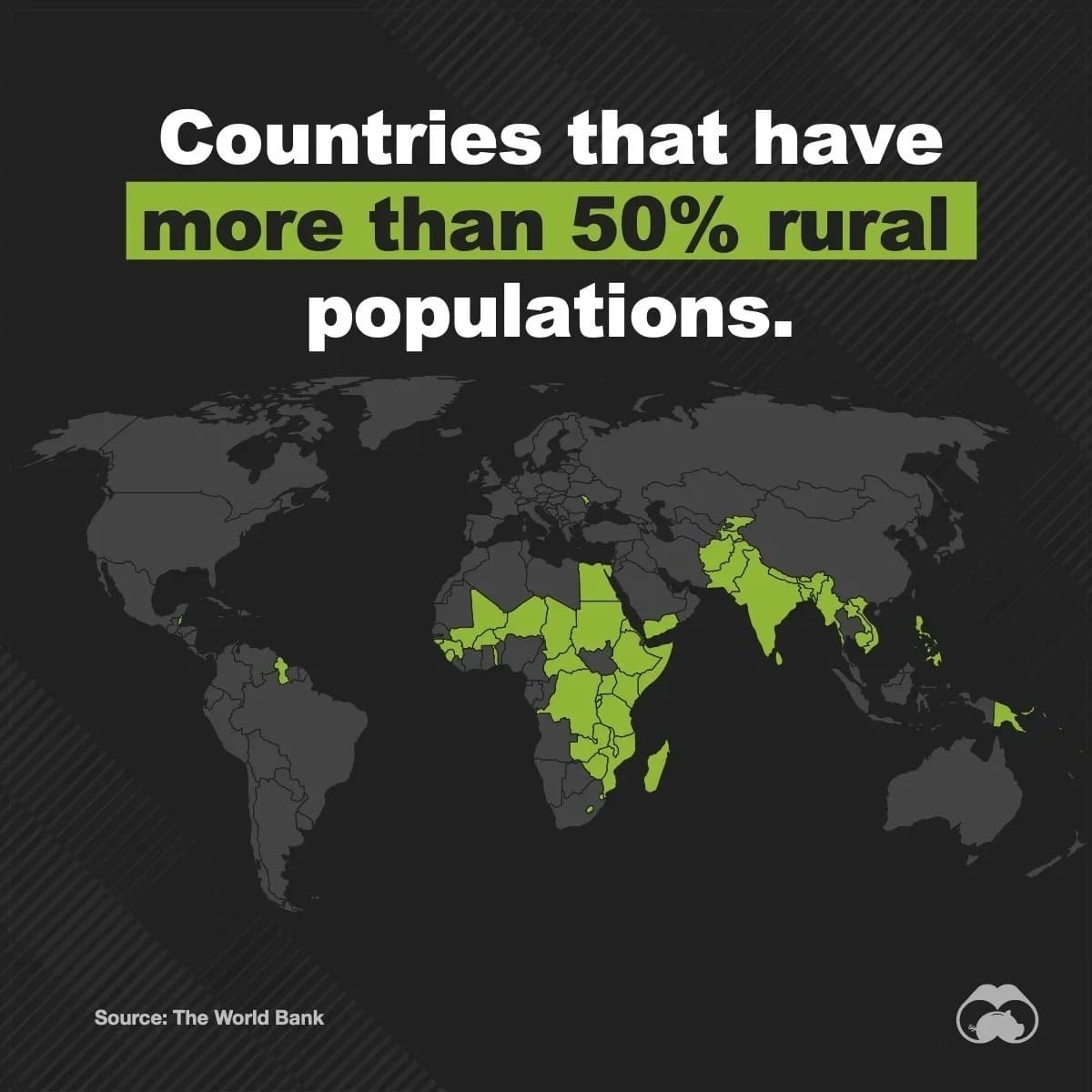
According to the World Bank, today only 36 countries in the world have a rural population exceeding the urban one, writes Naked Science. Most of them are Sub-Saharan African nations. Kazakhstan is part of this group: the share of the rural population in the country is about 44% — one of the highest rates among countries with a comparable level of economic development. For the agricultural sector, this is a resource. For the state, it is a systemic challenge.
In a nutshell
- In 1960, about two-thirds of the world's population lived in rural areas. Today, that share has shrunk to roughly 43%, and urban dwellers make up the majority of the Earth's population.
- The vast majority of countries with a predominantly rural population are in Sub-Saharan Africa. Among the leaders are Burundi, Malawi, Niger, and Sudan. Outside Africa — Nepal, Papua New Guinea, Cambodia, and East Timor.
- Urbanization was particularly rapid in East Asia, Latin America, and the Middle East. In most low-income developing countries, the rural population will still predominate for a long time.
- Kazakhstan, with a rural population share of about 44%, remains one of the few countries with high agricultural potential that retains a significant rural majority.
Global trend: the countryside gives way to the city
Urbanization is one of the main demographic trends of the last 60 years. As economies develop, jobs, education, healthcare, and infrastructure concentrate in cities, attracting populations from rural areas. This process is happening everywhere — just at different speeds.
In 1960, about two-thirds of the world's population lived in villages. Today — less than half. According to most demographic forecasts, the main growth of the planet's population in the coming decades will occur precisely in cities.
Why Africa remains rural
Sub-Saharan African countries are the undisputed leaders in the share of rural population. The reasons are structural: a young and rapidly growing population, a low level of industrialization, and agriculture as the basis of employment and the economy. At the same time, African cities are among the fastest-growing in the world — urbanization is happening, but it is not keeping pace with demographic growth.
The Kazakh context
Kazakhstan is a rare case of a country with a large economy and a significant rural population simultaneously. About 44% of Kazakhs live in rural areas — higher than in most countries with a similar GDP per capita. This ratio is due to historical factors: a vast territory, traditional livestock farming, and the Soviet settlement system.
For the agricultural sector, this is an obvious resource: a significant part of the workforce in the agro-industrial complex, deep-rooted agricultural traditions, and proximity to the land. For the state, it is a systemic challenge: to provide quality services, infrastructure, jobs, and income for tens of thousands of settlements scattered across a huge territory.
That is why the topics we regularly cover — preferential lending for the agro-industrial complex, agricultural product processing, digitalization of agriculture, and access to healthy nutrition — are not abstract discussions, but issues that concern almost half of the country.
Author's conclusion
The world is becoming urban — but unevenly and not simultaneously. 36 countries with a predominantly rural population are not backwardness, but a special type of economy requiring special solutions. For Kazakhstan, rural Kazakhstan and urban Kazakhstan are not two different worlds, but two poles of one task: how to turn agricultural potential into sustainable prosperity for those who live on the land.

Comments ()