Over $4 million may be allocated to Kazakhstan's climate projects
Kazakhstan's International Green Technologies and Investment Projects Center (IGTIC) is advancing climate finance—from livestock methane reduction to forest-climate projects.
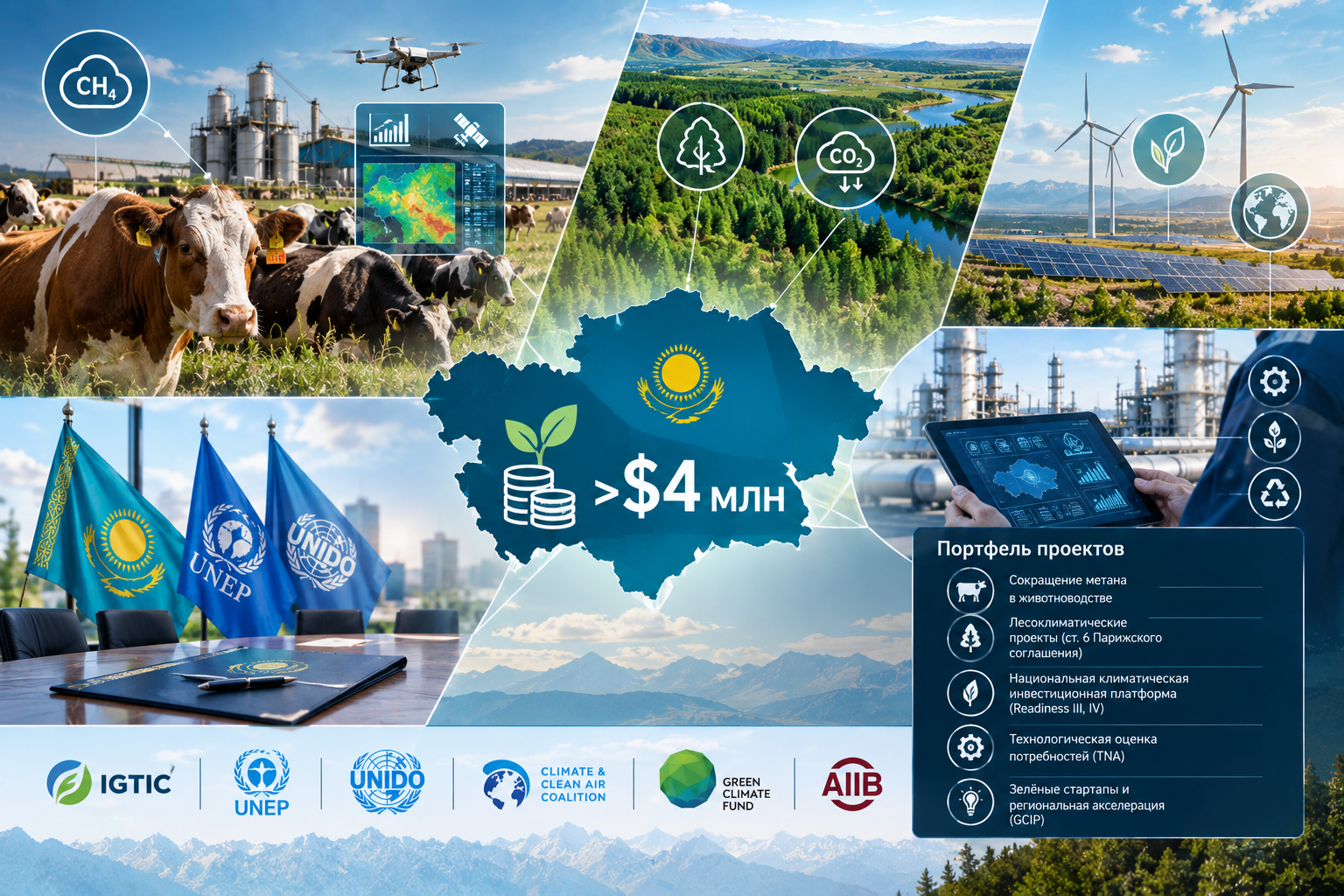
The final sum may exceed $4 million, but most of this money remains not yet approved, but merely discussed financing, reports the Ministry of Ecology and Natural Resources of the Republic of Kazakhstan.
The essence in brief
- IGTIC discussed financing and technological cooperation with representatives of UNEP and UNIDO during Baku Climate Action Week; this is not about a single already-approved package worth $4 million, but about a portfolio of projects at various stages of readiness.
- The most concrete direction is an application for financing of up to $1 million from the Climate and Clean Air Coalition for a project to reduce methane emissions in agriculture, primarily in livestock farming, including the creation of a measurement, reporting and verification (MRV) system.
- The creation of a national climate investment platform within the framework of the Green Climate Fund's Readiness III program with a planned budget of about $1 million is being discussed, as well as continued cooperation in the Readiness IV cycle.
- Forest-climate projects under Article 6 of the Paris Agreement are being developed separately — Kazakhstan has already developed rules for the implementation of carbon projects following the summer 2026 amendments to the Environmental Code.
Methane in livestock farming — the most concrete direction
The project to reduce agricultural methane has advanced further than other initiatives — IGTIC, together with the Climate Change Coordination Center, has already submitted an application to the competition announced for Kazakhstan by the Climate and Clean Air Coalition. This is not about simply installing equipment on farms: the project involves assessing sources of agricultural methane, identifying the most effective ways to reduce emissions, preparing regulatory requirements, creating an MRV system, and using satellite and geospatial data for precise emission control. Particular attention is planned to be paid specifically to livestock farming and manure management — one of the main sources of agricultural methane. An important part of the initiative is to turn the identified solutions into ready-made investment projects capable of attracting public, private or international financing, rather than remaining at the level of recommendations.
Forest projects and the link to the carbon market
A separate direction of negotiations with UNEP concerns forest-climate projects under Article 6 of the Paris Agreement — a mechanism allowing countries to cooperate in reducing greenhouse gas emissions and transfer to each other recognized results of such work. For Kazakhstan, this opens the prospect of considering afforestation and other nature-based solutions not only as environmental measures, but also as a source of international climate financing. The topic logically continues what we have already covered: the bottom of the dried-up Aral Sea released 748 million tons of CO₂ into the atmosphere, and scientists proposed monetizing its restoration specifically through the sale of carbon credits — similar logic is now being officially enshrined at the level of state regulation, and not only in scientific proposals. Practical experience with reforestation in the country is already accumulating: near Astana, with the participation of Chinese scientists, tree species resistant to the steppe climate are being tested within the framework of the "Green Belt" project — such developments could in the future become the basis for larger forest-climate projects seeking international carbon financing.
Technologies that Kazakhstan specifically needs
Another project is the country's Technology Needs Assessment, implemented by the Ministry of Ecology together with the UNEP Copenhagen Climate Centre and IGTIC with financial support from the Asian Infrastructure Investment Bank at a cost of about $300 thousand. The work has already reached its final stage — preparation of the Technology Action Plan, and the main areas of assessment were energy, agriculture and waste management. The project's task is not to compile a general list of promising technologies, but to identify specific solutions most useful specifically for Kazakhstan, and to prepare roadmaps for their implementation. It is telling that agriculture appears in the TNA as one of the three priority sectors at the same time as the country already has in force the law "On Soil Protection," which introduces a mandatory land passport and a unified soil monitoring system — both directions are moving toward the same goal of systemic management of the state of land resources, simply from different sides: one through a technology needs assessment, the other through direct legislative regulation.
Green startups as a regional model
Since 2023, Kazakhstan has been implementing the Global Cleantech Innovation Programme (GCIP) with the support of UNIDO and the Global Environment Facility — over three cycles, about 100 startups have completed acceleration with combined revenue of over $2 million, and the country remains the first in Central Asia where the program has been fully implemented at the national level. Now the possibility of transferring this model to the entire region through a green acceleration hub is being considered — that is, Kazakhstan's experience could become the basis for similar programs among its neighbors.
An important caveat
The sum of over $4 million is not a single tranche already received, but an aggregate of projects at different stages. From open sources, the CCAC agricultural methane project worth up to $1 million, the planned Readiness III budget of about $1 million, and financing for the TNA work are confirmed, but the methane project is still undergoing competitive selection, negotiations on Readiness continue, and forest projects are only being formed. It would be more accurate to speak not of Kazakhstan having already received the stated sum, but of an emerging portfolio of initiatives with potential financing.
Connection to an already familiar picture
The development of climate financing logically complements the topic we have already covered: Kazakh farmers can already earn up to $40 per ton of CO₂ through regenerative agriculture via the international carbon market Verra. IGTIC's initiatives and the national regulatory framework for carbon projects create an institutional foundation for such initiatives at the state level — that is, private projects like farmers' carbon units and government negotiations with UNEP and UNIDO are moving in the same direction almost simultaneously.
Author's conclusion
IGTIC's project portfolio shows that climate financing for Kazakhstan is gradually transforming from one-off grants into systemic institutional work — with a regulatory framework, a technology needs assessment, and the creation of an investment platform to coordinate various sources of funds. For now, the concretely confirmed portion of the stated $4 million remains modest by global standards, but the architecture itself — from methane in livestock farming to forest-climate projects — shows that the country is building not individual initiatives, but an interconnected system capable of eventually attracting financing on a much larger scale.

Comments ()