Pakistan considers joining the Middle Corridor
The China-Central Asia-Europe transport route via the Caspian, Azerbaijan, Georgia, and Turkey has drawn interest from another country.
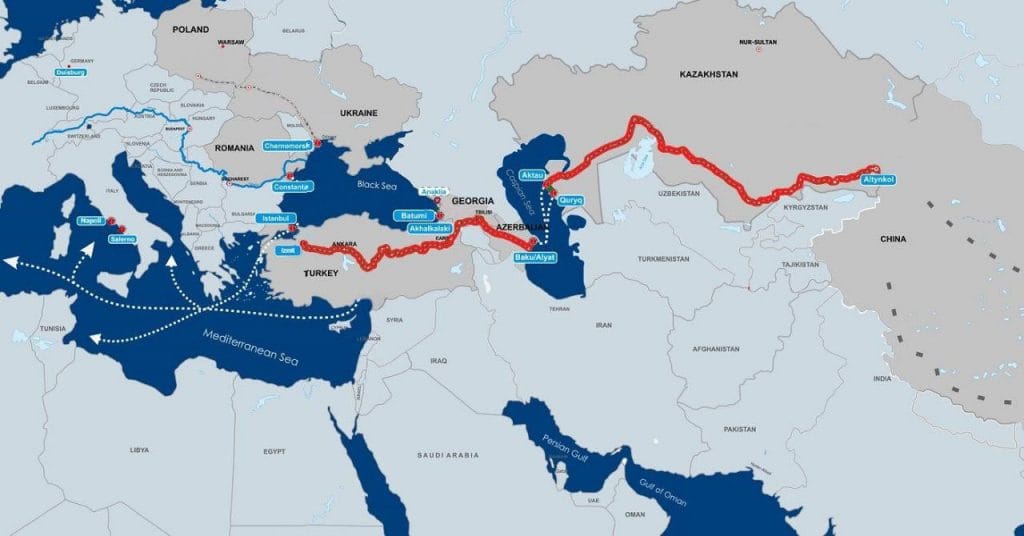
Pakistan is eyeing the Middle Corridor as a way to turn its Arabian Sea ports into full-fledged gateways for the landlocked part of Eurasia — and this comes amid the route as a whole growing cargo traffic several times faster than expected.
The gist
- Pakistan has shown interest in joining the Middle Corridor — the route linking China and Central Asia with Europe via Kazakhstan, the Caspian Sea, Azerbaijan, Georgia, and Turkey.
- Cargo volumes along the corridor have grown nearly fivefold since 2019 — from 0.7 million tonnes to over 4 million tonnes.
- For Pakistan, participation means integrating the ports of Karachi and Gwadar into an already functioning Eurasian system, bypassing unstable land routes through Afghanistan.
- The Kazakhstani section of the corridor is already ramping up cargo flows: handling of Uzbek cargo through the ports of Aktau and Kuryk grew by more than 60% in 2025.
Why Pakistan needs the Middle Corridor
Pakistan has long positioned itself as the maritime gateway for Central Asian countries — through the ports of Karachi and Gwadar — but this role has largely remained declarative: land routes to the region via Afghanistan are unstable and do not provide predictable transit. Joining the Middle Corridor solves this problem differently — not through the Afghan section directly, but by integrating Pakistani port capacity into an already functioning system where the land leg from the Caspian to Europe is provided by Kazakhstan, Azerbaijan, and Georgia. For Pakistan, this means access to cargo flows forming between China, Central Asia, and Europe, as well as an incentive to modernize its own port and customs infrastructure to meet the corridor's common standards.
Corridor growth in numbers
Pakistan's interest did not emerge out of nowhere — the route has indeed shown multiple-fold growth since 2019, when cargo volumes did not exceed 0.7 million tonnes. This growth is driven by investments from several corridor participants at once. Azerbaijan has modernized the Baku–Tbilisi–Kars railway, reconstructing 153 km of track and building another 27 km to European standards, which quintupled the line's capacity — from 1 to 5 million tonnes of cargo per year. In parallel, the Kazakhstani section of the route is developing: port capacities at Aktau and Kuryk on the Caspian are being expanded, and Kazakhstan's Deputy Prime Minister Olzhas Bektenov has earlier called ensuring reliable sea access for Central Asian states through Kazakhstani ports a national priority.
Kazakhstan's role in this system
The Kazakhstani section of the corridor is not just a transit territory but an actively developing hub of the country's own logistics strategy. The Aktau International Sea Trade Port, Kazakhstan's largest maritime transport hub, handles oil and petroleum products, grain, metals, and container cargo, while the more than 60% growth in handling Uzbek cargo through Aktau and Kuryk in 2025 shows that interest in the route is rising not only from distant countries like Pakistan but also within Central Asia itself. In parallel, Kazakhstan and Azerbaijan are developing the digital dimension of the same corridor — the completed laying of a fiber-optic cable along the Caspian seabed is expected to complement the cargo route with data flows, forming a broader infrastructural link between the two countries.
Author's conclusion
Pakistan's interest matters not so much in itself but as an indicator of the route's maturity: countries are no longer waiting for the Middle Corridor to be fully formed but are already seeking their own place within it. For Kazakhstan, which is developing its section of the route in parallel with Azerbaijani and Georgian investments, this means growing cargo flows through its own ports and an additional argument that investments in Caspian port and railway infrastructure pay off not only through regional neighbors but also through increasingly distant participants in Eurasian logistics.
Comments ()