Potato variety bred in China grows on saline soils with yield of 45 t/ha
After over 20 years of research, the National Potato Engineering Research Center and Xisen Potato Industry Group developed salt-tolerant potato varieties for the Yellow River Delta's saline-alkali soil.
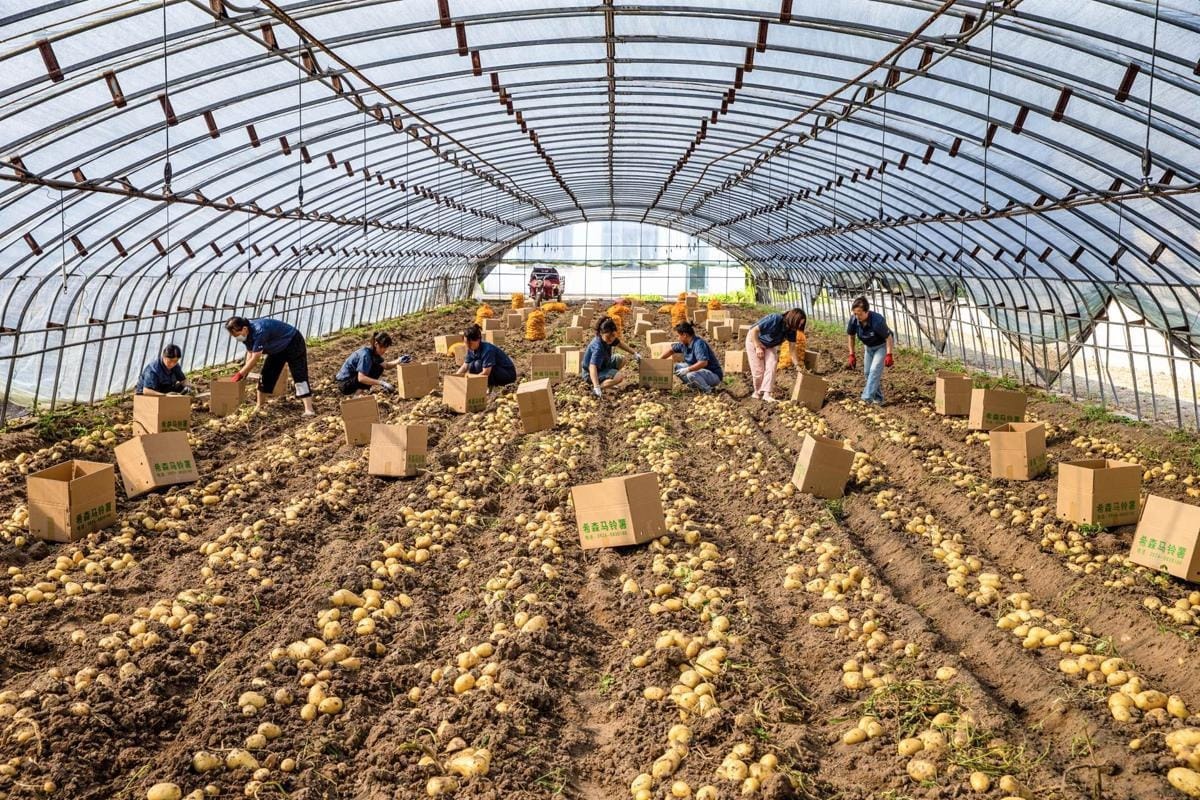
Technology paves the way for using lands previously considered unsuitable for agriculture — a relevant topic for Kazakhstan as well, where soil salinization remains a chronic problem in the agricultural south.
In Brief
- Joint efforts have created China's leading genetic resource bank for salt-tolerant potatoes — over 2,800 preserved samples. A standardized salt tolerance evaluation system has been developed, and six new varieties have been bred.
- The Xisen No. 53 variety showed a yield of over 3,000 kg per mu (approximately 45 tons per hectare) on saline soils with a salt concentration of 5‰.
- Improved varieties and agronomic technologies have already been implemented on an area of over 10,000 mu (approximately 666.67 hectares) in the Yellow River Delta — offering a scientific solution for food security and the development of marginal lands.
Twenty Years for One Crop
The development of salt-tolerant potatoes is an example of a long-term agricultural scientific program, rarely seen under commercial pressure for quick results. It took more than two decades to create not just a single variety, but an entire system: a genetic resource bank, a methodology for assessing salt tolerance, and a line of varieties ready for industrial application.
The Yellow River Delta is one of China's regions with historically high soil salinization, caused by both natural factors and decades of intensive irrigation. Lands that could not be used for most agricultural crops now have a chance to return to agricultural use thanks to the new potato varieties.
Numbers That Change the Calculations
A yield of 45 tons per hectare on saline soil is a figure comparable to the average potato yield on normal, non-saline lands in many countries. This means that salt-tolerant varieties are not a compromise solution with inherently low productivity — they are economically competitive, not just environmentally sound.
The scale of implementation — 666.67 hectares — is still modest by China's overall standards, but it represents a transition from laboratory trials to real industrial agriculture. This is a typical trajectory for breakthrough agrotechnologies: a pilot region is followed by gradual expansion as practical experience accumulates.
Kazakhstan Context
Soil salinization is one of the systemic problems of irrigated agriculture in Kazakhstan, especially in the Turkestan and Kyzylorda regions, where decades of intensive irrigation combined with insufficient drainage have led to salt accumulation in the upper soil layers. According to various estimates, a significant portion of the irrigated lands in southern Kazakhstan is affected by some degree of salinization — this directly reduces yields and removes areas from effective agricultural use.
The Chinese experience demonstrates a practical path forward: not combating salinization through costly land reclamation, but adapting the crop to existing soil conditions. For Kazakhstan, where potatoes are not a major export crop but hold an important place in supplying the domestic market, breeding work in this direction could return part of the degraded irrigated lands to use without capital-intensive reclamation projects.
The recently adopted law "On Soil Protection" in Kazakhstan, with mandatory monitoring and land passports, creates an institutional framework for such work — data on the degree of salinization of specific plots will now be systematized, facilitating the selection of suitable crops and varieties.
Author's Conclusion
China's breakthrough in breeding salt-tolerant potatoes is a reminder that agricultural science can not only increase yields on good lands but also bring back into use lands considered lost. For Kazakhstan, with its problem of salinization in the irrigated territories of the south, this area of research deserves special attention — especially now, when the country is building a systematic soil monitoring system at the state level.

Comments ()