Reclamation of Tajikistan's largest uranium tailings site will not begin before 2028
Rosatom will manage the Digmai tailings dump in Buston, Sughd region. It holds about 45 million tonnes of Soviet-era uranium waste.
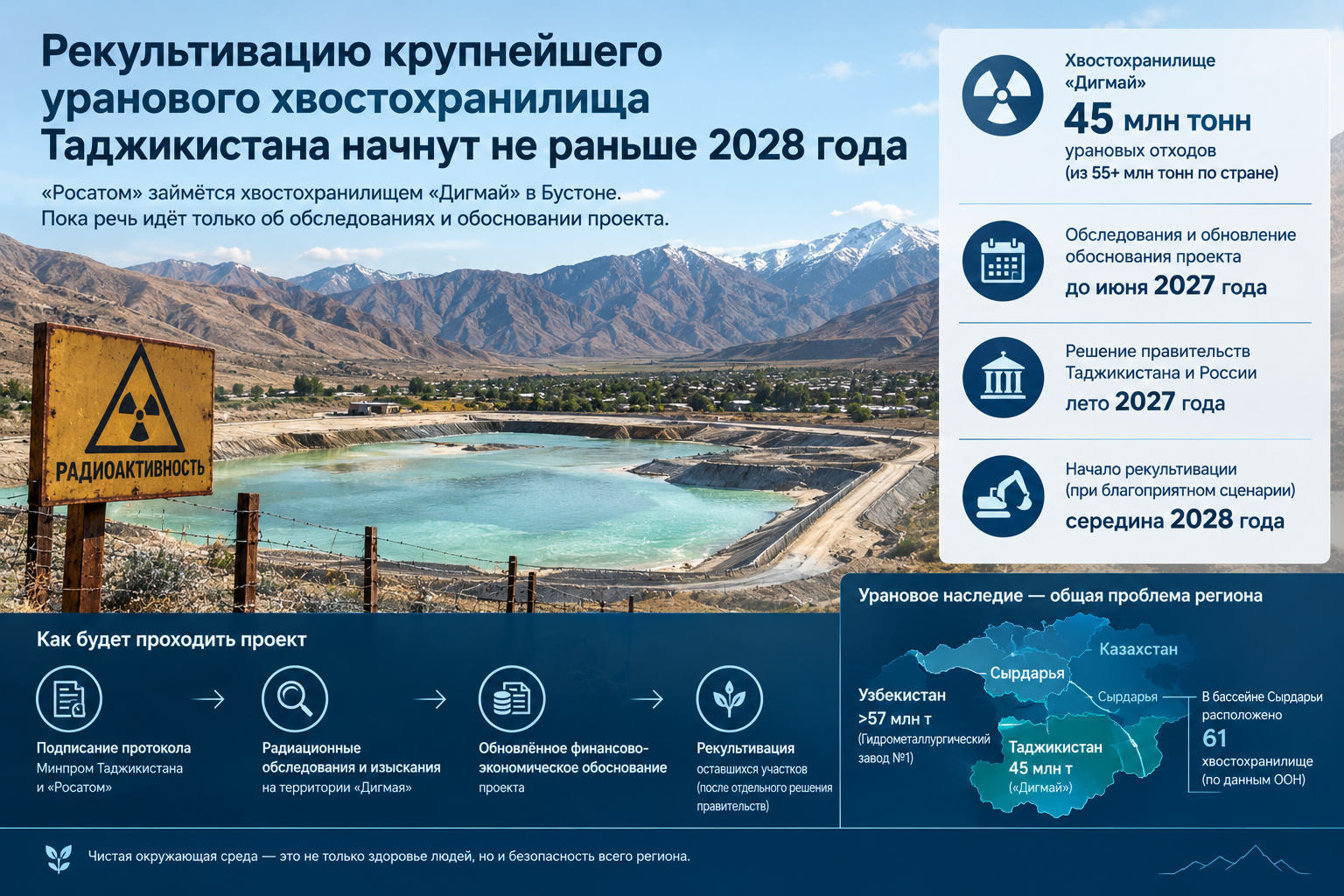
For now, we are only talking about surveys and project justification, and the decision on the reclamation itself will be made by the governments of Tajikistan and Russia no earlier than the summer of 2027, Avesta.tj reports.
The essence in brief
- The Ministry of Industry and New Technologies of Tajikistan and Rosatom signed a protocol on pre-project radiation surveys at Digmai and on updating the feasibility study for its rehabilitation.
- Digmai is the country's largest uranium tailings site: of the more than 55 million tons of uranium waste in Tajikistan, about 45 million tons are stored there.
- Rosatom must prepare the documentation by June 2027, and in the summer of 2027 the parties will present a report to the governments for a final decision.
- According to Deputy Minister Aziz Nazar, the reclamation of the remaining sections may begin in mid-2028.
What was signed in Dushanbe
Deputy Minister of Industry and New Technologies of Tajikistan Aziz Nazar spoke about the project. The protocol was signed following a meeting of the Tajik-Russian intergovernmental commission in Dushanbe. The document provides for radiation surveys and studies on the territory of the tailings site, as well as an updated feasibility study for its rehabilitation. At this stage, Rosatom takes on both the financing and the study of the territory, as well as the preparation of documents.
In other words, the loud headline "Rosatom will handle the reclamation" currently means a preparatory stage. The timelines at this stage also come with caveats. Nazar allows for the start of work in mid-2028, but only on the condition "if we continue at such a successful pace." The final phase still requires a separate government instruction.
The legacy of Taboshar and Adrasman
In Soviet times, uranium was mined and processed in northern Tajikistan, at the Taboshar deposits, present-day Istiqlol, and Adrasman. After the collapse of the USSR, the work was stopped, and millions of tons of radioactive waste remained in those territories. In 2016, with the support of international partners, 10 Tajik sites were included in the overall reclamation plan.
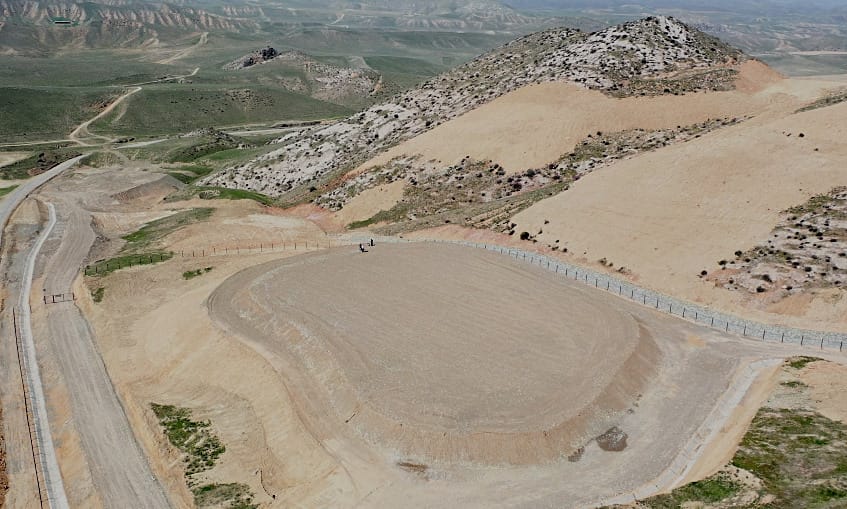
Rosatom has not been working here for the first year. In 2023, together with Tajik specialists, it completed the first stage of rehabilitation of the uranium mine in Taboshar. In early 2026, the practical reclamation of the remaining sections in Istiqlol and Adrasman began. Digmai is the largest and most complex facility on this list. According to Tajik scientists, the tailings site is located near populated areas, and monitoring records an elevated level of radon: the volumetric activity ranges from 50 to 680 Bq/m³, and the estimated annual release is about 201.5 TBq.
A common problem for the region
The uranium legacy is not a problem for Tajikistan alone. In Uzbekistan, at the tailings site of Hydrometallurgical Plant No. 1 of the Navoi Mining and Metallurgical Combine, more than 57 million tons of uranium waste accumulated between 1964 and 1994, that is, more than in all of Tajikistan. There, some facilities, in Yangiabad and Charkesar, were reclaimed with a 9 million euro EBRD grant. Tajikistan is betting on Rosatom at the key facility.
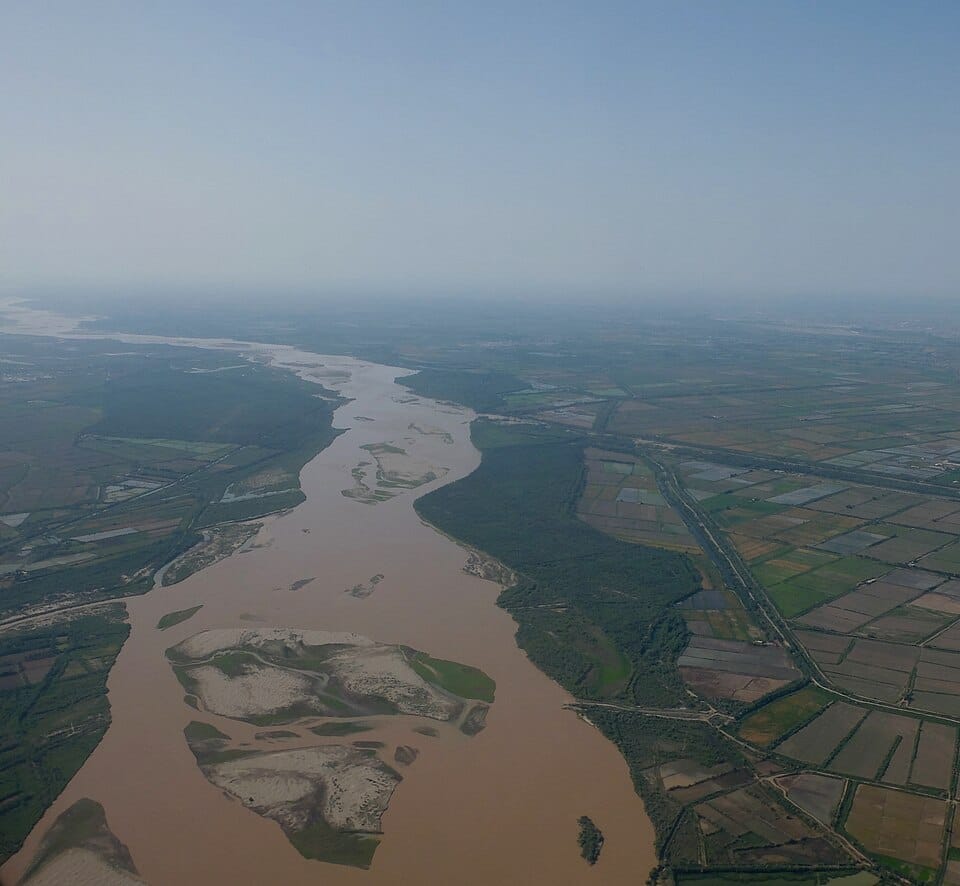
For Kazakhstan, the topic is also not foreign. The Sughd region lies in the Syr Darya basin, which then flows into Kazakhstan. According to a study conducted with the support of the UNECE, 61 tailings sites are located in the basin of this river. CIS countries agree to work on such facilities jointly: in the summer, on the basis of the National Nuclear Center in Kurchatov, a Regional Council of Competencies for Radioactive Waste Management was created, headed by Kazakhstan. Tajikistan participated in that conference, and one of the council's tasks is to compile a register of nuclear legacy facilities and rank them by degree of threat.
Author's conclusion
The news about Digmai should be read carefully: what was signed is not a reclamation contract, but a protocol on surveys and updating the justification. This is an important step, but real work is still at least a year and a half to two years away, along with two government decisions. Money is a separate issue. The preparatory stage is financed by Rosatom, but who will pay for the reclamation of the 45 million tons of waste itself, and in what amount, has not yet been stated. The experience of neighboring countries shows that such projects stall for years precisely over financing and the legal framework. At the same time, not only the residents of Buston depend on Digmai: radon and possible water contamination are risks for the entire Syr Darya basin.

Comments ()