Salt instead of batteries — how 15,000 mirrors heat a solar station in Tibet
Construction completed on a key phase of a plant in southwest China's Tibet that aims to set two world records: the highest-altitude tower solar thermal station and the first built in extreme cold with a weak power grid.
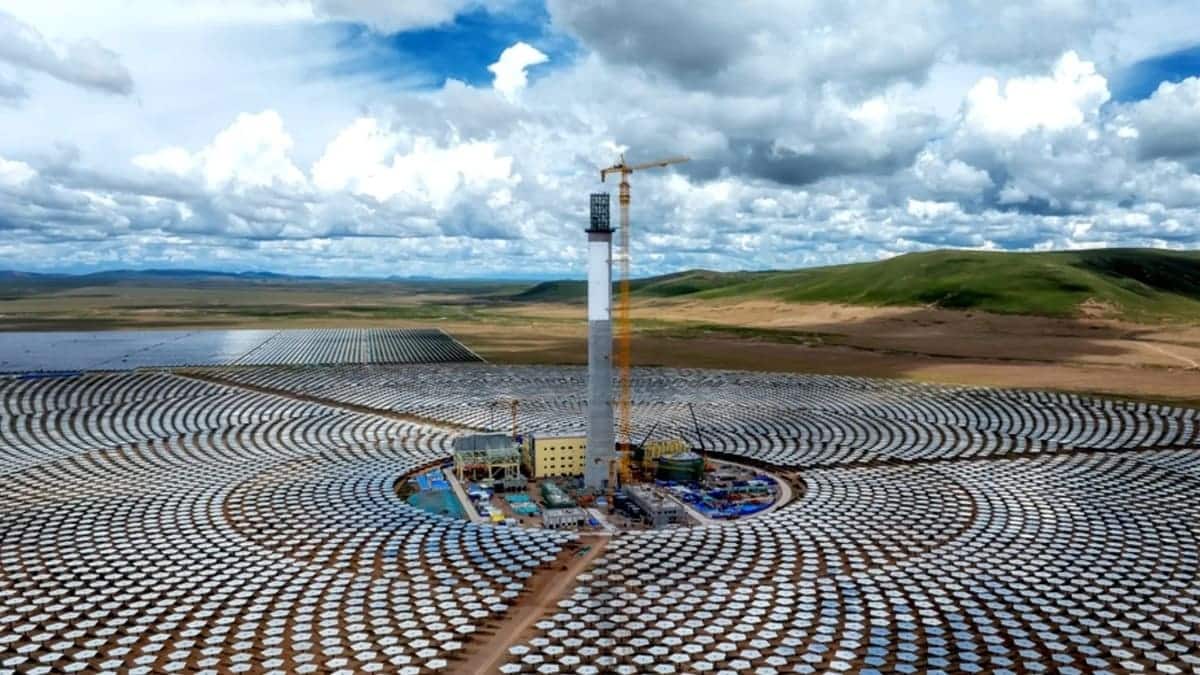
The technology used in Amdo County of Nagqu Prefecture in the southwest of the Tibet Autonomous Region — molten salt instead of lithium batteries — is already familiar to hunn.kz readers from other unconventional solar projects.
The gist in brief
- Installation of 15,927 heliostats — mirrors that track the sun's movement and direct its rays to a receiver atop a 210-meter tower — has been completed on a solar field covering about 800,000 m².
- The plant's capacity will be 100 MW; grid connection is scheduled for October 2026.
- Once at full capacity, the facility will generate about 255 million kWh of electricity per year, saving roughly 60,000 tons of standard coal equivalent and reducing CO₂ emissions by 165,000 tons.
- This is the first tower-type concentrated solar power plant in the Tibet Autonomous Region and the first such facility built at an extremely high altitude.
How the molten salt plant works
The plant's technology is fundamentally different from conventional photovoltaic panels: instead of directly converting sunlight into electricity, the light is first converted into heat. Nearly 16,000 heliostats concentrate solar radiation onto a receiver mounted atop the tower, while molten salt, heated to high temperatures, absorbs and retains that heat. It is this stored thermal energy that gives the plant its key advantage: it continues generating electricity even after direct solar radiation weakens or stops altogether — meaning the plant can operate in the evening and nighttime hours without a single lithium-ion battery.
Extreme construction conditions
The site for the plant was not chosen by chance: the Nagqu region records more than 2,800 hours of sunshine annually — a figure many lowland regions of the world would envy. But the same high altitude that provides an abundance of sun also creates serious engineering challenges — severe frost and a weak, underdeveloped power grid to which the plant must be connected. Building such a facility under these conditions is a first in the global practice of tower-type solar power, making the Tibetan project not just another power plant but a testing ground for the technology as a whole.
Another page in the history of unconventional solutions
The Tibetan plant continues a whole line of unconventional engineering solutions in solar energy that we have already covered. Austria's FLAPTrack system folds panels before storms and produces 40% more energy thanks to dual-axis sun tracking. A farm in Colorado became profitable through agrivoltaics — combining power generation with agriculture on the same plot. Swiss startup Sun-Ways successfully installed panels directly between railway tracks, and a year of operation confirmed the solution's safety. A five-year study in Minnesota showed that solar farms can restore rather than destroy biodiversity, becoming sanctuaries for wild bees. And the largest "relative" of the Tibetan project to date — the hybrid complex in the Gobi Desert — also uses molten salt instead of batteries, but with five times the capacity of the Tibetan plant. All these solutions have different goals — from hail protection to heat storage and ecosystem restoration — but together they show that modern solar energy is increasingly moving beyond the simple fixed panel on a rooftop.
Why this matters for Kazakhstan
Kazakhstan is developing renewable energy through an auction mechanism in steppe regions with high insolation, but faces the classic problem of all solar and wind plants — intermittency of output depending on weather and time of day. Today this problem is mainly solved with battery storage — for example, the Masdar wind farm in Zhambyl Region uses a storage unit with a capacity of 600 MWh — or with backup coal and gas generation. Molten salt energy storage technologies offer a third path — dispatchable, that is, controllable and predictable generation even after sunset — which Kazakh designers have not yet seriously considered. The Tibetan project, despite the incomparability of climatic conditions with the Kazakh steppe, shows that such solutions are already moving beyond pilot experiments and operating at industrial scale even in the most challenging geographic conditions.
Author's conclusion
Each new unconventional solar technology — whether foldable panels, railway solar strips, or molten salt towers — solves its own specific problem of conventional photovoltaics: weather, space, or output intermittency. The Tibetan project is interesting because it proves the viability of thermal storage technology in one of the most difficult places on the planet to build — which means that for regions with less extreme conditions, including the Kazakh steppe, such solutions look even more achievable.


Comments ()