Saudi Arabia completes construction of the world's largest green hydrogen plant
The country whose economy was tied to oil and gas for decades just finished building what should become the world's largest clean hydrogen producer.
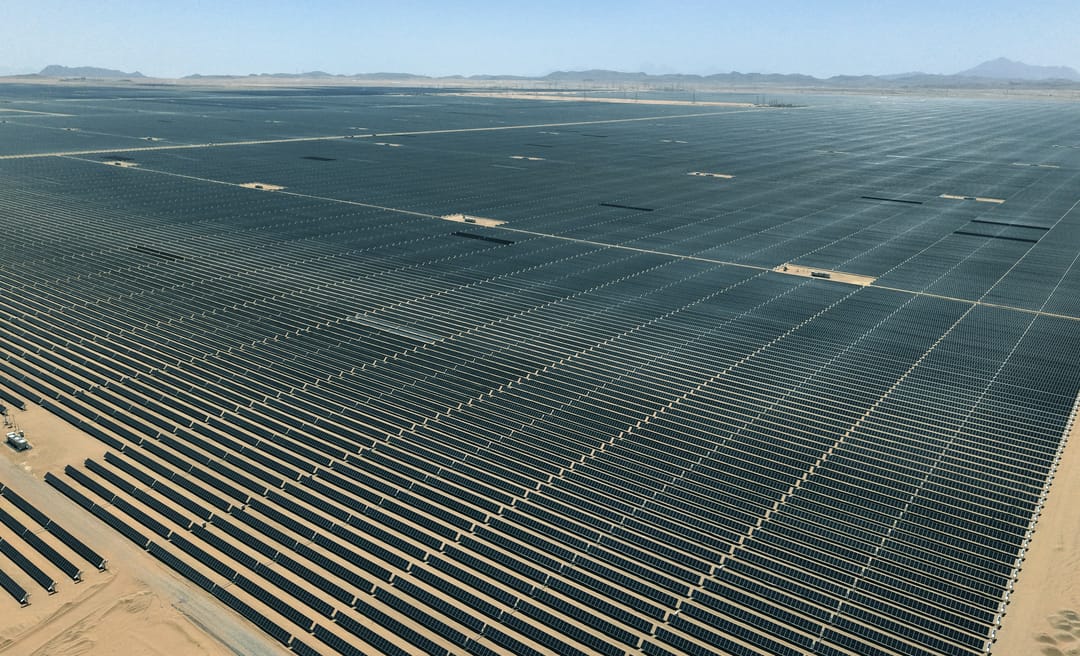
The NEOM Green Hydrogen and Ammonia complex in Saudi Arabia is moving from the construction phase to the commissioning phase — and with it, the country is making a practical claim to the status of one of the world's leaders in renewable hydrogen production.
The gist
- Construction of the NEOM Green Hydrogen and Ammonia complex worth $8.4 billion has been completed in Saudi Arabia; the facility is now in the commissioning stage, with commercial launch scheduled for 2027.
- At full capacity, the plant will produce up to 600 tonnes of pure hydrogen per day, converted into up to 1.2 million tonnes of green ammonia annually for export.
- The complex's electrolyzer capacity is about 2.2 GW, powered by dedicated solar and wind generation facilities with a capacity of about 4 GW.
- The project can prevent emissions of up to 5 million tonnes of CO₂ per year, has already secured a long-term offtake contract for ammonia supply, and has attracted $6.1 billion in debt financing from 23 banks and financial institutions.
Why convert hydrogen into ammonia
Pure hydrogen is an efficient energy carrier, but it is extremely inconvenient to transport over long distances: it requires extreme cooling or high pressure and easily escapes during storage. That is why the complex in Saudi Arabia does not just produce hydrogen but immediately converts it into ammonia — a compound that is far more practical to ship by sea in large volumes. Ammonia, however, is not merely a transport form of hydrogen: it is in demand in its own right as a feedstock for fertilizer production and is being considered as a promising low-carbon fuel for maritime vessels.
Scale as proof of concept
The project is being implemented by a joint venture of ACWA Power, Air Products and NEOM, and in terms of electrolyzer capacity, the complex is set to become the largest facility of its kind in the world. The significance of the project lies not only in its size but also in what it is meant to demonstrate: that renewable hydrogen can be produced on an industrial, not demonstration, scale. Global green hydrogen production remains fragmented, consisting mostly of relatively small pilot plants, and NEOM is expected to become the first truly industrial benchmark for the entire industry.
Diversifying the oil economy
For Saudi Arabia, the project is part of a broader economic strategy. Vast territories, high solar activity, and suitable wind resources give the country an objective advantage for large-scale renewable generation, while its existing industrial and export infrastructure facilitates bringing new products to global markets. NEOM is positioned not merely as a hydrogen plant but as part of a strategy of economic diversification — an attempt by a country long associated with fossil fuels to establish itself as a major exporter of clean energy and fuels of the future.
Why this matters for Kazakhstan
Kazakhstan is developing its own hydrogen sector at a much more modest pace, but with similar logic: at a meeting of the Public Council on the fuel and energy sector under the Ministry of Energy on August 11, 2026, an update to the Hydrogen Energy Development Concept through 2040 was announced, and the ministry describes the sector as connected not only to energy but also to industry and transport. Kazakhstan, like Saudi Arabia, has a distinctive geographic advantage for such projects — vast steppe territories with high insolation and wind potential that are already used for solar and wind generation. The Saudi project shows what a logical next step could be for countries with similar resources: not just increasing renewable electricity output, but converting its surplus into an export product such as hydrogen or ammonia.
Author's conclusion
The transition of NEOM from construction to commissioning is an important signal for the entire industry: until now, the biggest obstacle for green hydrogen has been the question of whether it can be produced in volumes comparable to traditional energy, rather than only at experimental facilities. The answer to this question will become known in 2027, when the complex is expected to enter commercial operation — and how successfully it performs will determine whether green hydrogen becomes a tool for real energy diversification for countries like Kazakhstan, or remains a niche technology.
Comments ()