Scientists conducted an experiment feeding animals CBD hemp
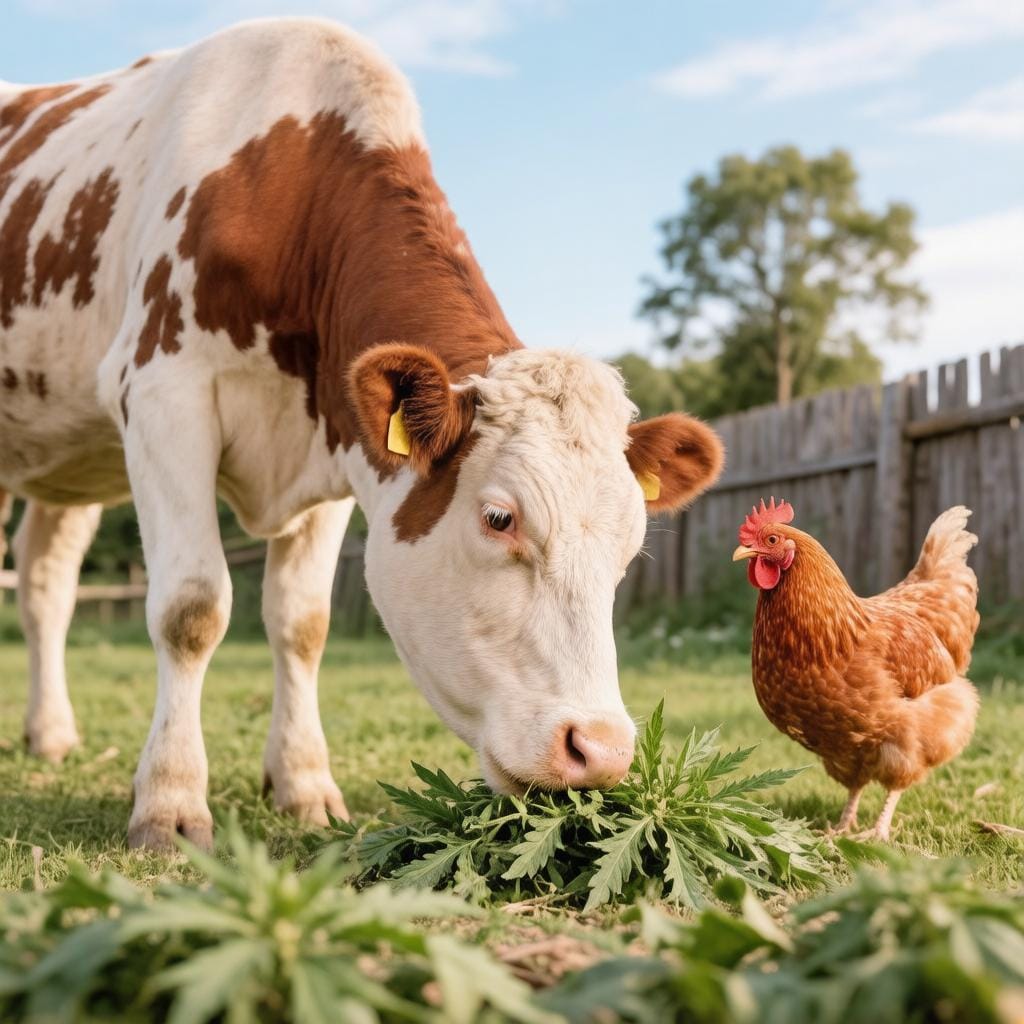
Hemp waste left over from CBD production is being tested as livestock feed. Scientists fed it to cows, bulls and broilers.
The result depends on the share of the additive, the animal species, and the product that reaches the consumer. There is no regulatory approval for such feed in the US yet.
The gist in brief
- Spent biomass of hemp grown for CBD retains nutrients and some cannabinoids, including the psychoactive THC.
- Less than 1% of consumed cannabinoids passed into cow milk, and 12 days after the additive was withdrawn, THC was no longer detected in the milk.
- In young bulls, 33 days after withdrawal, cannabinoids were no longer detected in tissues, except for CBD in fat.
- For broilers, an additive share of 10% or more worsened growth and feed conversion.
Why livestock need hemp
Feeding hemp leftovers to livestock sounds like the setup of a joke, but the task is quite practical. When cannabidiol (CBD) is extracted from the plant, spent biomass remains. It contains nutrients and some cannabinoids, including psychoactive tetrahydrocannabinol (THC). For a farmer, this byproduct means not having to spend money on disposal, and for researchers it provides a reason to find out how much residual material will end up in human food and how quickly it will be cleared. Naked Science reported on the latest stage of this series of checks, drawing on work by a group at Oregon State University.
An important caveat about the plant itself. This is not about industrial hemp grown for fiber or seeds, and not about marijuana. The experiments used waste from varieties grown to extract CBD: their biomass contains a measurable amount of cannabinoids, including THC. Under American rules, such plants are classified as hemp, but precisely because of possible THC traces, the use of spent biomass in livestock feed is not yet permitted in the US.
What the milk experiment showed
In May 2025, a study involving 18 Jersey cows was published in the Journal of Agricultural and Food Chemistry. Nine animals received a diet in which 13% consisted of hemp biomass for four weeks, while the rest ate alfalfa and served as controls. Then the additive was withdrawn and substances in milk and tissues began to be measured. The psychoactive effect of the milk on humans was not tested in this experiment.
Less than 1% of consumed cannabinoids passed into the milk. But a small share does not equal absence of risk: in an unfavorable calculated scenario, THC intake could exceed the acute reference dose. 12 days after the additive was withdrawn, THC was no longer found in the milk, while it persisted longer in adipose tissue. Therefore, the milk clearance period cannot be considered the clearance period for the entire body, and the label "not detected" should be read as "not detected at the sensitivity of the assay."
What the young bulls showed
Next, the researchers tested 24 Angus steers. For eight weeks, the experimental group received a diet with 15% hemp residue. A small amount of THC was found in the muscles, but the calculated exposure from eating the meat remained below the selected reference dose for all consumer groups. 33 days after the additive was withdrawn, cannabinoids were no longer detected in the studied tissues, and CBD remained only in fat. The behavior and final weight of the animals did not change noticeably, but feed efficiency decreased.
In February 2026, the university summarized both studies as a basis for future rules on the use of such an additive.
What happened with the broilers
The third experiment was published on August 28, 2026, in Poultry Science. Over 42 days, 200 chicks received feed with 0, 5, 10, or 20% biomass. Starting at a share of 10%, growth and feed conversion worsened. At 20%, the meat was less tender, and corticosterone levels rose in the feathers, which may indicate chronic stress. At the 5% level, the authors did not see a comparable deterioration in productivity, although contamination of the cloacal area was more common in all groups with the additive.
Why the conclusions cannot be transferred
The new experiments explain why one successful study is not enough. The composition of a specific batch, the share of the additive, the animal species, and the product that will reach the table all matter. The head of the research, Massimo Bionaz, explained the meaning of the entire series as follows:
"This study is another step toward obtaining the data needed for FDA approval."
In the August article, the authors still note that there is no FDA-CVM approval for the use of spent biomass in feed for agricultural animals. For now, science provides grounds for developing conditions of use, not for declaring any hemp waste a safe additive.
Author's conclusion
The experiment with feeding cows hemp waste looks strange at first glance, but its value lies not in the exoticism but in the results. The authors have a sample, a control group, timelines, and specific figures, plus an honest caveat: conclusions about milk cannot be automatically transferred to beef and poultry meat, and there is still no regulatory approval. Even a failed result, such as worsened broiler growth at a high share of the additive, is useful here because it can be verified and taken into account.
In the Kazakh public sphere, the opposite is often true: an essentially ordinary solution is presented under a headline about a "breakthrough" or a "development with no analogues," with no verifiable data attached. In the material about BioDrop drones, neither the sample size nor the number of replicates was named; in the report about "marbled lamb" there was not a single figure; and in Kirill Pavlov's analysis, the schoolgirl's "AI system" boiled down to a photo from an iPhone and a prompt for GPT. To be fair, the complaints here are more often about how things are presented in press releases and news than about the researchers themselves: BioDrop probably works, and the schoolchildren, according to Pavlov, are doing great. But that does not make it easier for the reader, because behind a loud headline they cannot see what exactly has been verified.
If cows needed a control group, day-by-day measurements, and two more experiments on other animals just to speak cautiously about THC residues in milk, then "marbled lamb" would not have been hurt by at least one number to start with.
Comments ()